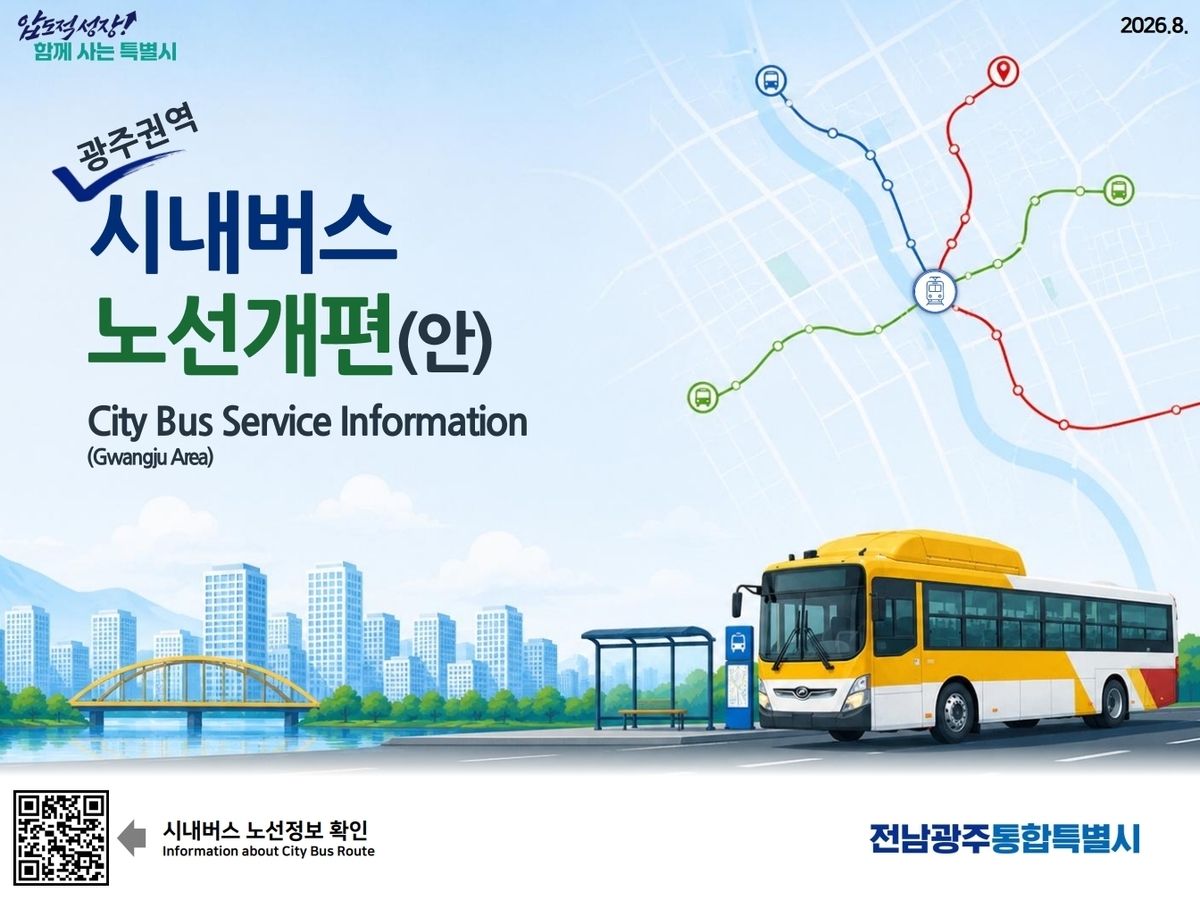
Gwangju's city bus route numbers will no longer carry neighborhood names, and direct and express services connecting major destinations such as hospitals, universities and railway stations will be strengthened.
New routes and stops will be added to outlying villages, newly developed residential areas and industrial complexes that currently have no bus service, and a transfer system linked to Urban Railway Line 2 stations will also be established.
The Jeonnam-Gwangju Integrated Special City has drawn up a plan to overhaul the Gwangju metropolitan bus network — expanding the total number of routes from 103 to 118 — after analyzing transportation big data and incorporating input from residents, relevant agencies and bus operators.
It is the largest restructuring of Gwangju's city bus network since 2017, the first in nine years.
The plan's most notable features are faster service and a simpler route structure.
The city will remove neighborhood names — such as Suwan, Cheomdan, Jinwol, Songjeong and Bongseon — that currently appear at the front of route numbers, while retaining the existing numerals as much as possible to minimize confusion for riders.
Route Sunhwan 01 will be split into routes 01 and 11; Jwaseok 02 will become direct routes 1001 and 1002; Suwan 03 will be reorganized into routes 03, Express 03 and 80; Maewol 06 will become routes 06 and Express 06; Jiwon 152 will become Express 1003; and Cheomdan 95 will be split into routes 05 and Express 05, separating express and trunk services.
Long-distance route Bongseon 37 will be divided into routes 37 and 58, while Ilgok 38 will be straightened to reduce lengthy detours, with routes 07-1 and 14 taking over the diverted segments.
Routes serving high-demand facilities such as hospitals, universities and railway stations will also be straightened by cutting detours, and six direct and express routes will operate on long-distance and high-demand corridors.
Route 61, linking Chonnam National University Hospital and Chosun University Hospital, will be introduced in the Seonggyo district of Dong-gu, while route 56, connecting Sotae Station, will serve the Yongsan district.
Route 79 will connect the Bongseon-dong hagwon district to the Pungam and Hyocheon areas of Seo-gu, and route 24 will run between Honam University and the Suwan and Cheomdan districts.
Intercity and express links to neighboring cities and counties such as Damyang and Jangseong will expand from one route to three, and overlapping, long-distance and inefficient segments will be reorganized.
Stops near Urban Railway Line 2 stations will be relocated closer to station entrances. The stop currently named "Court Entrance" will be renamed to exits 1 and 2 of Gwangju Court and Prosecutors' Office Station, and the Bank of Korea stop will be moved to exits 1 and 2 of City Hall Station.
New routes will be introduced along approximately 35.9 kilometers of corridors that currently have no city bus service, an ongoing source of inconvenience for residents.
The areas to be served include the Seonggyo district in Dong-gu; the Apchon, Dorae and Songhwa Village Complex 1 neighborhoods in Nam-gu; the Yongdu and Cheomdan 3 districts in Buk-gu; and the Seonun 2 district and Bitgreen Industrial Complex in Gwangsan-gu.
In Daechon-dong and the Energy Valley area, a previously suspended alternative service segment of route 70 will be restored and trunk route 06 will be added. New routes will also serve the Apchon and Dorae village areas.
Routes 24, 92, 97 and 197 will pass through the Seonun 2 district, while routes 96, 96-1, 97 and 197 will serve the Bitgreen Industrial Complex.
A total of 69 new stops are planned — 53 within Gwangju and 16 in outlying areas including Damyang and Jangseong.
Flexible commuter bus services will operate five times daily toward industrial complexes and twice daily toward the innovation city.
Long-distance and unpopular routes will be reduced, and terminal and turnaround points will be adjusted to improve charging and rest conditions for bus drivers.
If implemented as planned, the total number of routes will grow from 103 to 118, comprising three direct and intercity routes, 44 trunk routes and 71 branch routes.
Without adding any vehicles, the average headway is expected to shorten from 25.2 minutes to 20.7 minutes — a reduction of 4.5 minutes — and the number of daily trips is projected to increase by about 960.
The headway and trip-frequency figures are estimates at the planning stage, and route alignments, numbers and stop locations may be further adjusted during the public consultation process.
The city aims to finalize the plan after a public hearing and a review by the Bus Policy Committee in August, then update stops, route maps and the bus information system before launching the revised network in October.
sij@heraldcorp.com