
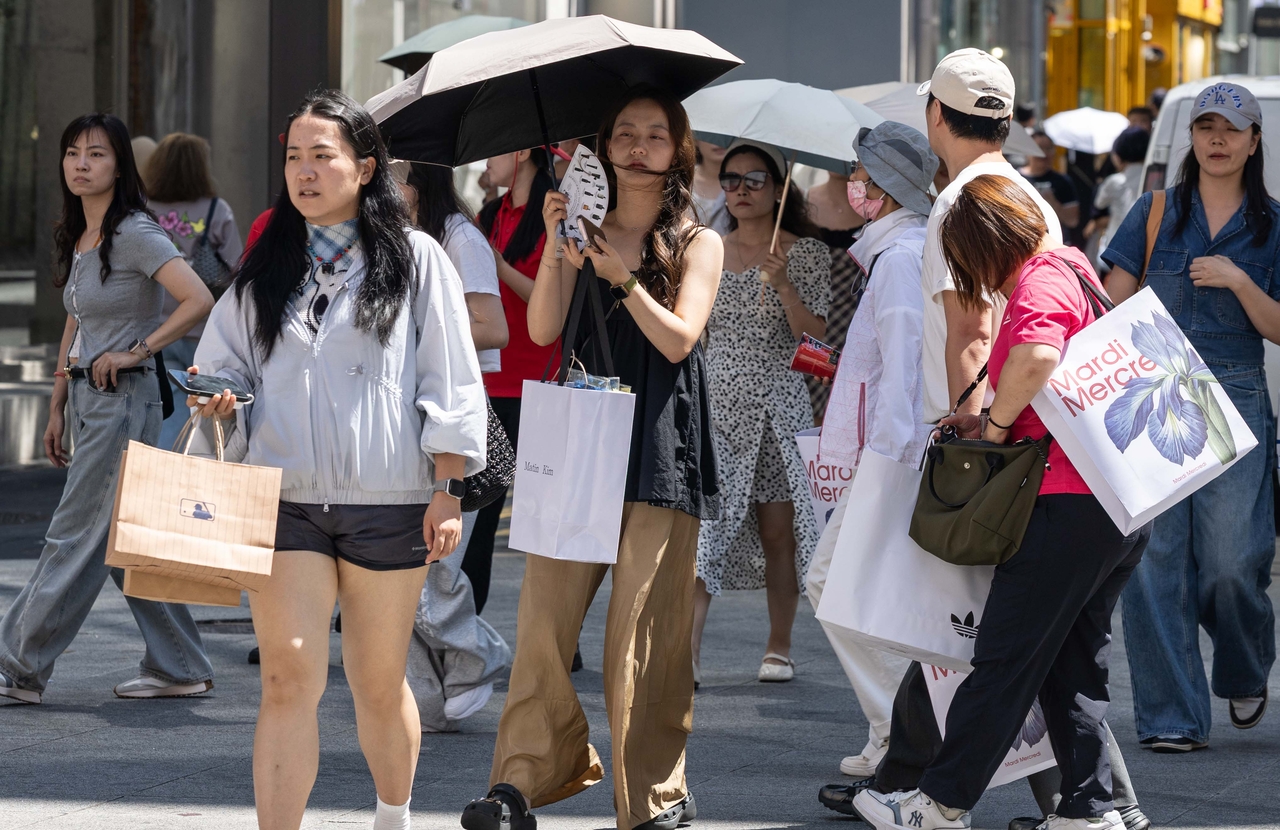
The number of foreign visitors to Seoul in the first half of this year rose more than 20 percent from a year earlier, and the amount they spent on credit cards in the city jumped more than 50 percent, with Gangnam-gu recording the highest foreign card spending of any district.
About 8.23 million foreign tourists visited Seoul from January through June, a 21.3 percent increase from the same period last year, the Seoul Metropolitan Government said Sunday.
Total credit card spending by foreign tourists in Seoul reached 5.62 trillion won ($3.9 billion), up 56.8 percent from the same period a year earlier.
"Both visitor numbers and spending set all-time records in the first half of this year," a Seoul Metropolitan Government official said. "The fact that spending grew far faster than visitor numbers suggests Seoul tourism is moving beyond a simple quantitative recovery and entering a phase of growth centered on longer stays and higher consumption."
By district, Gangnam-gu accounted for the largest share of foreign card spending at 29.3 percent, followed by Jung-gu at 28.4 percent and Mapo-gu at 7.3 percent. Those three districts together accounted for 65 percent of all foreign card spending in the city.
The city said Myeong-dong, Dongdaemun and the Gangnam area have solidified their roles as hubs for shopping and medical tourism, while areas such as Hongdae and Seongsu — known for everyday Seoul life and local culture — are drawing a growing share of foreign visitors and spending.
K-content events such as the BTS comeback live show held at Gwanghwamun Square in March, along with neighborhood tourism programs blending history and culture, also drew foreign visitors. Seoul's guided walking tour program, in which tourists explore alleyways and historic sites with a commentary guide, attracted about 46,000 participants in the first half of this year, roughly 35 percent of them foreign.
The Han River is also evolving from a quick sightseeing stop into a destination for extended stays, combining performances, festivals and hands-on experiences.
Of the about 7.06 million people who took part in the Seoul Spring Festival 2026 held along the Han River, about 1.17 million were foreign visitors. Sales by businesses at Han River bus ferry terminals rose 257 percent from a year earlier during the same period. The share of foreign passengers aboard Seoul Dal — a tethered gas balloon operating at Yeouido Park — climbed from 40.2 percent last year to 43.6 percent in the first half of this year.
By sector, shopping accounted for the largest share of foreign card spending at 46.4 percent, followed by medical and wellness services at 24.4 percent — making the two the twin pillars of foreign tourism spending in Seoul, together representing 70.8 percent of the total. Food and beverage came next at 13.1 percent, followed by accommodation at 10.7 percent.
Among spending categories, large shopping malls recorded the steepest growth, with spending rising 73.2 percent from 706.3 billion won to 1.22 trillion won. Medical tourism spending climbed 63.3 percent from 556.3 billion won to 908.4 billion won, dining spending rose 54.5 percent from 378.2 billion won to 584.3 billion won, and beauty spending increased 40 percent from 331.1 billion won to 463.7 billion won.
In the second half of this year, the Seoul Metropolitan Government plans to expand nighttime tourism offerings in line with its "night economy" strategy — a key initiative of the current city administration. The goal is to give foreign tourists reasons to enjoy Seoul into the evening and late night, and to use that extended activity to energize dining, shopping, culture and local commercial districts near major attractions.
In addition, the city plans to accelerate efforts to develop high-value tourism industries including medical tourism, MICE (meetings, incentives, conventions and exhibitions) and premium tourism.
"In the second half of the year, we will link experiential tourism content more closely with local commercial districts so that visitors can enjoy every corner of Seoul and the benefits ripple out to neighborhood businesses and the broader local economy," said Jo Seong-ho, head of the Seoul Metropolitan Government's tourism and sports bureau.
ken@heraldcorp.com




