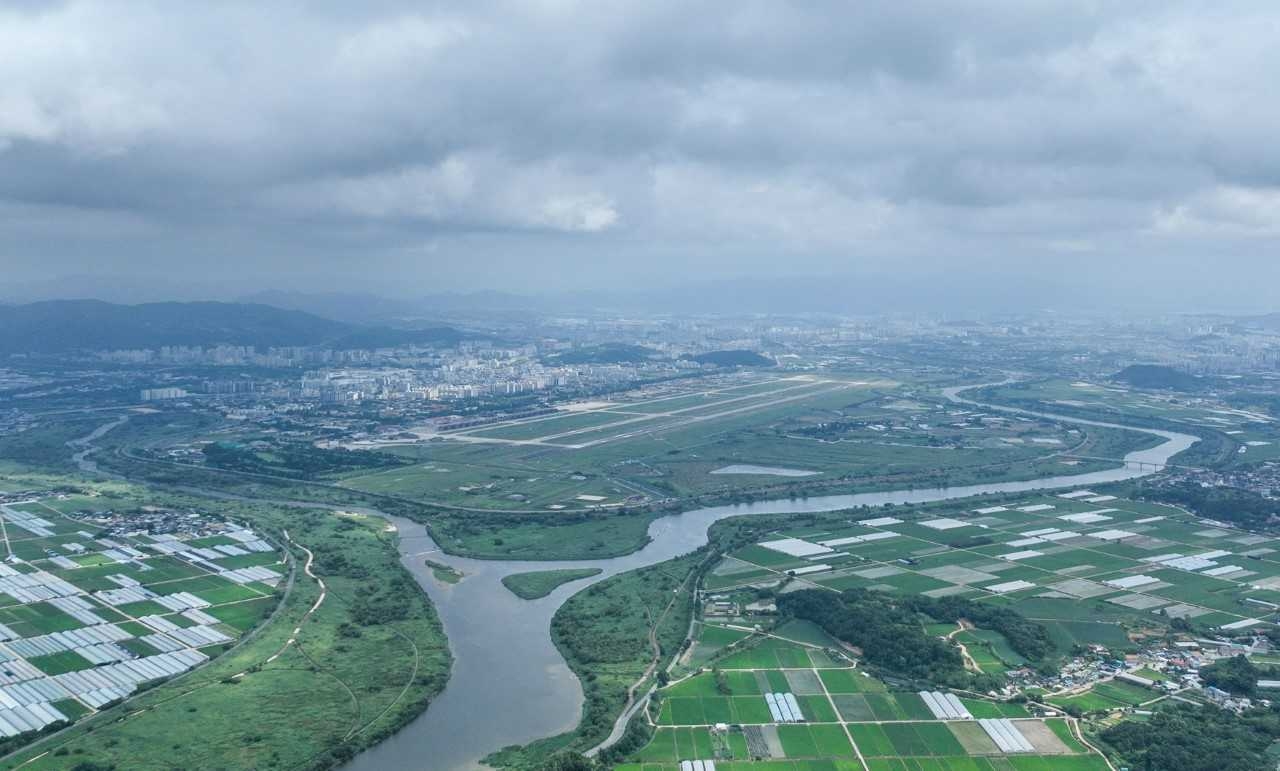
The designation of the Gwangju military airport area as a candidate site for a national industrial complex has made the question of whether Samsung Electronics and SK hynix will break ground on their semiconductor fabrication plants this year or in early next year a hot-button issue for the region.
Both companies have recently visited the site to review the land and hold successive consultations on power and water supply, raising expectations that the project could move forward. The pace is picking up as the central government, the companies and local authorities align their efforts.
The Ministry of Land, Infrastructure and Transport designated approximately 8.26 million square meters around the Gwangju military airport as a candidate site for a Honam-region semiconductor national industrial complex on Wednesday.
The candidate site is sized to accommodate the initial production facility needs of Samsung Electronics and SK hynix. The government plans to review further expansion to house partner companies, research facilities and residential functions.
Representatives from Samsung Electronics and SK hynix recently visited the military airport site to examine potential fab placement zones, land area, power and water supply conditions, and transportation networks, and met with Mayor Min Hyeong-bae to discuss implementation plans.
The Ministry of Climate, Environment and Energy has also launched a working-level consultative body on power supply, bringing together the special city, Gwangsan-gu, Jangseong-gun, Korea Electric Power Corporation, Samsung Electronics and SK hynix.
The group is reviewing a plan to supply power to the complex from the 345-kilovolt Sinjangseong and Singwangju transmission lines and to complete the first phase of the supply network by the end of 2029.
Before full-scale site development can begin, several steps remain — including the designation of a project operator, a feasibility review, and the formulation and approval of an industrial complex plan.
Once the Ministry of Land, Infrastructure and Transport designates an operator — such as the Korea Land and Housing Corporation or a local public enterprise — that operator will review move-in demand, project costs and development costs, and begin preliminary surveys and design work.
A subsequent industrial complex plan covering fab and partner-company placement, along with power, water and road infrastructure, must then be drawn up and cleared through environmental, traffic and disaster impact assessments, consultations with relevant agencies, and public comment.
Finally, the Ministry of Land, Infrastructure and Transport must formally designate the national industrial complex and approve and gazette the industrial complex plan before construction can begin.
A preliminary feasibility study exemption may be pursued given the project's urgency as a national strategic initiative, but neither the exemption status nor the financing method has been finalized.
Development of the national industrial complex is effectively led by the Ministry of Land, Infrastructure and Transport, while the special city's role is to shorten the project timeline by handling local permits, resident complaints, public briefings and consultations with the local assembly — meaning the pace cannot be dictated by the local government alone.
It may be possible to designate a project operator and begin preliminary surveys, design work or some advance construction within the year. Observers say the schedule is too tight, however, to complete industrial complex plan approval and launch large-scale site development before year's end.
The biggest variable is the relocation of the military airport.
Muan-gun, the preliminary candidate site for the airport's relocation, has been reluctant to accept the move, citing three preconditions it says must be met first, making persuading the county another challenge.
Most of the planned industrial complex site is currently in use as a military facility, and full-scale development of fab sites and infrastructure cannot proceed until the relocation site and method, cost-sharing arrangements and the timing of the handover of the existing site are determined.
The companies' final investment decisions are also a critical factor: the scale of the four fabs planned by Samsung Electronics and SK hynix, along with their ground-breaking and operational timelines and phased power and water demand, must be confirmed before the industrial complex design and infrastructure investment can be finalized.
sij@heraldcorp.com