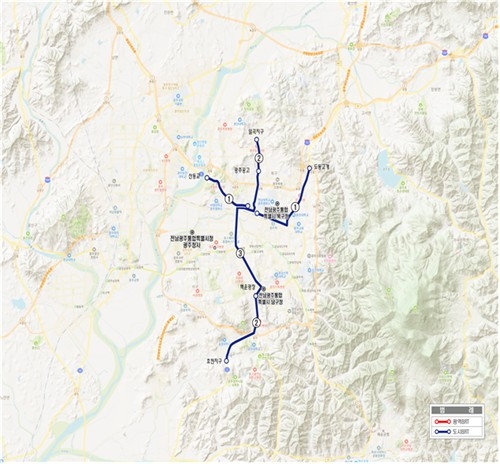
Gwangju's bus rapid transit network will expand to three lines connecting major residential areas across the city under a newly announced national plan.
Two new BRT routes — Unam-Gakhwa and Hyocheon-Ilgok — have been added as new projects in the Ministry of Land, Infrastructure and Transport's second comprehensive BRT plan covering 2026 to 2030, joining the existing Baekun-Maegok line.
Project costs by route are 45.26 billion won ($31.2 million) for Baekun-Maegok, 63.78 billion won for Unam-Gakhwa and 41.81 billion won for Hyocheon-Ilgok, bringing the combined total to about 150.8 billion won.
The Unam-Gakhwa BRT will run 8.4 kilometers from Sandong Bridge in Buk-gu to Dodong Pass, improving public transit access for the densely populated residential neighborhoods of Unam, Duam and Gakhwa-dong.
The Hyocheon-Ilgok BRT will cover a 6-kilometer corridor linking the Hyocheon district and the former Daedong High School with Gwangju Technical High School and the Ilgok district, effectively extending the Baekun-Maegok line currently under development.
City officials expect that connecting all three routes will form a BRT trunk network linking Gwangju's north-south axis with its western and northern areas, helping to eliminate transit blind spots and improve mobility for residents.
Each project will be carried out in phases by route, following a review of progress, traffic demand and feasibility.
Kim Yeong-seon, head of the transportation bureau at the Jeonnam-Gwangju metropolitan authority, said the city would push ahead with the planned routes without delay "so that residents can get around more quickly and conveniently."
sij@heraldcorp.com