![LG Energy Solution's factory in Wroclaw, Poland (left), SK On's US subsidiary SK Battery America, and Samsung SDI's headquarters in Giheung [provided by each company]](https://wimg.heraldcorp.com/news/cms/2026/07/31/news-p.v1.20260320.eb2466e4e0e44739b5442039d25f2967_P1.png)
South Korea's three major battery makers, long rivals in the electric vehicle market, are now squaring off again in the power market for AI data centers. As AI data centers proliferate, grid connection delays and power load fluctuations are intensifying, pushing demand for batteries beyond large-scale ESS to include uninterruptible power supplies (UPS) that guard against outages and battery backup units (BBU) for servers.
The three companies unveiled their second-half ESS strategies in succession during their second-quarter earnings conference calls held Thursday, industry sources said. Large-scale ESS linked to solar and wind power or used for grid balancing had traditionally dominated the market, but the companies said they are now responding to a growing trend of data centers building their own power generation and storage infrastructure.
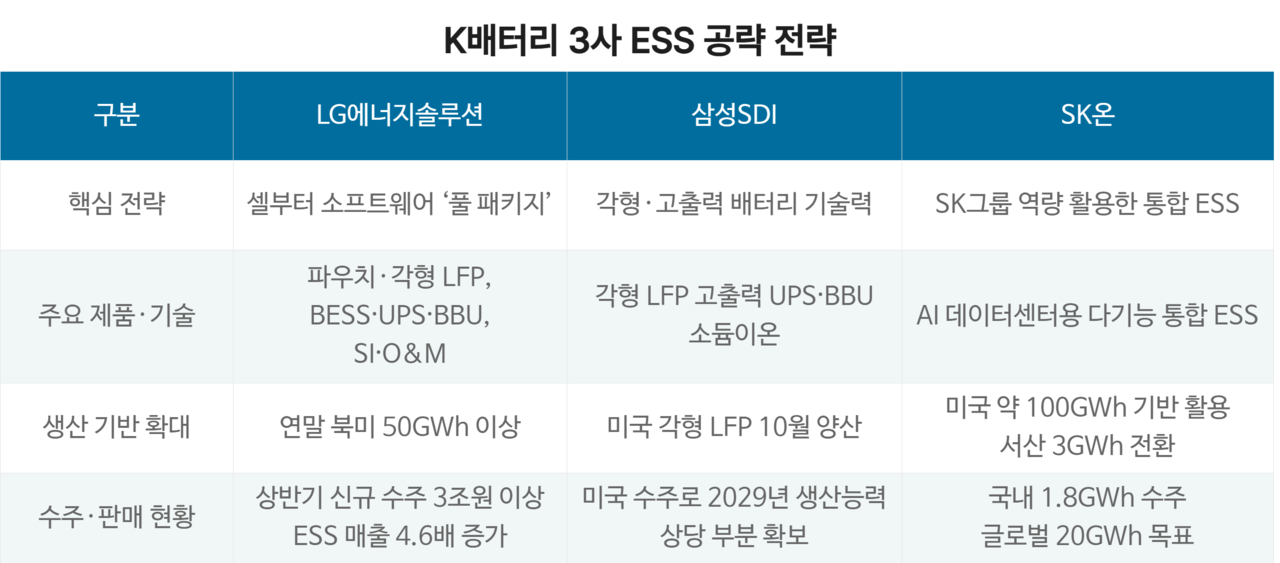
LG Energy Solution: 'full package' from cell to software
LG Energy Solution is leading with its large-scale North American production capacity and a "full package" that bundles hardware with software. The company plans to target customers across all major product lines — large ESS for grids and power plants, as well as battery energy storage systems (BESS), UPS and BBU for data centers.
ESS sales in the first half of this year grew to 4.6 times the level of the same period last year, and the company secured more than 3 trillion won ($2.07 billion) in new orders, including data center projects for AI hyperscalers.
LG Energy Solution began ESS production in May at a joint venture plant with General Motors and in June at a joint venture plant with Honda. Building on that, the company plans to expand its North American ESS production capacity to more than 50 GWh by the end of this year. It will focus on scaling up pouch-type lithium iron phosphate (LFP) output this year, with plans to also supply prismatic batteries starting next year.
The company intends to combine its systems integration (SI) and maintenance capabilities with software that supports energy efficiency and power trading, offering services spanning ESS design through operation.
"The area where we are most differentiated from Chinese competitors is our SI and O&M (operations and maintenance) capabilities," said Lee Yeon-hee, head of management strategy at LG Energy Solution. "We will secure a structural competitive advantage by transitioning to a high-margin, software-based business beyond hardware."
ESS shipments in the third quarter are expected to rise more than 50 percent from the previous quarter, with second-half output projected to more than double that of the first half. The company aims to achieve profitability in the fourth quarter even without North American production subsidies.
![SBB 2.0, an ESS product equipped with LFP batteries [provided by Samsung SDI]](https://wimg.heraldcorp.com/news/cms/2026/07/31/news-p.v1.20251210.b812e011ca774896a13f92cb8361d373_P1.jpg)
Samsung SDI: prismatic LFP and high-power products as technology barriers
Samsung SDI is focusing on technological competitiveness through prismatic LFP batteries and high-power products. The company plans to supply prismatic LFP batteries for large-scale power grids while providing batteries for UPS and BBU applications inside data centers — products that require bursts of high output power.
Its US production line for prismatic LFP batteries for ESS is currently in the quality verification stage, with cell mass production set to begin in October and deliveries to customers planned before year-end. To comply with US government regulations on foreign entities of concern, the company has built its supply chain for key materials and components — including LFP cathode materials — around domestic and US-based suppliers.
US ESS orders have filled a substantial portion of its production capacity through 2029. Including additional projects in the pipeline, orders are expected to exceed production capacity from 2028, and the company is considering a capacity scale-up.
Another strength for Samsung SDI is its track record in the UPS and BBU markets. The company projected that battery sales from both product lines would each grow more than 70 percent this year compared with last year. Backed by high-power performance, safety credentials and a long supply history, it holds a market share of roughly 40 to 50 percent in each of the UPS and BBU segments.
"UPS and BBU require instantaneous high-power performance and a high level of stability, making product adoption criteria extremely stringent," said Cho Han-jae, head of strategy and marketing at Samsung SDI. "The high barriers to entry allow us to maintain relatively higher profitability compared with other product lines."
For its next-generation lineup, Samsung SDI is developing sodium-ion batteries — which use abundant sodium instead of lithium — targeting the long-duration ESS market, where power must be supplied for several hours or more, and the UPS market, where safety is paramount. The company said it plans to finalize development and mass production plans for ESS products using sodium-ion batteries.
![An aerial view of SK On's Seosan factory [provided by SK On]](https://wimg.heraldcorp.com/news/cms/2026/07/31/news-p.v1.20260708.b00b9282dc014ff885682c6a5cdd293e_P1.jpg)
SK On: multifunctional integrated ESS through 'group synergy'
SK On is banking on "group synergy" — a collaborative network with SK Group affiliates. Rather than simply supplying batteries, the company plans to analyze the power consumption patterns of data centers and incorporate those findings into product design, developing an integrated ESS tailored for AI data centers.
"We are working with SK Group affiliates and related partner networks to analyze the power demand patterns required by data centers," said Kim Hyeon-gwang, head of financial management at SK On. "Based on this, we are developing multifunctional integrated ESS products for AI data centers and jointly pursuing efforts with group companies to strengthen our ESS business competitiveness."
SK Group is pursuing plans to build 15 GW of AI data center capacity nationwide by 2035, though Kim said it has not yet been decided whether SK On will supply ESS to those facilities.
SK On's primary customers are AI hyperscalers and power utilities. The company is pursuing a plan to combine SK Group's power generation and energy business capabilities with SK On's battery technology to deliver peak power management, emergency power supply and grid stabilization functions for data centers in a single integrated system.
In February, the company won a domestic long-duration ESS project order of 1.8 GWh, which will be produced at the Seosan factory and supplied from the third quarter of 2027. SK On also plans to participate in the third round of the ESS central contract market tender.
In North America, the company is in talks with Flatiron and others for additional orders and maintained its global ESS order target of 20 GWh. It plans to convert some of its EV battery lines to LFP for ESS use, drawing on approximately 100 GWh of US-based production capacity. Domestically, it is also converting 3 GWh of the Seosan factory's 7 GWh capacity to ESS production.
kwater@heraldcorp.com