
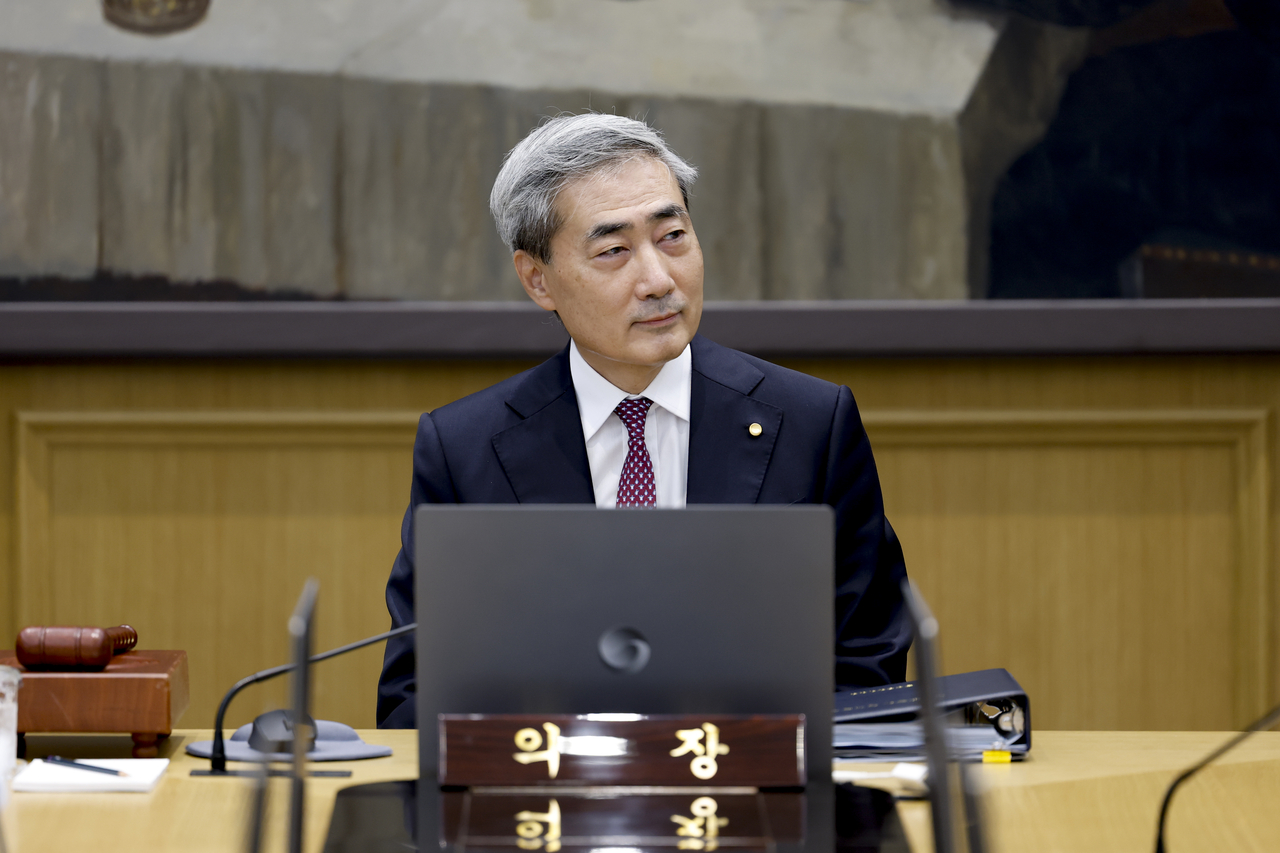
The Federal Reserve's decision to hold interest rates steady has kept the Korea-US rate gap unchanged, but the Bank of Korea's momentum toward further rate hikes is building.
Three dissenting votes in favor of a rate increase and Fed Chair Kevin Warsh's hardline stance on inflation have deepened the Fed's hawkish (favoring monetary tightening) tilt. A surprise acceleration in South Korea's second-quarter GDP growth has also eased the burden of raising rates. July consumer price data, due out early next month, will be the key indicator for whether the Bank of Korea delivers consecutive hikes in August.
Fed holds at 3.5–3.75% with three dissents; US long-term yields surge
The Federal Open Market Committee held its benchmark interest rate at 3.5–3.75% in the early hours of Thursday, marking a fifth consecutive hold and keeping the Korea-US rate gap at 1 percentage point on an upper-bound basis. The Bank of Korea's Monetary Policy Board raised its benchmark interest rate from 2.5% to 2.75% on July 16, narrowing the Korea-US gap by 0.25 percentage point.
The Korea-US rate differential is widely seen as a constraint on the Bank of Korea's monetary policy room. The inversion — with US rates above Korean rates — has persisted for four years since the United States surpassed South Korea's rate in 2022. The gap had narrowed from 1.5 percentage points to 1.25 percentage points in December 2025, and has now tightened again after roughly seven months. A 1-percentage-point gap was last seen in January 2023, about three and a half years ago.
The Fed's hawkish tone, however, has grown more pronounced. Markets are increasingly pricing in the possibility of a future rate increase. Should the Bank of Korea's Monetary Policy Board hold rates next month, the Korea-US gap could widen again.
Unlike the previous meeting, where the committee voted unanimously to hold, three of the 12 members voted for a rate increase this time. Fed Chair Warsh doubled down at his press conference, saying "there is no soft or implicit inflation target," reiterating that he would not tolerate elevated inflation.
According to the CME Group's FedWatch tool, the probability of a 0.25-percentage-point rate increase at the September FOMC meeting stood at 57.4% as of Wednesday (local time), outpacing the odds of a hold at 42.6% by 14.8 percentage points.
Markets have already begun pricing in the likelihood of a hike. The Dow Jones Industrial Average fell 2.19% on Thursday — its steepest single-session drop in 15 months since April last year. The yield on the 30-year US Treasury rose 0.11 percentage point to 5.21% shortly after the New York close. That marked its highest level in 19 years, last seen in July 2007, just before the global financial crisis.
The surge in US long-term Treasury yields could ripple through South Korean financial markets as well. According to the Bank of Korea, 58 percent of the variation in South Korea's long-term interest rates during the global monetary tightening cycle from 2022 to 2024 was attributable to shocks in US Treasury yields — the fifth-highest sensitivity among 35 major economies. Government bond yields serve as the benchmark for corporate bonds, bank bonds and mortgage rates. A US-driven rise in yields could push up South Korean government bond and market rates, increasing borrowing costs for businesses and households. It could also stimulate demand for the dollar, raising the risk of capital outflows.
As of around 9:20 a.m. Thursday, the yield on South Korea's 30-year government bond was trading at 4.523 percent, up 0.08 percentage point from the previous close, according to the Bank of Korea. The 10-year yield was up 0.11 percentage point at 4.266 percent.
Oil prices are expected to be the key variable going forward. Moon Da-un, a researcher at Korea Investment & Securities, said a rebound in oil prices since July had driven a hawkish shift from a unanimous hold in June to three votes for a rate increase, and that if WTI crude averages above $80 per barrel in August, "inflation could rebound and the hawkish tone at the September meeting could intensify." Kim Jin-seong, a researcher at Heungkuk Securities, said that despite some caution, investment remained solid and employment concerns had eased, and that "a temporary rate increase would be possible if inflation persists for an extended period."
BOK rate-hike momentum builds; all eyes on July core inflation
For the Bank of Korea, the immediate pressure from a widening Korea-US rate gap has eased. But with the possibility of a US rate hike still very much alive, the Bank of Korea retains ample room to raise its benchmark rate preemptively to get ahead of any renewed divergence. The likelihood of back-to-back rate increases — following this month's hike — at the August Monetary Policy Board meeting is growing, particularly with the September FOMC on the horizon.
A surprise second-quarter GDP result has added further weight to the case for consecutive hikes. South Korea's real GDP grew 0.6 percent quarter-on-quarter in the second quarter (advance estimate), three times the 0.2 percent growth the Bank of Korea had projected in May. Year-on-year growth came in at 3.7 percent. At this pace, annual growth of 3 percent or more this year appears well within reach.
If July consumer prices, due in early August, also come in elevated, the case for consecutive hikes will strengthen further. Inflation has been on an upward trend since the Iran war. Consumer price growth stood at 2 percent at the start of the year and has moved steadily further from the Bank of Korea's 2 percent price stability target — reaching 2.2 percent in March, 2.6 percent in April, 3.1 percent in May and 3.2 percent in June.
Some analysts expect the pace of increase to slow in July compared with June, but the Bank of Korea is focusing more closely on core inflation — a measure that strips out volatile items such as energy and food to capture the underlying, longer-term trend. The index excluding food and energy, the Bank of Korea's preferred core inflation gauge, rose from 2.2 percent in March and April to 2.5 percent in May and June. Some forecasters expect it to climb even higher in July.
Bank of Korea Governor Shin Hyun-song told the National Assembly's Finance and Economy Planning Committee on Wednesday that "maintaining a rate-hike stance to rein in core inflation is the most rational course of action," adding that "the timing of hikes and how aggressively to respond will depend on incoming data and economic conditions."
Bank of Korea Deputy Governor Park Jong-woo chaired a market conditions review meeting Thursday morning, saying the central bank would "continue to monitor with heightened vigilance the development of domestic and external risk factors and their impact on South Korea's financial and economic conditions," given that market anxiety had already risen on concerns about a slowdown in AI investment, and that uncertainty surrounding the Fed's monetary policy and the Middle East situation had also increased.
kimstar@heraldcorp.com




