![Kia's Yancheng factory in Jiangsu Province, China. [Joint press corps via Ministry of Foreign Affairs]](https://wimg.heraldcorp.com/news/cms/2026/07/29/rcv.YNA.20260709.PYH2026070907150050401_P1.jpg)
Kia plans to increase output at its Yancheng factory in China by more than 10%, using the plant as a full-scale global export hub serving emerging markets in Latin America, the Asia-Pacific region and the Middle East.
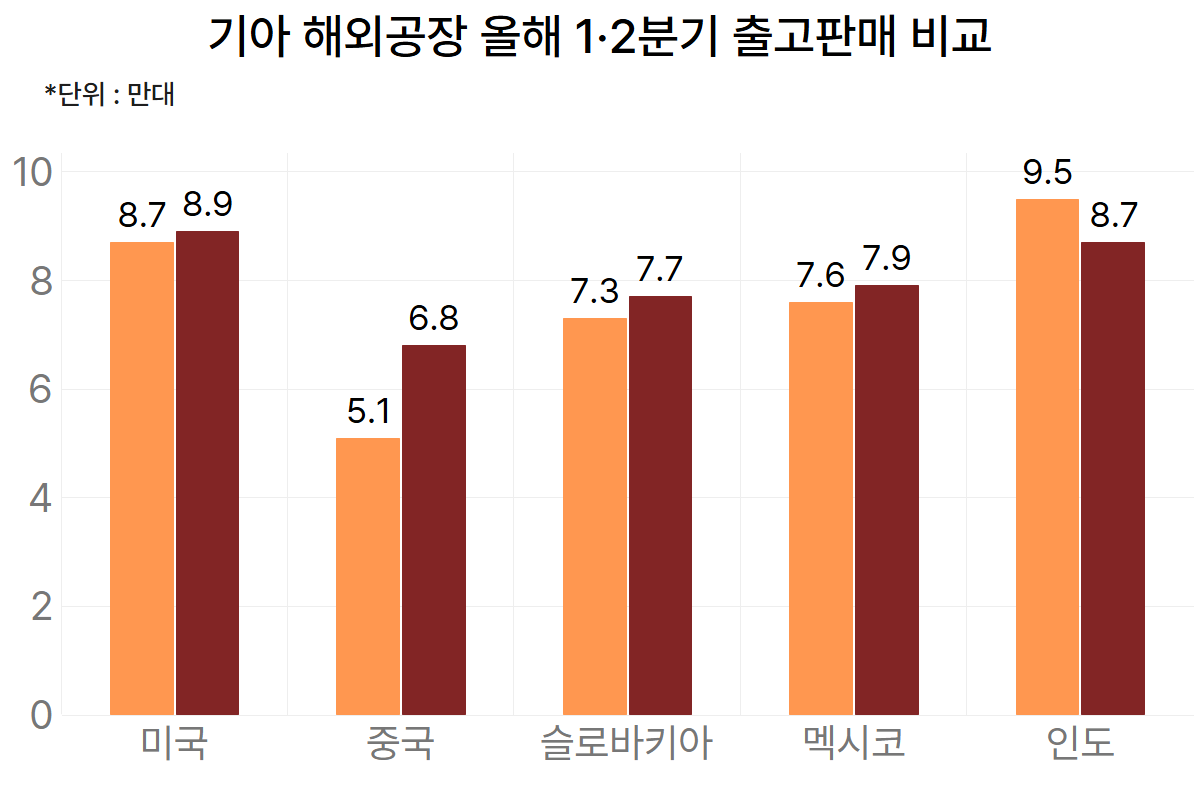
Kia's five overseas factories — in the United States, China, Slovakia, Mexico and India — sold a combined 776,046 vehicles in the first half of this year, according to industry data released Wednesday. That was up just 0.4 percent from 772,828 units in the same period last year.
By plant, the US factory sold 176,200 vehicles, down 1.8 percent year-on-year, while the European factory sold 150,100 units, a decline of 14.1 percent. The China factory also posted a first-half drop, with cumulative sales of 117,994 units, down 4.8 percent. India and Mexico bucked the trend, however — India's factory grew 15.6 percent and Mexico's rose 9.1 percent.
On a quarterly basis, the China factory's sharp recovery stands out. First-quarter sales there came to just 50,000 units, but the figure jumped 36.0 percent to 67,993 units in the second quarter.
Over the same period, the US factory grew 2.3 percent, Slovakia 5.3 percent and Mexico 4.1 percent, while India fell 4.0 percent. With most overseas plants hovering near flat, the China factory expanded its utilization at the fastest pace of any Kia facility abroad.
June sales hit nearly 6-year high as production expansion strategy takes shape
Monthly sales at the China factory have risen for four consecutive months since February. June sales climbed 10.9 percent from a year earlier to 25,767 units — the highest monthly figure since October 2020, nearly five years and eight months ago.
The trend signals that Kia's China-centered production expansion strategy is beginning to show up in actual results. Jung Sung-kook, Kia's executive vice president for IR strategy and investment, said at the first-quarter earnings conference call in April that "the factories primarily responding to emerging-market demand are the domestic plants and the China factory," adding that Kia "plans to increase production at the China factory by more than 10 percent."
![An exterior view of Kia's No. 2 factory in Yancheng, Jiangsu Province, China. [Kia]](https://wimg.heraldcorp.com/news/cms/2026/07/29/news-p.v1.20260729.fdbc7ab393fd4a988f375c8eea7023b2_P1.png)
The strategy calls for using Chinese production to meet rising demand in key export markets including the Middle East, Latin America, Mexico and Australia. As tariffs and expanding incentive costs weigh on profitability, Kia is leaning on the China factory's cost competitiveness to offset the pressure.
The export share of the China factory's output has risen sharply as a result — from 28 percent in 2022 to 48 percent in 2023, holding at around 68 percent since 2024. In the first half of this year, roughly 80,000 of the 117,994 vehicles shipped from the plant went overseas, meaning two of every three vehicles produced at the China factory are now exported. Demand from emerging markets in Latin America, the Asia-Pacific and the Middle East now drives the factory's operations more than domestic Chinese sales do.
![Robots on the production line at Kia's No. 3 factory in Yancheng, Jiangsu Province, China. [Joint press corps via Ministry of Foreign Affairs]](https://wimg.heraldcorp.com/news/cms/2026/07/29/rcv.YNA.20260709.PYH2026070907010050401_P1.jpg)
Two in three vehicles exported — but reviving China domestic sales remains a challenge
The continued decline in domestic Chinese sales remains a concern, however. Kia's local sales in China in the second quarter came to 19,000 units, down 7.9 percent from a year earlier — a contrast to the 0.8 percent increase in the factory's overall production over the same period. Export growth has helped restore factory utilization, but Kia has yet to rebuild its brand competitiveness and sales base within China. With domestic Chinese electric vehicle makers intensifying their push and price competition running fierce, excessive reliance on exports also leaves the factory's performance vulnerable to shifts in overseas demand.
The vehicles exported from the plant are compact models, primarily the Pegas and the K3. Pegas sales in the first half of this year reached 33,781 units, up 13.6 percent year-on-year. K3 sales more than doubled, rising from 3,207 to 6,618 units, and the KX1 grew 13.0 percent to 12,244 units.
Production of the dedicated electric vehicle EV5 also accelerated in the second quarter. Monthly EV5 sales climbed from the 100–200 unit range in the first quarter to 1,558 units in May and 2,037 units in June. Second-quarter deliveries totaled 4,295 units, up 34.5 percent from a year earlier.
![The Pegas, a compact sedan produced at Kia's Yancheng factory in China and exported to Latin America, the Middle East and other markets. [Kia]](https://wimg.heraldcorp.com/news/cms/2026/07/29/news-p.v1.20260729.fe5e42871cd34b0f915c22e44d91a557_P1.jpg)
Pegas, K3 and EV5 lead the charge — production target set at 270,000 units this year
The China factory produced roughly 650,000 vehicles annually as recently as 2016, but output fell to around 150,000 units in 2021 following the THAAD dispute, the COVID-19 pandemic and the rise of domestic Chinese electric vehicle makers. Kia has since expanded its export lineup and target markets, recovering production to around 250,000 units last year.
The production target for this year is 270,000 units. Given that the factory shipped 117,994 vehicles in the first half, Kia will need to increase second-half sales by roughly 29 percent over the first half to hit that goal.
Kia plans to introduce two new models in the Chinese market in the second half: the second-generation, fully redesigned Seltos and a facelifted version of the EV5. The new Seltos has already entered mass production at the Yancheng factory, with local pre-orders set to open Aug. 13. Kia intends the facelifted EV5 to sharpen the model's competitiveness and help revive domestic sales in China.
kwater@heraldcorp.com