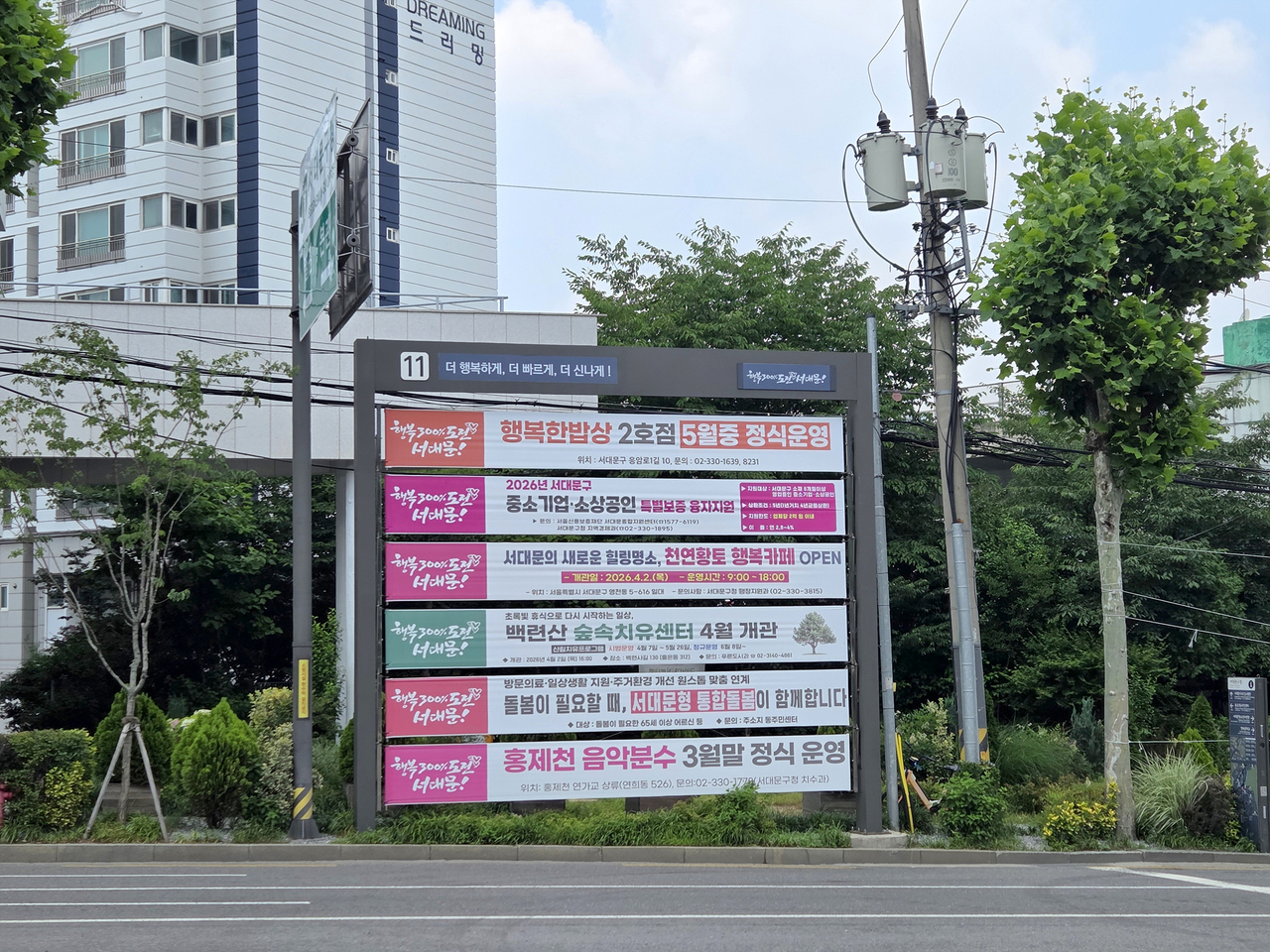
Local small-business owners and residents who have struggled to find space to promote their shops will soon have far more options — and lower advertising costs to go with them.
Seodaemun-gu announced Wednesday that starting Sept. 1, it will eliminate the distinction between public and commercial use at its designated banner display boards and shift to an integrated operating system. District Mayor Park Un-gi made the announcement.
The overhaul eases regulations that had divided display space along administrative lines, freeing residents and small-business owners to use the boards more flexibly. The district described the move as a livelihood-focused policy aimed at expanding promotional opportunities for neighborhood commercial districts.
Seodaemun-gu currently operates 25 designated banner board sites with a combined 144 display panels. Of those, 96 panels — two-thirds of the total — are reserved for public use, while commercial panels available to residents and small businesses are limited to 48. Many of those commercial boards are installed in low-visibility locations, drawing criticism that both utilization rates and user satisfaction have been poor.
Under the new system, only one or two tiers at each of the 25 sites will be kept for public use, with the remaining panels opened to residents and small businesses. The change will significantly increase the number of available panels and give advertisers a much wider choice of locations.
Applications open Aug. 1 through the website of Hansung Design Planning Co., the district's contracted operator of the designated banner boards. Applicants must submit requests between one month and one week before their desired posting date.
The district also plans to open 56 low-rise designated banner board sites with 106 panels to commercial use starting in October, after revamping the application system for those locations.
Particularly notable is that 22 of those sites — accounting for 33 panels — had previously been reserved for political party banners. Since political parties were permitted to post banners directly on public streets in 2024, utilization of those dedicated boards has dropped sharply. The district plans to convert them for use by residents and small businesses to address the shortage of available display space.
The changes also aim to ease the financial burden on small-business owners.
After consultations with the contracted operator, the district agreed to cut commercial banner advertising agency fees by 5.7 to 7.4 percent. The combination of expanded space and lower costs is expected to provide meaningful support for promoting local commercial districts.
"For small-business owners running shops in the neighborhood, the opportunity to get the word out is itself a competitive advantage," district Mayor Park said. "We will continue to look at the spaces and systems the district controls from the residents' perspective and press ahead with practical regulatory reform that benefits neighborhood commercial districts."
seouldream01@heraldcorp.com