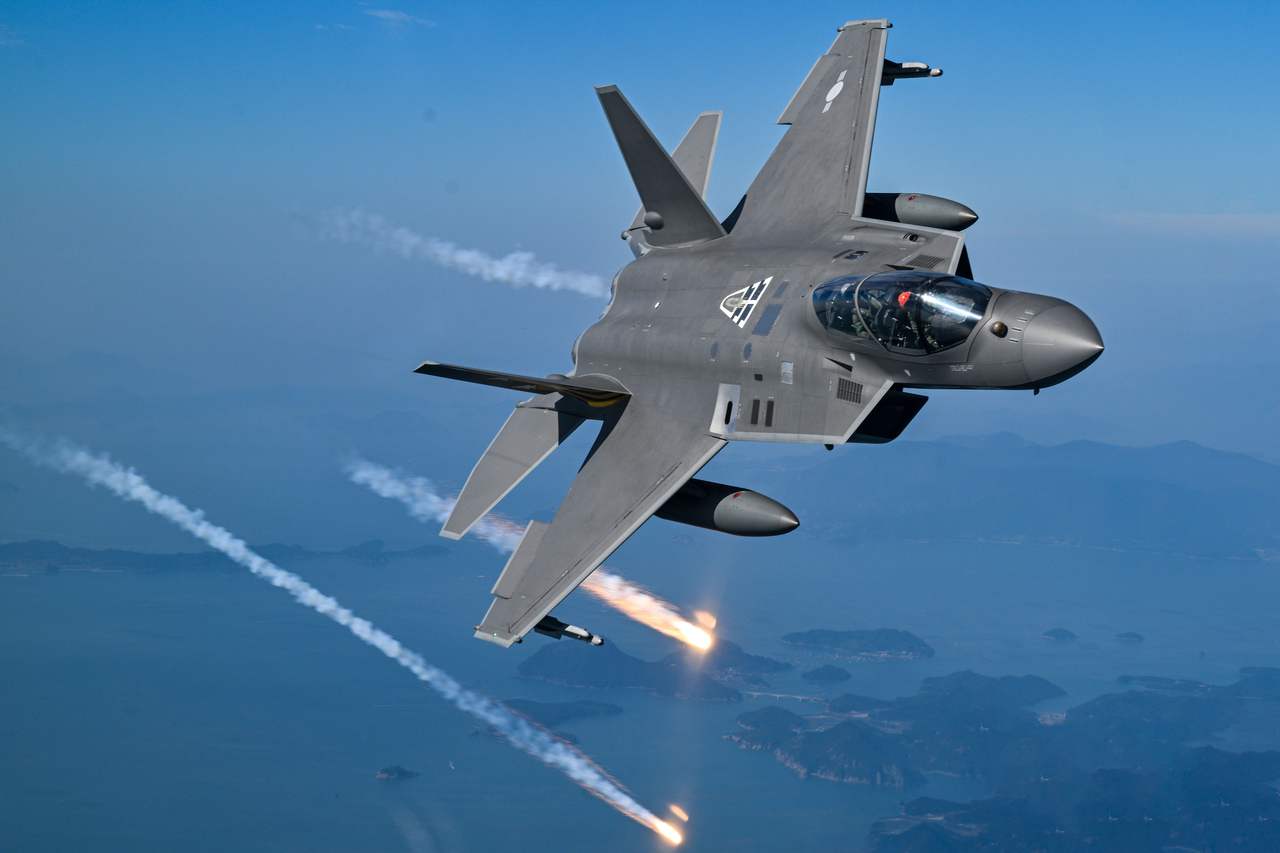
More than a decade after the program took its first steps in December 2015, South Korea's homegrown fighter jet, the KF-21 Boramae, has completed its system development phase, marking a milestone in the country's ability to defend its own airspace.
The Defense Acquisition Program Administration (DAPA) is holding a ceremony Wednesday at Korea Aerospace Industries (KAI) headquarters in Sacheon, South Gyeongsang Province, to mark the conclusion of the KF-21/IF-X system development program — the moment South Korea's first domestically developed supersonic fighter jet is officially certified as a combat-ready, finished product.
The ceremony brings together officials from the Ministry of National Defense, the Ministry of Foreign Affairs, the Ministry of Science and ICT, the Agency for Defense Development (ADD), KAI and other institutions involved in the program, as well as representatives from Indonesia's Ministry of National Defense, the program's co-development partner.
Since the program launched in December 2015, the KF-21 has cleared a series of major milestones: the first prototype rolled out in April 2021, the final flight test was completed in February, and in May the aircraft received a "combat-ready" certification — the last hurdle in the system development process.
Completing more than 1,600 demanding developmental test flights over 42 months across six prototypes without a single accident is a record with few, if any, parallels in global aviation history.
After finishing performance verification — including air-to-air weapons firing tests and South Korea's first aerial refueling test — the KF-21 received national defense specifications and a combat-ready certification in May, laying the groundwork for mass production and demonstrating the program's technical maturity.
The project carries particular significance in the defense industry because of its co-development model with Indonesia.
Indonesia is the program's sole partner nation, having shared a portion of the KF-21's development costs and participated from the earliest stages. The finished aircraft carries two designations — KF-21 for South Korea and IF-X for Indonesia.
The KF-21/IF-X is widely regarded as a virtually unique case in international supersonic fighter development: a program in which a partner nation was involved at every stage — from initial design and prototype construction through flight testing — and whose name is embedded in the aircraft's own designation.
South Korea has now joined the United States, China, Russia, Japan, France, Sweden and the European consortium (the United Kingdom, Germany, Italy and Spain) as the eighth nation to independently develop a 4.5-generation supersonic fighter — a distinction made all the more significant by the collaborative model that brought a developing nation along for the entire journey.
DAPA plans to deliver the first mass-production KF-21 to the Air Force in the second half of this year.
"The success of the KF-21 was made possible by the blood and sweat of everyone involved in the program and the technical teams who built it, and by the support of the Korean people who believed in our capabilities," DAPA Administrator Lee Yong-cheol said. "We will again prove South Korea's strength through the KF-21's excellence and through self-reliant national defense built on technological independence."
rimsclub@heraldcorp.com