Revised local tax ordinance adds 25% relief on top of statutory reduction
Daejeon has introduced sweeping measures to address the urban blight caused by completed but unsold apartments and long-vacant homes sitting neglected across the city.
The city announced Wednesday it would expand acquisition tax relief for completed but unsold apartments and vacant-home redevelopment through a partial revision to its local tax reduction ordinance.
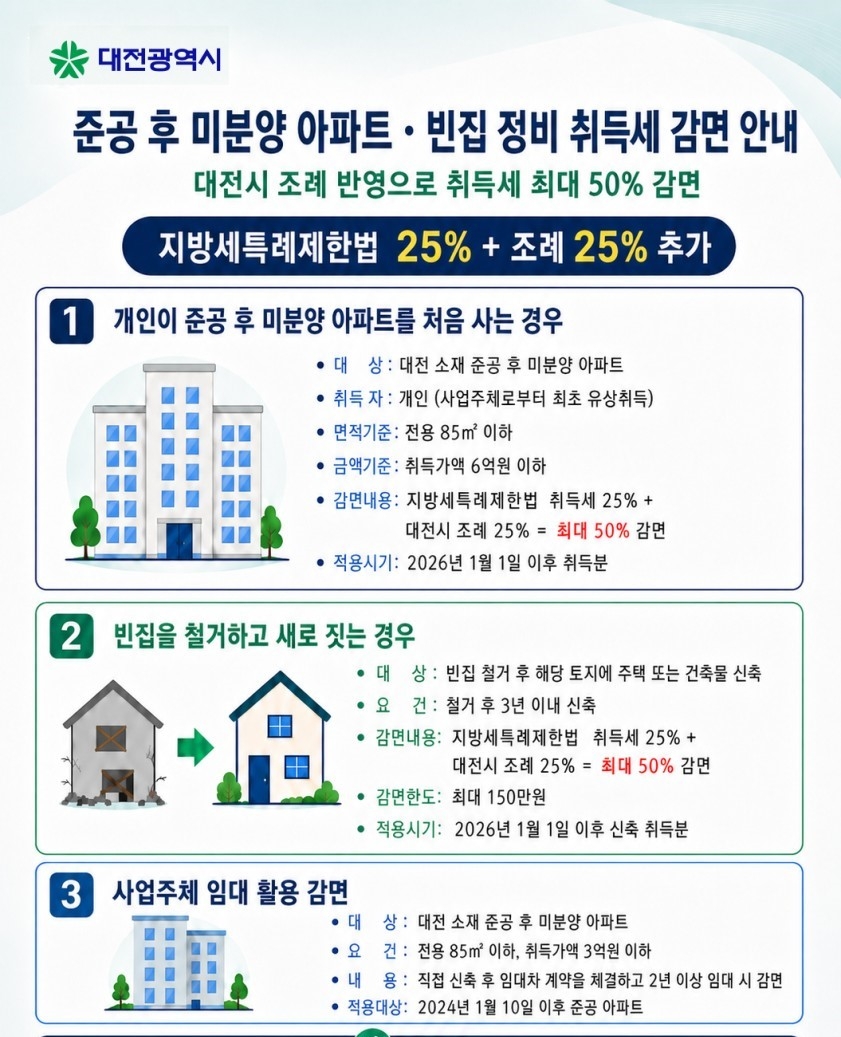
The amendment reflects an additional tax reduction rate delegated to local governments under a revision to the Special Act on Restriction of Local Tax Exemptions and Reductions. Its centerpiece is a 25% acquisition tax reduction on top of the statutory relief for housing or buildings newly constructed after demolishing completed but unsold apartments or vacant homes.
For completed but unsold apartments, the relief falls into two categories: cases where an individual makes the first paid acquisition directly from the developer, and cases where the developer acquires the unit to use as rental housing.
An individual who makes the first paid acquisition of a completed but unsold apartment in Daejeon — with an exclusive use area of 85 square meters or less and an acquisition price of 600 million won ($409,000) or less — directly from the developer can receive up to 50 percent off acquisition tax, combining the statutory 25 percent reduction with an additional 25 percent under the ordinance. The relief applies to acquisitions made on or after Jan. 1, 2026.
A developer that signs a lease contract on a completed but unsold apartment in Daejeon with an exclusive use area of 85 square meters or less and an acquisition price of 300 million won or less, and rents it out for at least two years, is also eligible for relief. That provision covers acquisitions made on or after Jan. 10, 2024.
Support for vacant-home redevelopment will also be expanded. If a new house or building is constructed and acquired on the site of a demolished vacant home within three years of the demolition, the combined statutory and ordinance reductions bring the acquisition tax cut to a maximum of 50 percent, capped at 1.5 million won. The relief applies to newly constructed acquisitions made on or after Jan. 1, 2026.
Daejeon expects the volume of units scheduled for move-in to rise from roughly 6,000 households in 2026 to more than 17,000 in 2027, even as a backlog of completed but unsold units remains. The city hopes the expanded relief will stimulate transactions for those unsold apartments and encourage residents to voluntarily redevelop long-neglected vacant homes.
"This amendment is intended to strengthen the effectiveness of the new relief system created by the legislative revision and to provide tax support tailored to local conditions," said Lee Je-chang, Daejeon's tax administration officer. "We will make sure residents understand exactly who qualifies and what the requirements are so they can take full advantage of the system."
kwonhl@heraldcorp.com