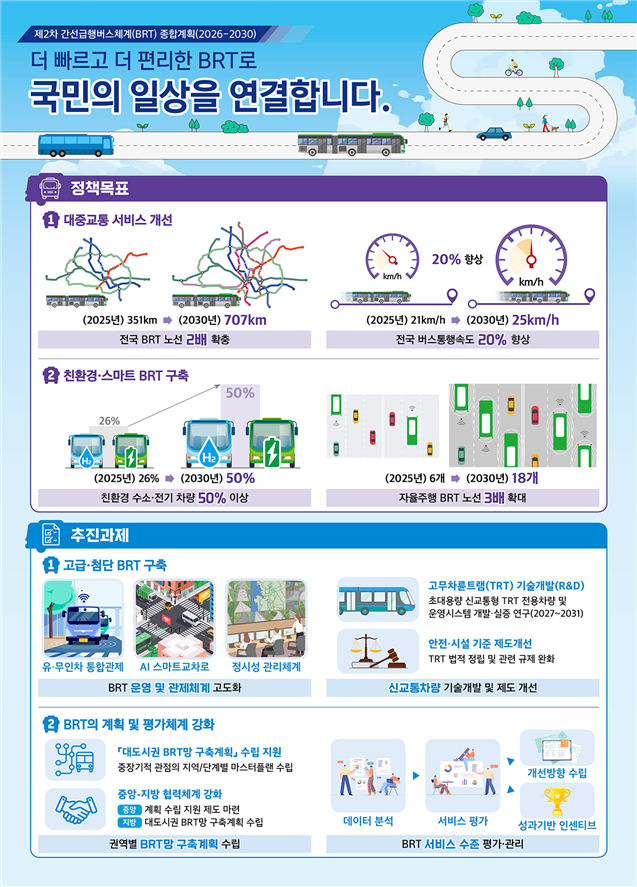
Bus Rapid Transit lanes will be built across 38 road segments nationwide — including Incheon's Yeongjong-daero and Seoul's Segok–Naegok–Wirye corridor — by 2030, doubling the current BRT lane network. Autonomous driving BRT routes will triple over the same period.
The Metropolitan Area Transport Commission under the Ministry of Land, Infrastructure and Transport announced Wednesday it had finalized and officially published the Second BRT Master Plan (2026–2030), a five-year policy roadmap outlining medium- and long-term goals for efficient BRT construction.
The plan aims to improve daily mobility by expanding regional transit access and shifting travel patterns away from private cars toward public transportation. The commission set out a vision of "BRT that connects people's daily lives more closely and conveniently," positioning the system as what it calls a "subway on the road."
Four core targets underpin the plan: doubling dedicated BRT lanes, raising average travel speeds by 20 percent, increasing the share of eco-friendly hydrogen and electric buses to at least 50 percent, and tripling autonomous driving BRT routes.
The commission plans to complete 38 BRT routes across the country by 2030 at a total project cost of 1.6 trillion won ($1.09 billion), of which 530 billion won will come from the national budget — including 407.6 billion won allocated to non-metropolitan regions. The plan is structured to significantly expand investment in regional metropolitan areas to narrow transportation gaps between the capital and the rest of the country.
The plan also calls for tighter integration with major transit hubs — airports, railway stations and bus terminals — to build a transfer-centered intermodal network, with BRT serving as a core connector across multiple modes of transportation rather than simply another bus route.
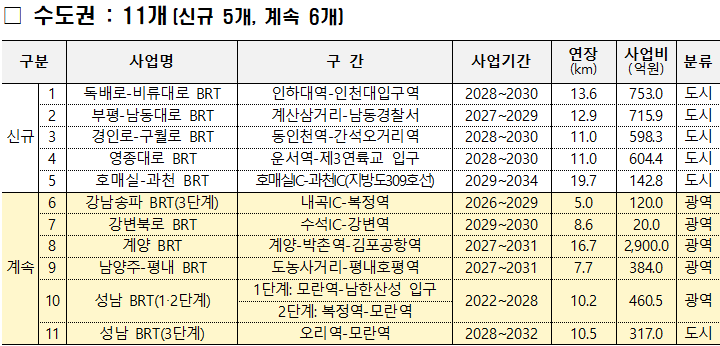
Airport-linked BRT routes will be developed along Incheon's Yeongjong-daero, the Gadeokdo New Airport corridor connecting South Gyeongsang Province's Jinhae and Busan, and Daegu's Ayang-Sinam-ro. Rail-linked routes include Incheon's Dokbae-ro, South Gyeongsang Province's 3·15-daero, and the Gongju–Sejong corridor in South Chungcheong Province. Residential-area routes cover Seoul's Segok–Naegok–Wirye third-phase segment, Busan's Sinho–Hadan, and Gwangju's Unam–Duam–Gakhwa. Transit-hub connections include Daegu's Daemyeong–Bisan, Gwangju's Baegun–Maegok, and Daejeon's Oisam–Yuseong.
Regional cross-boundary projects include the Changwon Jinhae–Busan Gangseo–Hadan–Daeti Station corridor in South Gyeongsang Province, the Osong Station–Sejong National Assembly route in North Chungcheong Province, the Cheongju–Sejong line in North Chungcheong Province, the Seoul Songpa Bokjeong Station–Seongnam Ori Station link, the Changwon Seongsan-gu–Busan Jinhae-gu corridor in South Gyeongsang Province, and the Sejong Bus Terminal–Cheonan Asan Station route.
The master plan also includes measures to strengthen mobility rights for transportation-disadvantaged users and improve the overall competitiveness of public transit by enhancing BRT punctuality and passenger convenience.
Planned improvements include standardized barrier-free stops, minimized platform-to-vehicle gaps, expanded low-floor bus deployment, and AI-based operations and control upgrades. The commission also intends to link BRT service-level assessments to fiscal support through a performance management framework, raising the quality of public transit as experienced by riders.
The plan further calls for building a future-ready BRT system by incorporating new mobility technologies such as eco-friendly vehicles and autonomous driving. The commission plans to expand hydrogen and electric bus adoption, apply precision autonomous operations and real-time control systems, and develop new vehicle types suited to a changing transportation environment.
Kim Yong-seok, chairman of the Metropolitan Area Transport Commission, said the second BRT master plan goes beyond simply expanding bus infrastructure, describing it as "a medium- and long-term blueprint to develop BRT as the backbone of a wide-area transport network connecting the five major hubs and three special zones." He added that the commission would "create an environment where people can travel faster and more conveniently by advancing inter-regional connectivity and upgrading transfer systems at key transit nodes."
smh@heraldcorp.com