
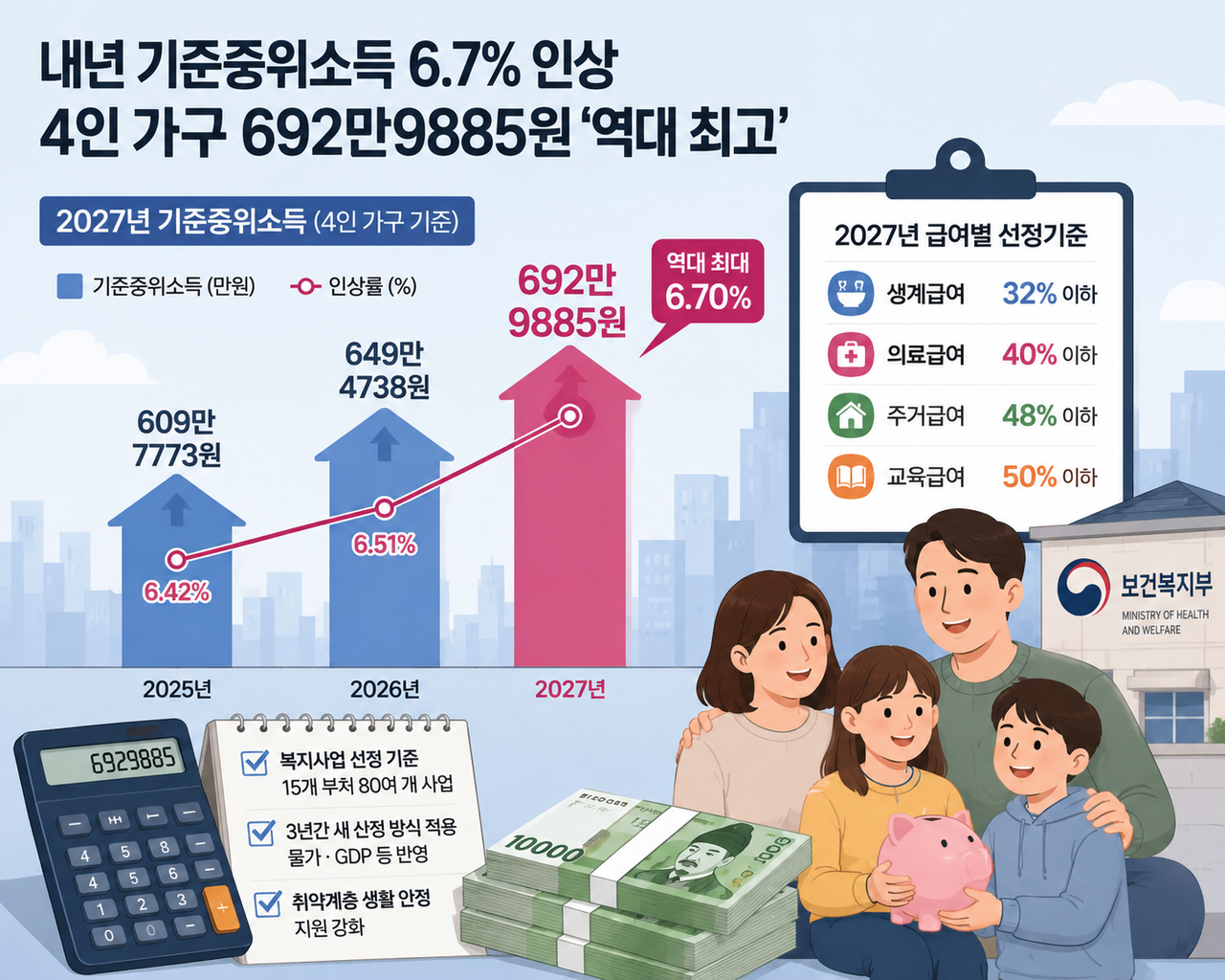
The government has set next year's reference median income at 6.93 million won ($4,730) per month for a four-person household, a 6.7 percent increase from this year.
The hike marks the highest increase rate since the reference median income system was established and extends the record to six consecutive years. The government said the decision reflects efforts to address the growing financial hardship facing low-income households and widening income inequality.
According to the Ministry of Health and Welfare, the government convened the 80th Central Self-Sufficiency Committee at Government Complex Seoul on Tuesday and voted to set the 2027 reference median income and eligibility thresholds for benefits under the National Basic Livelihood Security system. The figure serves as the benchmark for selecting recipients of more than 80 welfare programs run by 15 central government ministries, including the basic livelihood security system.
The reference median income for a four-person household next year will rise to 6.93 million won per month from 6.49 million won this year. The figures for other household sizes were set at 2.74 million won for single-person households, 4.48 million won for two-person households, 5.72 million won for three-person households, 8.06 million won for five-person households and 9.13 million won for six-person households.
The government said it decided on the record-high increase rate in light of deepening poverty and widening income polarization. Household income survey data show that the deficit among the bottom 20 percent of earners expanded from 438,000 won in the fourth quarter of last year to 519,000 won in the first quarter of this year.
Eligibility thresholds for individual benefits remain unchanged from this year, set at 32 percent of the reference median income for livelihood benefits, 40 percent for medical benefits, 48 percent for housing benefits and 50 percent for education benefits.
As a result, the maximum monthly livelihood benefit for a four-person household will increase from 2.08 million won this year to 2.22 million won next year. Medical benefits will cover four-person households with a monthly income of up to 2.77 million won, housing benefits up to 3.33 million won and education benefits up to 3.46 million won.
For housing benefits, the standard rental subsidy will rise by 12,000 to 50,000 won depending on region and household size. The maximum monthly support for a four-person household will be 596,000 won in Seoul, 488,000 won in Gyeonggi Province and Incheon, 403,000 won in metropolitan cities, Sejong and special cities outside the Greater Seoul area, and 369,000 won in other regions.
Among education benefits, the educational activity support allowance will increase to 513,000 won for elementary school students, 714,000 won for middle school students and 945,000 won for high school students.
The government will also overhaul the method used to calculate the reference median income starting next year. The current approach bases the figure on the median income growth rate from the Household Finance and Welfare Survey over the previous three years. Under the new method, key economic indicators — including the consumer price index and real GDP growth rate — will also be factored in to better reflect current economic conditions.
Beyond the statistical adjustments, the new framework allows for further adjustments to the growth rate based on considerations such as relative poverty reduction, the adequacy of basic livelihood protection and the state of government finances. The new calculation method will be applied for three years.
"We raised the reference median income to a record high in consideration of the difficult living conditions facing people in need, including a growing deficit among lower-income groups and widening income gaps," Health and Welfare Minister Jeong Eun-kyeong said. "This decision reflects the government's commitment to providing stronger protection for those in hardship."
fact0514@heraldcorp.com




