The AI memory investment frenzy centered on Samsung Electronics and SK Hynix has spread well beyond the Kospi, now igniting capital markets across China and Japan. In China, CXMT — the world's fourth-largest DRAM maker — topped the mainland's market capitalization rankings after completing Asia's biggest initial public offering this year, while in Japan, asset managers are pushing to launch single-stock leveraged ETFs tied to Kioxia and other leading AI and semiconductor names. A wave of AI memory investment that first took shape in South Korea is now rippling outward — manifesting as a blockbuster IPO in China and a new class of leveraged products in Japan — as competition across Asian capital markets for AI memory exposure intensifies.
CXMT debuted Monday on the Shanghai Stock Exchange's STAR Market, closing at 49 yuan ($7) per share — a gain of 465.82 percent over its offer price of 8.66 yuan. During trading, the stock surged as high as 55.03 yuan, a jump of 535.45 percent. At the closing price, CXMT's market capitalization reached 3.28 trillion yuan (about 711 trillion won), overtaking Industrial and Commercial Bank of China to become the most valuable company listed on China's mainland exchanges, and briefly surpassing the market cap of US chipmaker Intel. Daily turnover hit 141.2 billion yuan, the first time a single stock on the A-share market has exceeded 100 billion yuan in one session.
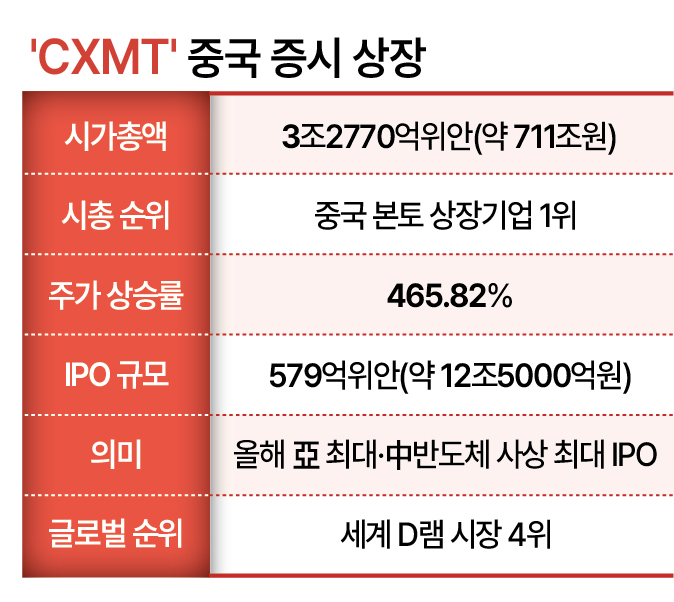
The flood of money into CXMT reflects a bet on growth potential rather than current technological prowess. Most analysts say the company has yet to close the gap with Samsung Electronics and SK Hynix. CXMT lifted its share of the global DRAM market from 3 percent last year to 8 percent in the first quarter of this year, but analysts estimate it trails Samsung and SK Hynix by roughly two to three years in advanced memory segments such as high-bandwidth memory for AI applications. Markets, however, are assigning a premium to the prospect of China's expanding AI investment and CXMT's production capacity growth.
Those expectations translated into a record-breaking fundraise. CXMT raised 57.9 billion yuan through the IPO, making it the largest listing by a Chinese chipmaker in history and the biggest IPO in Asia so far this year. It is also the second-largest IPO on China's mainland exchanges since Agricultural Bank of China in 2010. Many in the market view the listing as more than a routine capital raise — a symbolic milestone in China's push for semiconductor self-sufficiency. Nomura set a target price of 116 yuan for the stock, citing strong growth prospects.
Japan is seeing a parallel expansion in single-stock leveraged ETFs built around leading AI and semiconductor companies. According to SEC filings, Tuttle Capital is preparing products based on Kioxia, SoftBank, Nintendo and Metaplanet. Direxion is pursuing a launch tied to Tokyo Electron and Toyota, while Themes ETF Trust is working on products referencing Lasertec and Fujikura. Among these, Kioxia is set to become the first Japanese company to serve as the underlying asset for a single-stock leveraged ETF.
Because Japanese regulations prohibit the domestic public listing of single-stock leveraged ETFs, these products are being launched through US markets instead. Matthew Tuttle, CEO of Tuttle Capital — which is preparing the Kioxia leveraged ETF — said there are many Japanese companies that US investors want exposure to, adding that "Japan will be the next wave" for single-stock leveraged ETFs. He noted that South Korean investors have also shown strong interest, with Korean investor capital accounting for roughly one-third of his firm's assets under management.
The AI memory investment enthusiasm that gained prominence on the Kospi is now feeding into China's IPO market and Japan's leveraged ETF space, drawing attention as a factor amplifying volatility across Asian equity markets more broadly.
On Monday, CXMT's debut rattled South Korean semiconductor stocks, widening intraday swings as foreign investor flows shifted. Kang Jin-hyeok, an analyst at Shinhan Investment, said that despite positive catalysts — including a temporary halt to US airstrikes on Iran that eased oil price anxiety and announcements of large-scale cooperation projects with US big-tech firms — CXMT-driven volatility still spread to the domestic market. "It appears that supply-and-demand spillover around the opening of Chinese markets affected South Korean equities as well," he said.
As debate over the volatility risks of single-stock leveraged ETFs continues in South Korea, similar concerns are surfacing in Japan. Andrew Jackson, head of Japan equity strategy at Ortus Advisors, told Bloomberg that single-stock leveraged ETFs "distort normal market mechanisms and significantly amplify volatility."

kacew@heraldcorp.com