
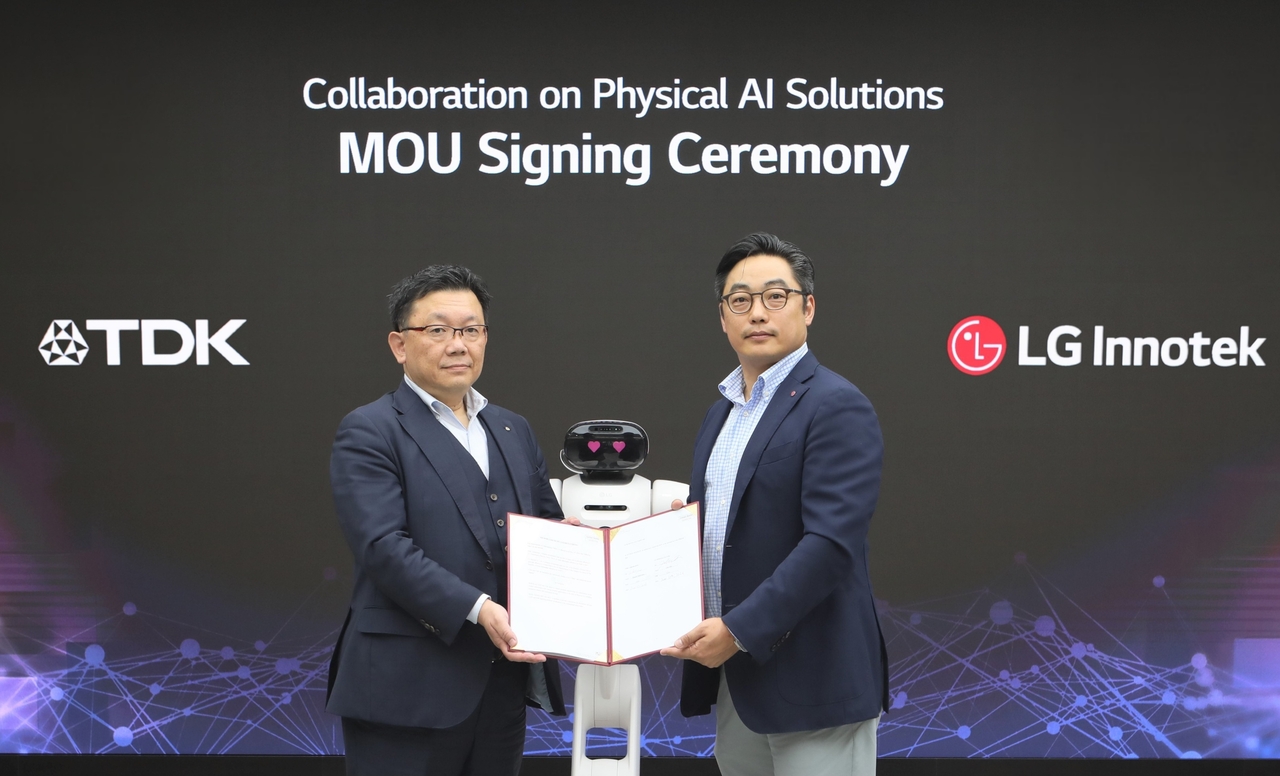
LG Innotek has teamed up with Japanese electronic components giant TDK to strengthen its physical AI sensing module capabilities. The move is a concrete step toward the vision CEO Moon Hyuk-soo outlined at CES 2026 earlier this year, when he declared the company's ambition to evolve from a components maker into a solutions company and flagged plans to commercialize robotic tactile sensors.
LG Innotek announced Tuesday that it had signed a strategic partnership with TDK in the physical AI space. The two companies plan to combine LG Innotek's optical and ultra-precision design technology with TDK's sensor expertise to develop a range of physical AI sensing solutions, including a next-generation vision sensing module and a tactile sensing module.
TDK is a global top-tier electronic components company that has been building its sensor business for more than two decades. It has assembled a broad portfolio covering inertial, positional, pressure and temperature sensors applicable to physical AI systems.
LG Innotek will conduct advanced research to integrate TDK's inertial and positional sensors, microphones and other sensor types into its own vision sensing modules. The goal is a next-generation vision sensing module with higher recognition performance and multi-function capability compared with current offerings. When TDK's inertial sensors are embedded in a vision sensing module, they correct for image-data shake caused by a robot's movement, enabling more accurate recognition.
"The forms that a next-generation vision sensing module can take through synergies with TDK — which holds dozens of sensor technologies — are limitless," an LG Innotek official said. "We will first unveil a module equipped with an inertial sensor in 2027."
The two companies also agreed to jointly develop a tactile sensing module, targeting completion next year. LG Innotek has until now focused on vision sensing — effectively the robot's eyes — drawing on its optical solution technology. The partnership with TDK expands that scope into tactile sensing, combining LG Innotek's modularization and digital signal processing capabilities with TDK's ultra-precision tactile sensing technology.
Tactile sensing is one of the new businesses Moon flagged at CES 2026 earlier this year. "LG Innotek is no longer a components company — it is a solutions company," he said. "Based on our core technologies in sensing, substrates and control, we will continue to identify and pursue commercialization of robot sensing, actuators, tactile sensors and more."
Tactile sensing modules mount on a robot's hands, arms, torso and other parts, functioning as the robot's skin. They allow a robot to detect contact and measure pressure. Developing them requires advanced technical capabilities — including ultra-precision, ultra-thin and flexible structures — making them among the more challenging components to engineer.
The growth potential is substantial. According to market research firm Grand View Research, the global tactile sensor market was valued at approximately $3.68 billion last year and is projected to grow at a compound annual rate of 25 percent, reaching about $21.5 billion by 2033.
The two companies plan to deepen their cooperation in physical AI going forward. "We are delighted to join hands with LG Innotek, a world-class physical AI sensing company," said Saito Noboru, president and CEO of TDK. "We will combine TDK's foundational technologies and sensors with LG Innotek's core capabilities to bring to market products that can reshape the competitive landscape."
Moon said "multi-sensing" — integrating numerous sensors — would become a defining trend in robotics, and that the partnership with TDK, with its wide sensor portfolio, would help LG Innotek lead the ecosystem for core robot components. He added that the company would continue collaborating with various partners to advance key technologies for robot vision and hands, and to accelerate its push to capture the physical AI market.
jeongwan@heraldcorp.com




