![A view of residential buildings in Seoul as seen from N Seoul Tower on Namsan. [Herald DB]](https://wimg.heraldcorp.com/news/cms/2026/07/27/9/news-p.v1.20260616.63817cff63614c559b9f6a1a353192a2_P1.jpg)
As the government prepares to unveil its tax reform package, market attention is focused on how far it will raise the basic deduction threshold for the comprehensive real estate tax — currently set at 1.2 billion won ($818,000) for single-home owners. With Seoul's average apartment price having risen by hundreds of millions of won since the threshold was last adjusted in 2023, experts say a new ceiling of 1.3 billion to 1.5 billion won would be appropriate. Analysts also caution that any upward revision could intensify price alignment toward the new threshold, particularly in mid- to lower-priced districts.
According to officials at relevant ministries, the government is reviewing a plan to raise the 1.2 billion won comprehensive real estate tax threshold for single-home owners as part of this year's tax revision bill, reflecting the sustained rise in housing prices.
Under current law, the tax base is calculated by subtracting the basic deduction — 1.2 billion won for single-home owners and 900 million won for multi-home owners — from the publicly assessed value of a property, then applying the current fair market value ratio of 60 percent. Single-home owners have generally begun incurring the tax on properties with a market price of around 1.7 billion to 1.8 billion won, and the government plans to raise that threshold further.
The previous administration included a proposal to raise the basic deduction from 1.1 billion to 1.2 billion won in its July 2022 tax reform package. The revised comprehensive real estate tax act passed the National Assembly plenary session on Dec. 23, 2022, and took effect in 2023. According to the Seoul Real Estate Information Plaza, the average price of apartments actually transacted in Seoul in December 2022 — when the legislation passed — was 864.63 million won. By June this year, that average had risen to 1.21 billion won, a 39.7 percent increase, or 342.86 million won, over four and a half years. Compared with January 2023, when the revised law first took effect, prices have risen 24 percent, or 233.58 million won, from 973.91 million won.
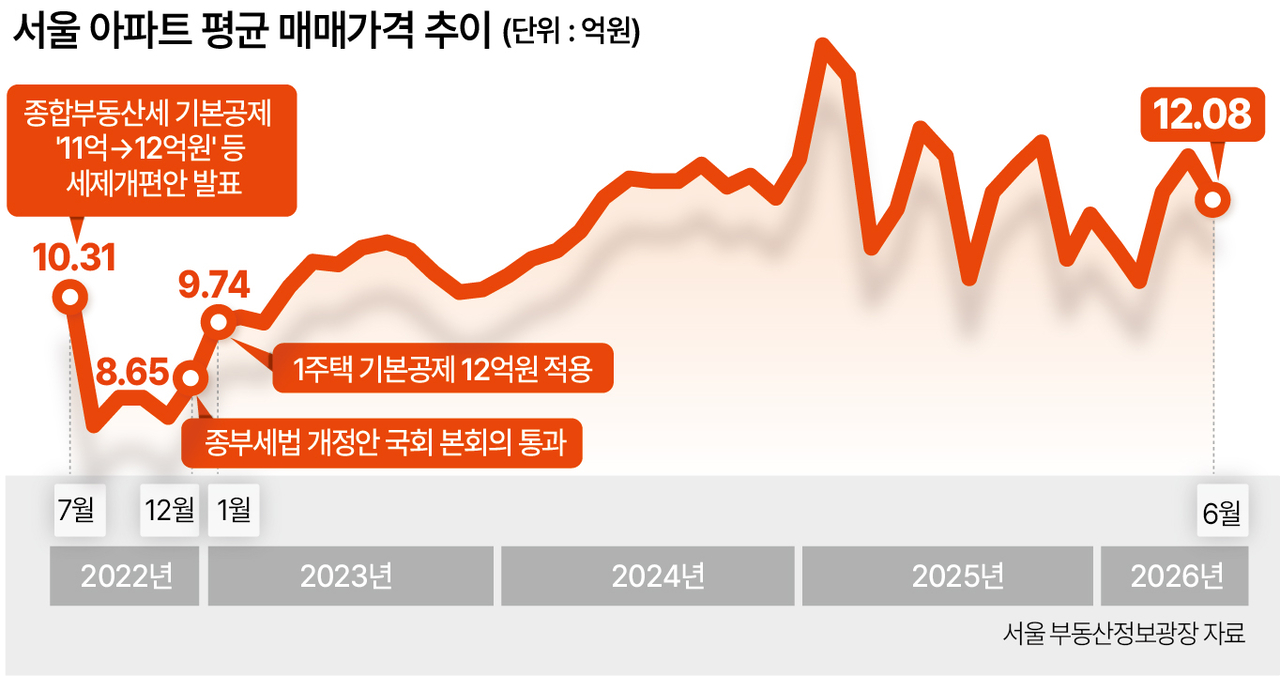
As housing prices have surged across Seoul and other major metropolitan areas, the number of properties subject to the tax has grown sharply. According to publicly assessed housing price data the Ministry of Land, Infrastructure and Transport released in late April, the number of homes nationwide with a publicly assessed value exceeding 1.2 billion won reached 487,632 this year — a roughly 53 percent jump, or 168,721 units, from the previous year.
Against this backdrop, the government is seeking to ease the tax burden on middle-class owner-occupiers squeezed by rising home values, while restructuring the system toward differentiated taxation based on property value. The plan involves raising the single-home deduction threshold to reduce resistance among ordinary residents, while refining taxation on ultra-high-value properties through adjustments to the fair market value ratio.
President Lee Jae Myung also weighed in at a public forum on real estate policy on Thursday, saying the government is "considering setting an appropriate basic holding burden for a typical single home, then offering reductions for owner-occupied residences and homes for ordinary and middle-class households." He added that the government is "thinking about a tiered approach that applies additional weighting to luxury homes, multi-home ownership and clear cases of speculative buying."
Experts put the appropriate new basic deduction for single-home owners at 1.3 billion to 1.5 billion won, arguing the threshold must be updated to reflect the rise in average and median apartment prices in Seoul.
Seo Jeong-yeol, a real estate professor at Youngsan University, said "the current average Seoul apartment price based on KB real estate market data already exceeds 1.5 billion won," adding that "given the substantial gains over the past several years, the deduction should be set at 1.5 billion won or higher." Song Seung-hyeon, head of the research firm Dosi wa Gyeongje, said he expects the government to "set the deduction standard based on the average Seoul apartment price," and projected it "could be raised by around 100 million to 200 million won from the current level."
However, analysts warn that raising the single-home deduction threshold could trigger price increases in mid- to lower-priced apartment complexes. With more headroom below the new ceiling, buying interest could concentrate in units just beneath the new threshold — a so-called price alignment effect.
Song said that "if the basic deduction is raised, properties with a market price of up to around 2 billion won would effectively be exempt from the comprehensive real estate tax, which means prices in existing mid- and lower-priced areas could rise to reach that level." He added that "if complexes at the front of the price range push upward, there is a good chance that complexes further down the range will follow."
Seo also said that "if the current favorable housing supply conditions continue, we will see price alignment toward the new threshold among complexes that fall out of the tax's scope."
hwshin@heraldcorp.com