The government plans to overhaul the national health insurance premium system, raising the ceiling on contributions from the highest earners while updating a premium floor that has been effectively unchanged for 26 years. The changes aim to strengthen fairness by requiring top earners to pay more, while tying the minimum premium benchmark to the annual minimum wage to shore up the program's fiscal base.
According to the Ministry of Health and Welfare and other officials, the government recently submitted a reform proposal on the premium assessment system to a subcommittee of the Health Insurance Policy Deliberation Committee.
The core of the proposal is a simultaneous adjustment of both the premium ceiling and floor.
The ceiling applied to the highest-income subscribers will rise sharply. Under the current system, premiums are capped at a fixed level regardless of income, meaning top earners all pay the same maximum amount — a long-standing equity concern.
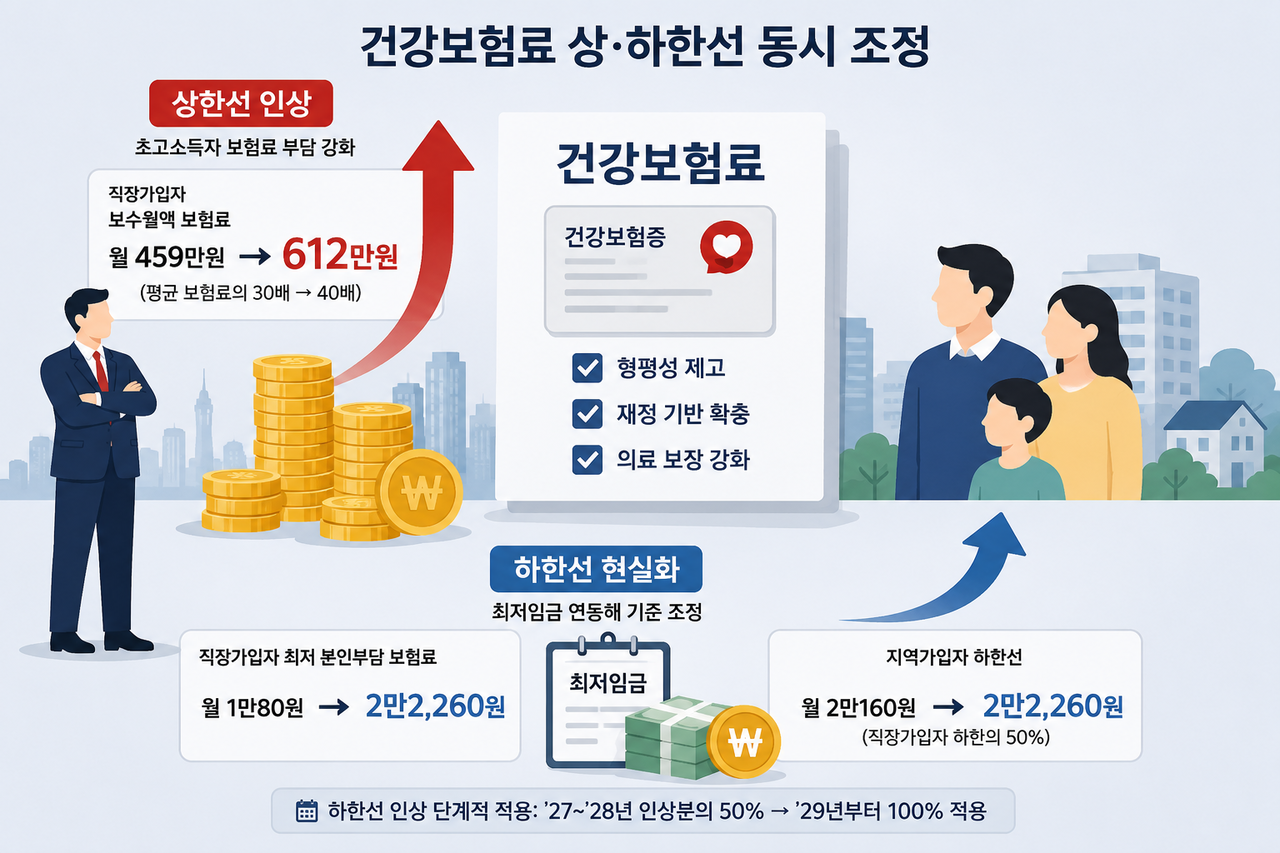
Under the new plan, the ceiling for workplace subscribers' salary-based premiums will be raised from 30 times to 40 times the average premium. The maximum monthly premium a workplace subscriber pays will increase by 1.53 million won, from the current 4.59 million won ($3,120) to 6.12 million won.
The ceiling on premiums levied on non-salary income, as well as the cap for self-employed subscribers, will also rise — from 15 times to 20 times the average premium — bringing the monthly maximum for those categories to 6.12 million won as well.
The ceiling increase will affect about 7,060 workplace subscribers in the top 0.04% and roughly 1,890 self-employed households in the top 0.02%. The government expects the changes to generate about 175.1 billion won in additional premium revenue annually.
At the same time, the minimum premium benchmark will be revised for the first time since the National Health Insurance Act was enacted in 2000. The minimum monthly salary base for workplace subscribers has been fixed at 280,000 won for 26 years; going forward, it will be linked to the minimum wage announced each year.
As a result, the minimum monthly premium paid by workplace subscribers will rise from 10,080 won to 22,260 won. The floor for self-employed subscribers will also be adjusted to 50 percent of the workplace subscriber benchmark, climbing from 20,160 won to 22,260 won per month.
However, to ease the burden on low-income households, the floor increase will be phased in gradually. Only 50 percent of the increase will take effect from 2027 through 2028, with the full amount applied from 2029.
The floor adjustment will affect about 193,000 workplace subscribers in the bottom 1.0% and 4.86 million self-employed households. The government projects the changes will secure an additional 141.7 billion won in premium revenue per year.
The government said the reform will reinforce the principle that equal ability to pay should mean equal premiums, and that the additional revenue will be directed toward support for regional and essential medical services and expanded coverage for serious illnesses.
fact0514@heraldcorp.com