

Kim Hyun-gi, the newly inaugurated Gangnam-gu district mayor, has been drawing strong praise from district office employees since the very start of his term.
Winning the trust of staff is the most essential foundation for any district mayor who hopes to deliver results — it is the employees who help shape policy and drive outcomes on the ground. When that trust translates into performance, and performance into public confidence, local government works as it should.
By that measure, Kim appears to have a firm grasp of the fundamentals of organizational leadership.
His path to the post was anything but straightforward. Born into modest circumstances, Kim enrolled in the National Railway High School and went on to work as a railway civil servant after graduating. Within a year, however, he quit the job to pursue a different path — returning even the tuition support he had received.
He passed another examination, joined a new organization, and then set his sights higher still. He spent more than two decades as a National Assembly aide, learning the workings of national governance, and earned a doctorate in public administration from Dongguk University with a focus on budget policy.
He then served four consecutive terms as a Seoul Metropolitan Council member representing Gangnam-gu, building deep familiarity with local issues. He capped that experience by serving as speaker of the Seoul Metropolitan Council, a role that gave him a broad view of city governance as a whole.
Drawing on that record, Kim entered the race for Gangnam-gu district mayor and fought his way through a competitive People Power Party primary election. Winning the PPP nomination in a district as strongly conservative as Gangnam-gu was itself a mark of his electoral credibility.
Kim went on to win the June 3 local elections by a margin of roughly 100,000 votes over his opponent. The commanding margin in Gangnam-gu is also credited with providing meaningful support to Seoul Mayor Oh Se-hoon's election victory.
Closing the gap with staff
His first moves after taking office were aimed squarely at building rapport with employees.
On his first day at work, Kim stood at the entrance of the district office and greeted each member of staff individually with a handshake — choosing direct, eye-level contact with employees over a formal, authority-laden inauguration ceremony.
He also distributed the roughly 100 orchid arrangements sent as congratulatory gifts to new civil servants and various departments, sharing the flowers with staff rather than keeping them for himself as a way of signaling an open, collegial approach to leadership.
He then visited every department in the district office in person, handing out business cards printed with his mobile number and email address and asking staff to contact him directly whenever they had work-related concerns or ideas for district policy.
Inauguration kept to a bare minimum at 2.94 million won
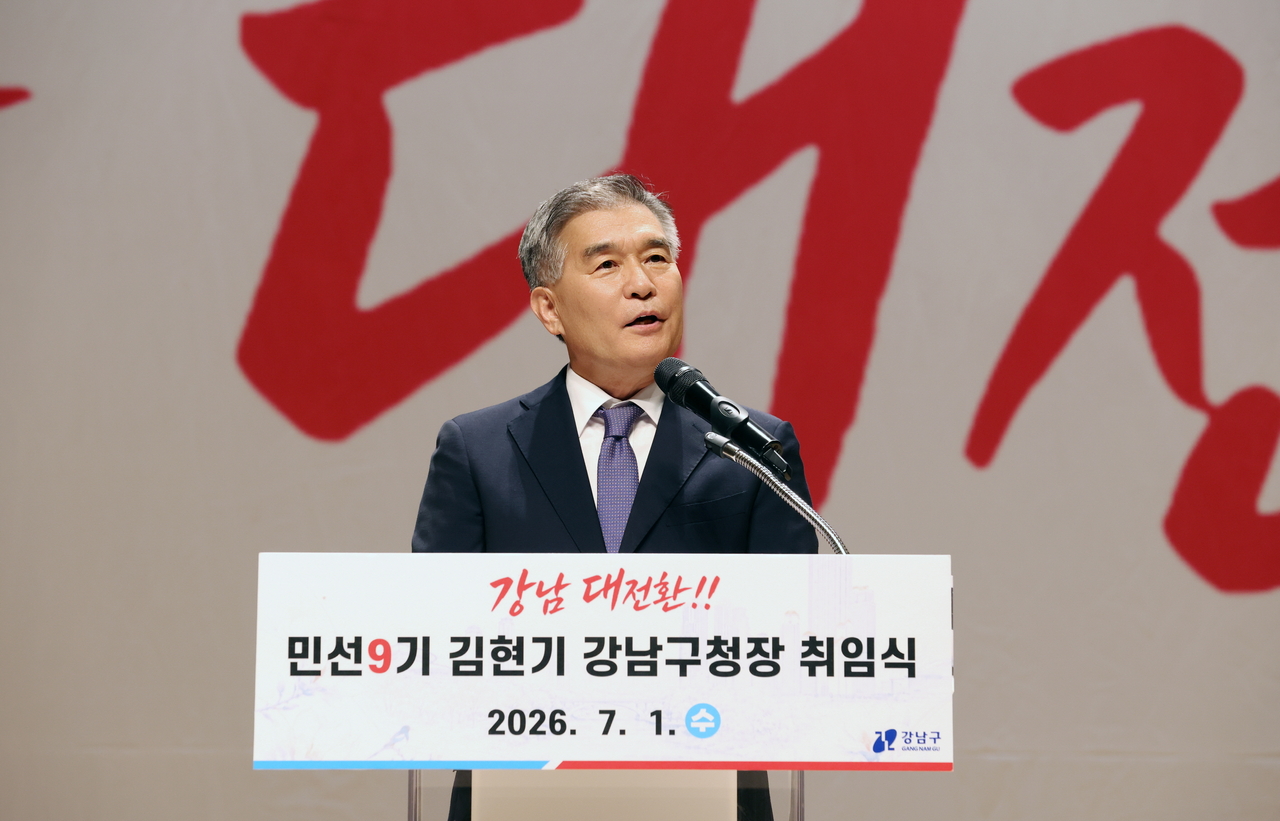
The inauguration ceremony itself was equally understated. Held at 3 p.m. on July 1 in the main auditorium of the Gangnam Community Center, the event for the ninth directly elected Gangnam-gu district mayor was kept to the bare essentials at Kim's direction — covering only the cost of banners, bottled water and chair rentals. The total budget came to just 2.94 million won ($2,000).
Kim has not stopped at internal communication — he has also moved quickly to deliver results that residents can feel directly.
Shortly after taking office, Kim approved the reconstruction project implementation plan for Eunma apartment complex and personally visited the reconstruction association to hand over the approval certificate. The move carried particular weight given that Eunma has long been synonymous with aging apartment stock and stands as an iconic symbol of Gangnam reconstruction.

Kim is also accelerating the early administrative steps in the reconstruction process.
Gangnam-gu has cut the approval period for reconstruction promotion committee applications from the statutory 30-day limit to just 10 days. The reduction was achieved by shifting from a sequential departmental review to a system in which all relevant departments examine applications simultaneously.
On Wednesday, the district issued the reconstruction promotion committee approval certificate for the Ilwon Hansol apartment complex just 10 days after receiving the application — 20 days ahead of the legal deadline.
The approval for the Daechi Sunkyung apartment promotion committee is set to follow on the same timeline. The district has completed its review and plans to issue the certificate on Thursday.
Kim has also approached personnel decisions — the core of organizational management — with care.
Following a reshuffle of section chief and neighborhood administrator positions on Friday afternoon, Im Seong-cheol, chairman of the Gangnam-gu Integrated Civil Servants' Union, said Kim "is someone who knows how to distinguish between what a basic local government can do and what it cannot."
Im added that he expects "employees will be able to reduce unnecessary workloads and work more rationally," and expressed hope that "every employee will faithfully fulfill their role."
The union leader's expression of confidence in the district mayor's administrative judgment and organizational direction is a significant boost for the administration going forward.
Whether Kim can sustain that trust — moving beyond internal communication to deliver fair personnel decisions and concrete policy results — remains to be seen.
seouldream01@heraldcorp.com




