When I bought my first home, I overlooked something. I was so afraid of not being able to repay all that money that I held back on borrowing more. When I bought my second home, I told myself not to hesitate — to borrow as much as I could. The better the home, the faster the price rises.

Manager Park, born in 1992, moved into an 84-square-meter apartment he had bought four years earlier through a gap transaction — purchasing the unit with an existing lease in place. He bought it as a bachelor, then moved in after getting married, and the home proved spacious enough for a family of three after the birth of their child. Buying a full-sized unit in a prime building at a time when the price gap between a 59-square-meter and an 84-square-meter apartment was negligible turned out to be a masterstroke for his family. When he purchased the unit at Gileum New Town 8th Complex Raemian in 2018, the price difference between the 59-square-meter and 84-square-meter units was less than 100 million won ($68,100).
☞ For the full story of how Manager Park bought his first home in Gileum New Town, see Part 1.
'The apartment I originally wanted rose even faster' — planning the upgrade from day one
Manager Park was not content to stay in his first home. From the moment he moved in in 2022, he was already plotting an upgrade. The apartment in Geumho-dong, Seongdong-gu, that he had tried and failed to buy in 2017 kept nagging at him.
"Four years after buying my home, my apartment had gone up in value — but the Geumho-dong apartment I originally wanted had risen even more. In Seoul, prices rise in sequence, and the places that move first rise the most."
A roughly 10-year price history of the complexes Park had considered tells the story clearly. In 2017, the 84-square-meter units at Geumho Daewoo and Gileum New Town 8th Complex Raemian were priced at 600 million won and 648 million won respectively — at their peak between June and July — a gap of just 48 million won. Three years later in 2020, the two apartments were still neck and neck at 1.2 billion won and 1.17 billion won, with Geumho Daewoo ahead by a mere 30 million won. They were, in effect, in the same price bracket.

From 2021, however, the gap widened sharply. The Gileum apartment, which had been at 1.17 billion won, climbed only 50 million won to reach 1.22 billion won, while the Geumho-dong apartment jumped 340 million won in a single year — from 1.2 billion won to 1.54 billion won. During the 2021 housing boom, when national home sale prices posted their highest annual gains in roughly 20 years, Seongdong-gu led the charge.
Park concluded that further delay would only widen the gap. He immediately began working out how to raise the funds.
He had already drawn on 200 million won in jeonse-exit financing. Even taking out the maximum loan on a 30-year term, he could raise only an additional 400 million won — the 40 percent debt service ratio cap left little room. Selling his current home, now worth 1.1 billion won, and adding the maximum new loan would give him a budget of 1.5 billion won. After factoring in acquisition taxes and renovation costs, the Geumho-dong apartment was within reach.
A loan that appeared out of nowhere — 'Timing is everything,' says Manager Park
Park had set his sights on the Geumho-dong apartment he had missed in 2017, but something still felt lacking.
"It's normal for Seoul apartment prices to rise in line with inflation. But wanting to live closer to the center of Seoul is human nature, so prices near the Han River tend to climb more steeply. The better the location, the more it rises — so I wanted to stretch as far as I could toward a higher-tier neighborhood."
That meant he needed more money. Life was not a struggle, but Park had been diligently chipping away at his debt with every paycheck, and there was no obvious way to suddenly borrow hundreds of millions of won more. Then a news article caught his eye.
50-year mortgage loans debated amid age-34 eligibility cap
Park, then 32, still had a window to take out a 50-year mortgage. Banks had begun rolling out ultra-long-term, 50-year mortgage products from 2023. The surge in household lending balances forced most lenders to close the window within a month or two, but some banks were still offering the product to borrowers under 35, factoring in their future earning potential.

Park's mind moved quickly. A 50-year mortgage would raise his borrowing limit from 600 million won to 800 million won. He would pay more in interest, but the larger loan was the key to moving somewhere better. The calculation made, Park reached his decision. Mapo. That was where he was going.
"Whether I repay 600 million won over 30 years or 800 million won over 50 years, the monthly principal-and-interest payments aren't that different. It's a loan I'll be paying off for the rest of my life anyway — so I thought, why not stretch a little further? If I moved to Mapo, I figured I wouldn't feel the urge to move again even as my child grows up."
The 50-year mortgage: a fleeting phenomenon
As soaring home prices made it increasingly difficult to buy a home with a 30-year loan, the government began offering 40- and 50-year mortgage products through policy-backed lending programs such as the Bogeumjari Loan in 2023. Commercial banks followed with their own ultra-long-term products.
The 50-year mortgage proved widely popular, with outstanding balances surpassing 1.26 trillion won in roughly a month. The appeal lay in the higher borrowing limits: stretching the repayment period reduces annual payments, lowers the share of income devoted to debt service, and thereby allows borrowers to take out larger loans. But the interest burden grows accordingly — borrowing 500 million won over 50 years can generate up to 700 million won in interest.
Banks subsequently capped eligibility at borrowers under 35, before the product disappeared entirely within a year as financial regulators tightened household lending controls. The maximum mortgage term at commercial banks is now 30 years.
'I sought advice from a Mapo native and made property scouting a daily habit' — with Yongsan next in his sights
Park began scouting properties across Mapo. From Gongdeok to the area around Daeheung Station, there was scarcely a corner of the district he had not walked.
One thing had changed since he bought his first home: his child was now the top priority. For information on school districts, he turned to a colleague he described as a lifelong Mapo native.
"When choosing a home, you should always listen to someone wealthy — someone with serious assets. And for neighborhood knowledge, the most reliable source is someone who grew up there. My sunbae at work recommended the area near Mapo Station — flat terrain with a forest path nearby. I also liked that we could settle there stably until my child starts middle school."
After scouting a range of properties above and below his target price, Park settled on a same-sized unit at Mapo Taeyoung apartments. He signed the purchase contract at 1.65 billion won, combining the 1.1 billion won proceeds from selling his first apartment with 800 million won in loans, including the 200 million won in existing jeonse-exit financing.
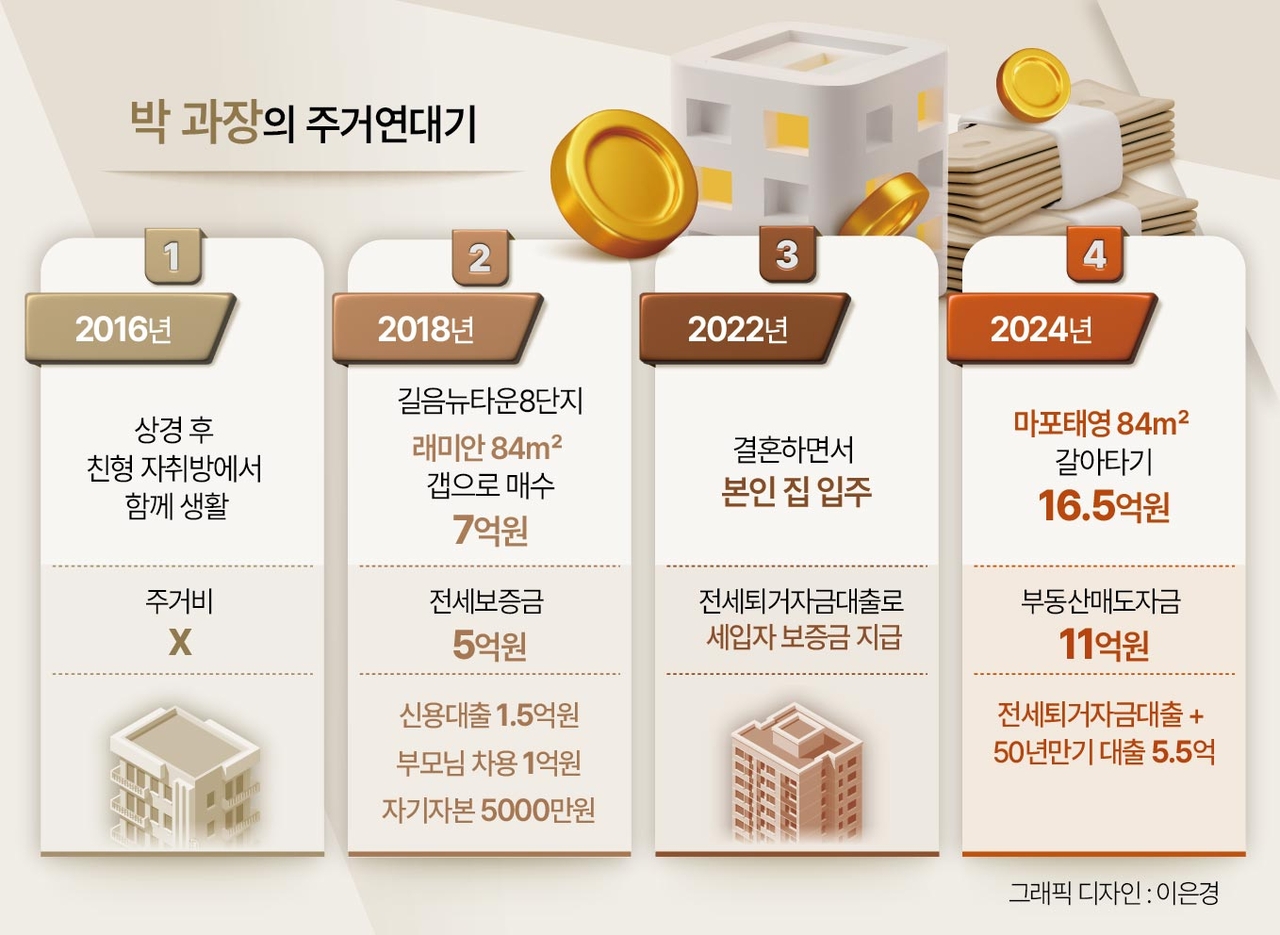
"When I bought it, I was certain it would hit 2 billion won no matter what," Park said. The Mapo Taeyoung apartment he purchased in 2024 for 1.65 billion won climbed into the 1.8 billion won range the following year and has since set a new record high of 2.2 billion won. The asking price now exceeds 2.4 billion won.
"When I lived in Gileum I never noticed how inconvenient the hill was, but once I moved to flat ground it felt like paradise. I'm planning to send my child to Yeomni Elementary School."
Park's next goal is to break into Yongsan, one of Seoul's most coveted addresses. "As my child gets older, there may come a time when we need to move to a better school district," he said, "but the educational environment where we live now is already good enough that I have no anxiety about it." The couple is also planning to have a second child.
Park said anyone can achieve what he did, as long as they seize the right opportunity. "Fortune doesn't abandon anyone," he said. "If anything, a sense of anxiety about housing is what pushes you to buy sooner and keep moving forward."
hss@heraldcorp.com