Factional tensions within the Democratic Party of Korea are escalating over allegations that the Shincheonji Church of Jesus infiltrated the party's Aug. 17 leadership convention, with the dispute now drawing in the party's top leadership as calls mount for an official inquiry.
The pro-Lee Jae Myung camp has urged candidates to stop trading accusations and let the party investigate the matter directly, while the pro-Jung Chung-rae faction — including sitting Supreme Council members and candidates — has pushed back hard, warning that candidate Kim Min-seok must take political responsibility if he cannot back up his claims with concrete evidence.
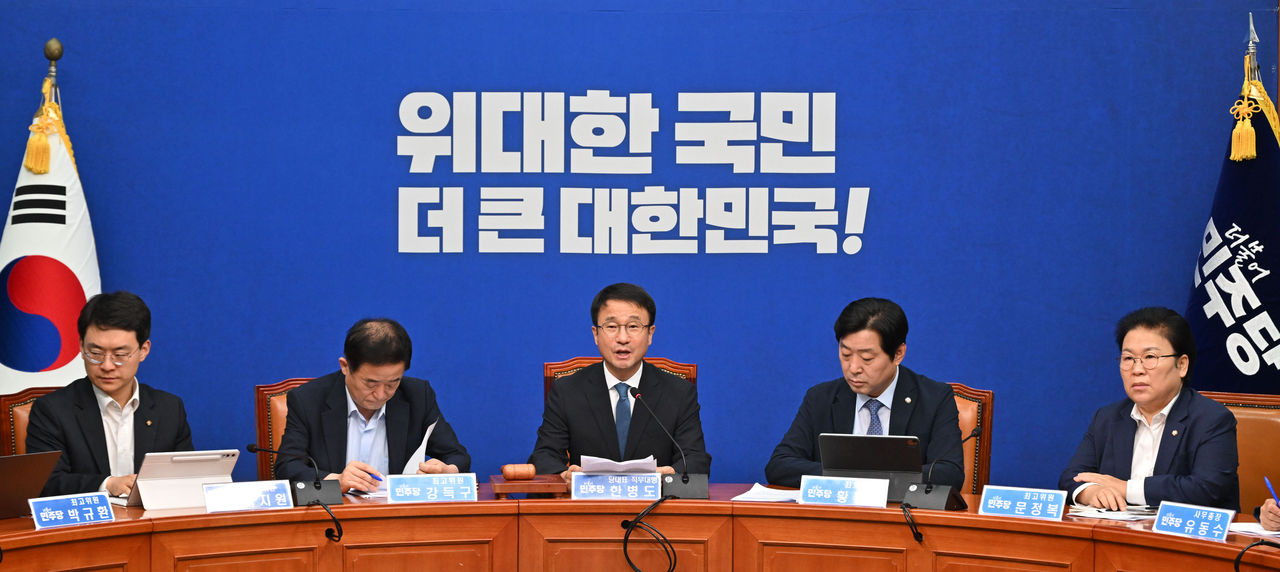
Supreme Council member Kang Deuk-gu, aligned with the pro-Lee camp, told a council meeting at the National Assembly on Friday that "no religious force, no organization, should interfere with the free choices of Democratic Party members," adding that any organized attempt to distort members' will "cannot be tolerated under any circumstances."
Kang also proposed a path forward for the party. "The time for candidates to raise allegations is over," he said. "It is now the party's responsibility to verify the facts and make a judgment. If the allegations are true, strict action must follow; if not, the misunderstanding must be clearly resolved."
Pro-Jung council member Moon Jeong-bok took a sharply different line, announcing that she had filed a police complaint against the person who labeled a Democratic Party women's members' group a Shincheonji front organization. She demanded that Kim "make public whatever evidence exists of Shincheonji involvement."
"If Shincheonji members really did join the party en masse in an organized way, that can only be confirmed through a formal investigation," Moon said, warning that without evidence convincing to the public and party members, "a very dangerous game is being played right now."
Fellow pro-Jung council member Park Gyu-hwan also pressed for proof, saying Kim must explain "when and how Shincheonji followers joined and what they actually did." Park called on the party's National Election Commission to open a probe into the relevant candidates and strip any candidate of eligibility who fails to substantiate their claims.
Three Supreme Council candidates aligned with the pro-Jung faction — Choi Min-hee, Han Min-su and Lee Sung-yoon — held a joint news conference at the National Assembly on Friday, urging Kim to provide specific evidence for his claim of a secret three-way alliance among anti-Lee forces, separatists and Shincheonji.
Han Min-su demanded that Kim "produce evidence of organized Shincheonji membership in our Democratic Party — not the People Power Party" and identify who conspired with Shincheonji to arrange the mass sign-ups.
Lee Sung-yoon said the People Power Party was using Kim's Shincheonji remarks to call for an investigation into the Democratic Party. "If there is no basis for these claims, you should resign and take responsibility for damaging the party's reputation out of blind ambition for the leadership," Lee said.
Meanwhile, the party leadership moved to cool tensions by releasing the results of a full membership audit. Chief spokesperson Kang Jun-hyeon told reporters after the meeting that the party's leadership election requires members to have joined at least six months before the eligibility date and to have paid dues at least six times over the preceding 12 months — a rule known as the "12-6-6" system.
Kang said the party cross-referenced the addresses of about 5 million members against those of religious organizations in its database last December, finding only four matching addresses and no significant results.
He added that voting rights had been restricted for 54,000 members suspected of irregular sign-ups, though he stressed they could not be definitively linked to any specific religion.
"The party can only go as far as comparing addresses," Kang said. "If there are clear tips or evidence, the party can conduct its own investigation or refer the matter to authorities."
sunpine@heraldcorp.com