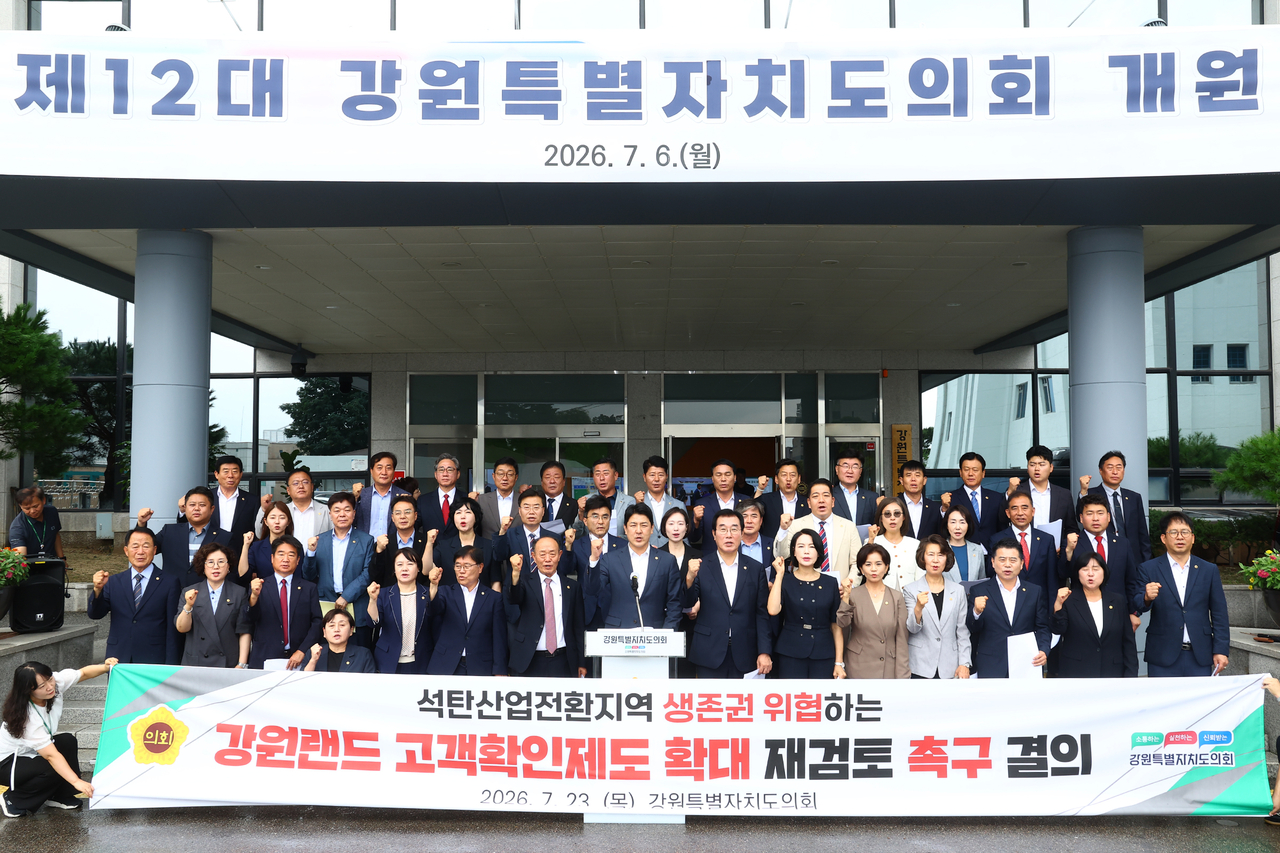
The Gangwon Special Self-Governing Provincial Assembly announced a resolution Thursday in front of the main assembly building, with all assembly members in attendance, calling on the government to fully reconsider its plan to expand the customer due-diligence (CDD) regime at Kangwon Land. Lawmaker Moon Gwan-hyeon of the People Power Party, representing Taebaek District 2, read the resolution on behalf of the assembly and strongly condemned what it called the government's unilateral push to tighten regulations.
Before the resolution was announced, Moon had already raised the issue during a five-minute free-speech session at the fourth plenary session of the 347th extraordinary assembly session held the same day, backing his concerns with specific figures. He said analysis showed that a full expansion of the CDD regime would cut annual casino sales at Kangwon Land by about 332.6 billion won ($226 million) and reduce annual fiscal contributions to the state and the region — including the closed-mine fund — by about 175.4 billion won. He urged the provincial government to work with the four affected cities and counties of Taebaek, Jeongseon, Yeongwol and Samcheok, as well as Kangwon Land itself, to conduct an objective impact assessment and proactively draw up fiscal and policy support measures.
In the resolution, the assembly said Kangwon Land was established under the Abandoned Mine Area Support Act as a key economic hub to revive communities in coal-industry transition zones that had underpinned South Korea's industrialization. Despite the anti-money-laundering rationale behind the CDD policy, the assembly said a full expansion of the regime would reduce visitor numbers, shrink the closed-mine fund and deal a serious blow to the regional economy as a whole.
The assembly particularly focused on what it described as contradictions and imbalances in government policy. It said the government should be giving full support to Kangwon Land's innovation drive — including its K-HIT Project aimed at strengthening global competitiveness — rather than holding it back with expanded regulations. The assembly also said it was irresponsible for the government to simultaneously undermine Kangwon Land's standing while discussing the introduction of a second domestic casino at sites such as Saemangeum, calling it a betrayal of the state's obligations to coal-industry transition zones.
Moon said residents of Taebaek and other coal-industry transition zones were deeply worried about the tightened regulations, given how directly their local economies were tied to Kangwon Land. "The government must reconsider its unilateral push to enforce these regulations and faithfully uphold the consistency of the support policies the state has promised," he said.
The resolution called on the Ministry of Trade, Industry and Energy to actively convey the region's position to relevant ministries, demanded government support for Kangwon Land's future projects including the K-HIT Project, urged a halt to plans for a second domestic casino at Saemangeum and elsewhere, and pressed for the establishment of effective economic compensation measures for the region.
The assembly plans to deliver the resolution to the Ministry of Trade, Industry and Energy — the ministry responsible for the Special Act on Support for Development of Coal-Industry Transition Zones — to convey the gravity of the situation facing those communities and press strongly for forward-looking countermeasures.
abc@heraldcorp.com