![[123RF]](https://wimg.heraldcorp.com/news/cms/2026/07/23/news-p.v1.20260723.32b6339c27af4e01a12af3ee17098212_P1.jpg)
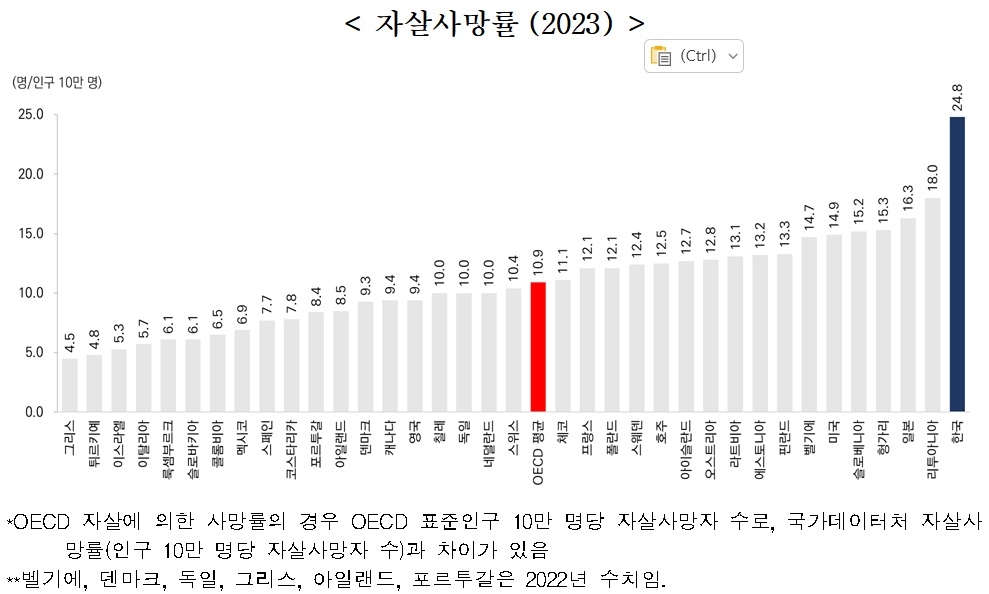
South Korea's life expectancy stands at 83.7 years, placing the country among the top tier of OECD members, yet its suicide rate remains the highest in the organization.
The country recorded the most outpatient visits per person among OECD nations and posted a preventable mortality rate well below the OECD average, but the number of practicing physicians remains near the bottom — a mixed picture for its health indicators overall.
The Ministry of Health and Welfare on Thursday released its analysis of key indicators from the OECD Health Statistics 2026.
Life expectancy for a child born in 2024 is 83.7 years, 2.5 years longer than the OECD average of 81.2 years. Life expectancy refers to the number of years a newborn in a given year is expected to live.
Only Sweden (83.8 years), Spain (84.0 years), Japan (84.1 years) and Switzerland (84.2 years) recorded longer life expectancies than South Korea.
The preventable mortality rate — deaths that could be avoided through disease prevention and appropriate treatment — stood at 139.0 per 100,000 people, well below the OECD average of 208.8.
South Korea's preventable mortality rate has fallen steadily over the past decade, from 194.0 per 100,000 in 2013 to 154.0 in 2018 and 139.0 in 2023.
South Korea still ranks first among OECD countries in suicide rate.
The suicide mortality rate in 2023 was 24.8 per 100,000 people, the highest among OECD members. The OECD average was 10.9.
If you're thinking about self-harm or suicide, contact the Ministry of Health and Welfare's helpline 1393, available 24/7. Please request a translator for English-language services.
South Koreans visited outpatient clinics an average of 17.9 times per year, the most among OECD countries and roughly 2.7 times the OECD average of 6.6 visits.
Current health expenditure accounted for 8.5 percent of GDP, slightly below the OECD average of 9.3 percent. Current health expenditure refers to the total annual spending by the entire population on healthcare services and goods.
Per capita current health expenditure has grown at an average annual rate of 8.5 percent over the past decade, driven in part by aging, outpacing the OECD average growth rate of 6.1 percent. In 2024, it stood at approximately $5,098 based on purchasing power parity.
The number of physicians per 1,000 people remains low.
South Korea had 2.6 practicing physicians (including traditional Korean medicine doctors) per 1,000 people, below the OECD average of 4.0 and the second lowest among OECD members after Costa Rica.
Total nursing personnel — including registered nurses and nursing assistants — numbered 9.8 per 1,000 people, slightly above the OECD average of 9.7. Registered nurses alone accounted for 5.5 per 1,000, below the OECD average of 8.8.
The smoking rate among those aged 15 and older was 13.2 percent, close to the OECD average of 12.7 percent, while annual alcohol consumption per capita stood at 7.6 liters, below the OECD average of 8.3 liters.
The proportion of people aged 15 and older who were overweight or obese was 37.3 percent, the second lowest among OECD countries after Japan at 25.3 percent, and well below the OECD average of 58.7 percent.
However, the overweight and obesity rate has been rising gradually, from 30.8 percent in 2014 to 33.7 percent in 2019 and 37.3 percent in 2024.
thlee@heraldcorp.com