
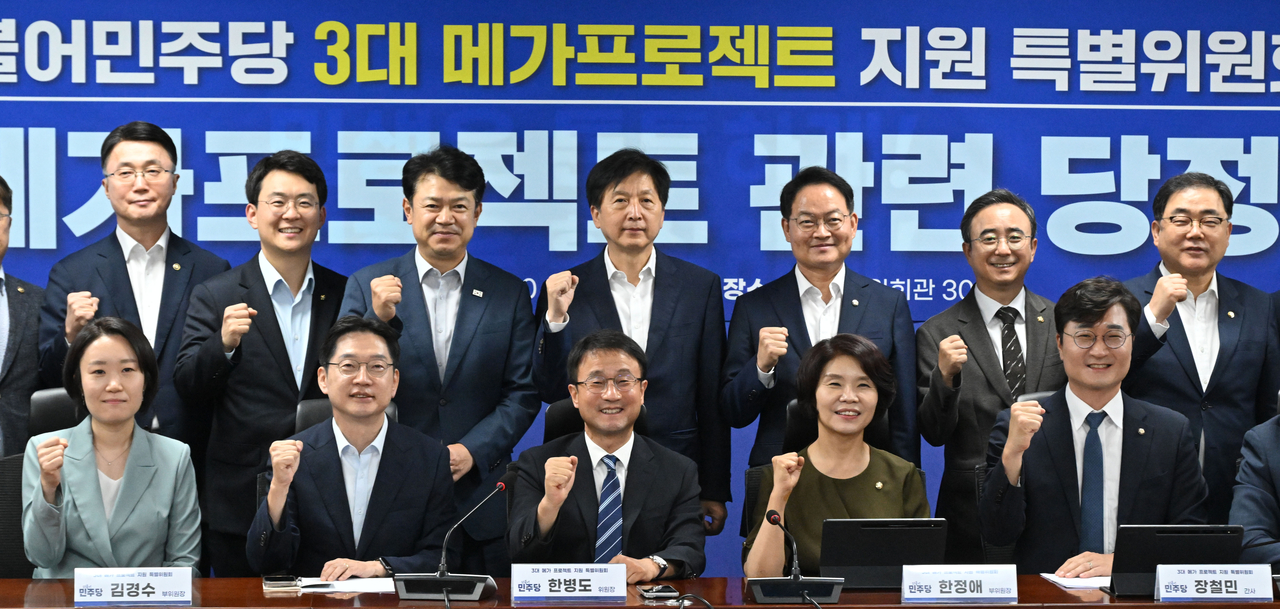
The Democratic Party of Korea said Wednesday it would move swiftly to pass special legislation and secure budget support for the country's three mega-projects.
Han Byung-do, the party's acting leader and floor leader, told a ruling party-government consultation at the National Assembly that the three mega-projects are "a national task to secure South Korea's breakthrough growth engine and open a new chapter in balanced regional development," adding that "the fate of these projects depends solely on speed."
Han pledged that the party would "handle everything without exception — from related legislation including a special law on mega special zones to the budget needed to build the necessary infrastructure," and vowed to "complete South Korea's new growth engine through bold innovation, decisive action and firm cooperation between the party and the government."
Han added that the party would "closely review each ministry's detailed implementation plans and seek ways to strengthen party-government cooperation in order to dramatically boost the projects' execution capacity." The meeting was also attended by officials from the Ministry of Land, Infrastructure and Transport, the Ministry of Science and ICT, the Ministry of Climate, Environment and Energy, and the Ministry of Trade, Industry and Energy.
Kim Kyung-soo, vice chair of the special committee, said regional-led growth "is the path South Korea's government must take — one it cannot afford to skip," adding that "particularly in the AI era, South Korea is heading toward a time when national growth is impossible without regional-led development."
Kim added that regions outside the greater Seoul metropolitan area now hold far greater competitiveness in AI infrastructure such as power and water supply, calling the three mega-projects "the catalyst and the key to making regional-led growth succeed."
Rep. Jang Cheol-min, the committee's secretary, urged the People Power Party to join the effort, saying the projects "must truly become a bipartisan, nationwide undertaking." He called on the PPP not to "neglect its duties out of resentment" but instead to "take part in productive, forward-looking discussions on building a new future, institutional frameworks and support mechanisms as the projects move forward."
addressh@heraldcorp.com



