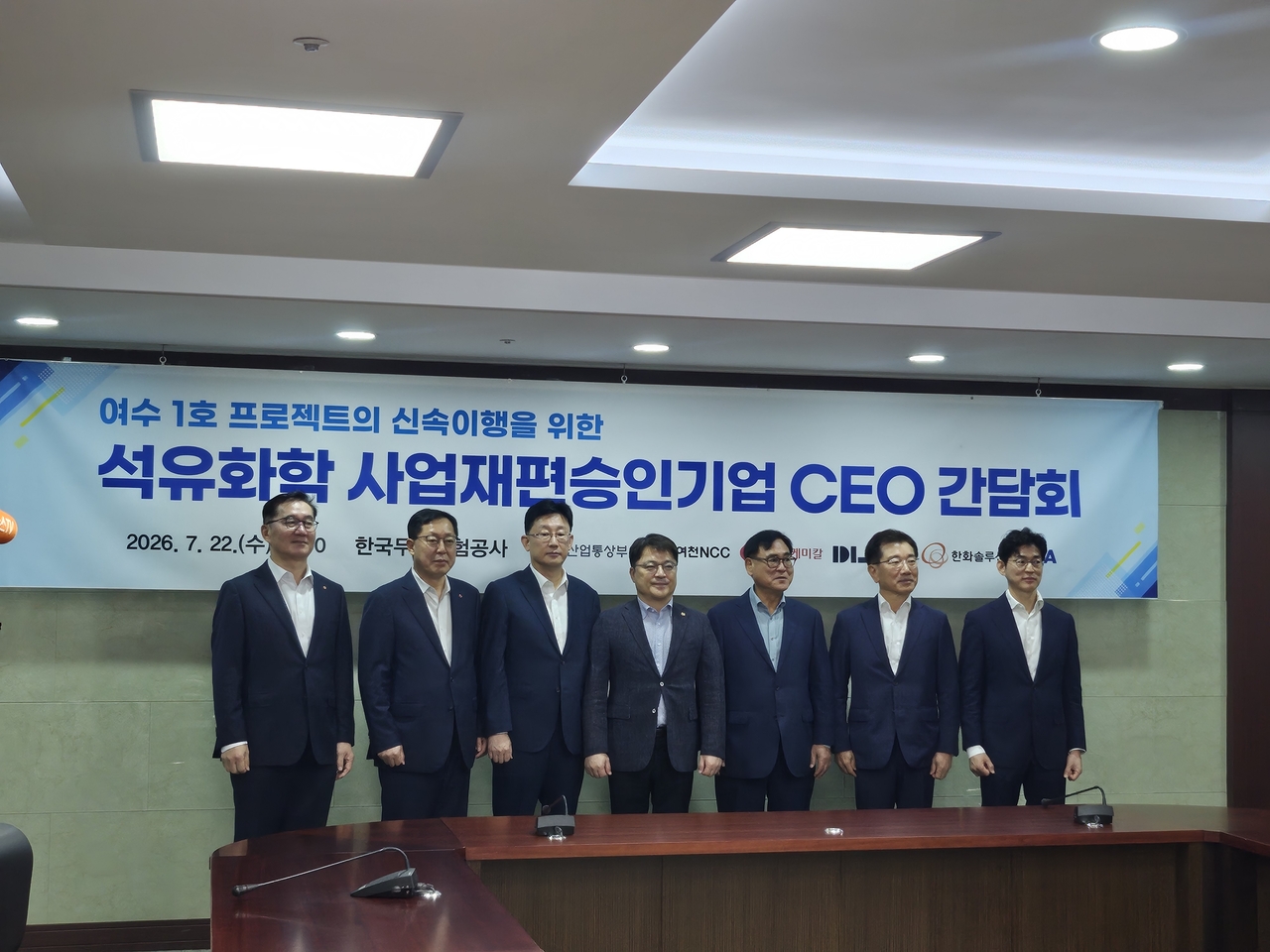
Companies in the Yeosu industrial complex that received final government approval for their petrochemical restructuring plans said Wednesday they would move swiftly to implement the next steps. The government reaffirmed its commitment to completing the broader industry overhaul, extending to the remaining Yeosu firms and the Ulsan complex.
Kim Jong-hyun, chief executive of DL Chemical, told reporters at a Ministry of Trade, Industry and Energy meeting Wednesday morning at the Korea Trade Insurance Corporation in Jongno-gu, Seoul, that the companies would "make the restructuring succeed without fail, in line with government policy."
Nam Jeong-un, chief executive of Hanwha Solutions, said the ongoing Middle East conflict would not have a direct impact on the companies, but added that it made restructuring "all the more urgent."
The meeting was held immediately after the ministry approved what has been dubbed the Yeosu No. 1 project — a restructuring plan submitted by Yeocheon NCC, Lotte Chemical, Hanwha Solutions and DL Chemical. Under the plan, Yeocheon NCC will shut down its No. 2 plant in addition to the No. 3 plant, which has already ceased operation, and merge the remaining No. 1 plant with Lotte Chemical's Yeosu factory to form a combined entity. The government will provide 450 billion won ($305 million) in new financing and 200 billion won in import insurance to support the companies' facility integration and transition to higher-value products.
The ministry reaffirmed its intention to extend the restructuring to the Yeosu No. 2 cluster — involving LG Chem and GS Caltex — and the Ulsan complex, which includes S-Oil, SK Geo Centric and Korea Petro Chemical IND. Those companies submitted preliminary restructuring plans to the government earlier this year but have yet to finalize detailed implementation plans.
The Ulsan cluster has been particularly contentious. S-Oil has maintained that its Shaheen Project, a state-of-the-art facility nearing the start of operations, should not be subject to restructuring — a position that has drawn pushback from other companies. Deputy Minister Moon Sin-hak said Wednesday that "all companies with naphtha cracking facilities must contribute to the restructuring in some form."
On the timeline, Moon said the Middle East conflict had caused delays but expressed confidence the process would proceed smoothly, noting that the government and industry had continued consultations throughout.
In his opening remarks, Moon also stressed that a successful restructuring of the petrochemical industry required the participation of every industrial complex, with no free-riders. "We will take responsibility and see through every project — from Daesan and Yeosu to Ulsan — without disruption, so that the petrochemical industry, a pillar of the national economy, can regain its competitiveness and take off again," he said.
klee@heraldcorp.com