ICE vehicles under 30 million won account for 36.4% of sales
Weak demand pushes combustion cars toward low-price gap in EV lineup
Hybrids and EVs claim half of 40 million won segment
Tesla drives growth — 'EVs entering mainstream phase'
![Tesla vehicles charge at a shopping mall in Seoul on Saturday. [Newsis]](https://wimg.heraldcorp.com/news/cms/2026/07/21/news-p.v1.20260721.baa269d1b11d4d7982191583fa909326_P1.jpg)
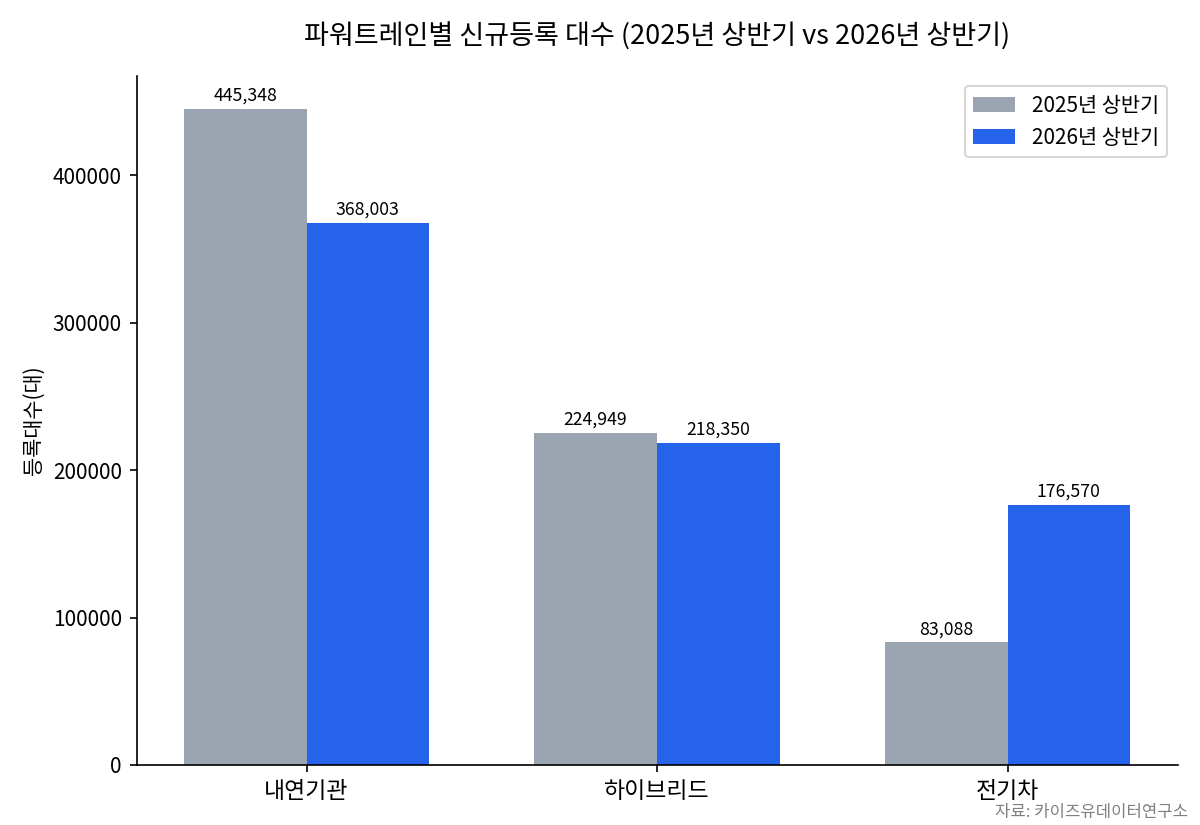
The domestic auto market is splitting sharply along price lines, with internal combustion engine vehicles retreating into the budget segment while electric vehicles consolidate demand in the 40 million to 50 million won range. ICE cars have grown more dependent on the sub-30 million won ($20,200) market even as overall sales decline, while EV demand has concentrated in the 40 million to 50 million won bracket.
New registrations of ICE vehicles in the first half of this year totaled 368,003 units, down 17.4 percent from the same period last year, according to data released Tuesday by the Carisyou Data Research Institute. Hybrid registrations also fell 2.9 percent to 218,350 units. EVs, by contrast, jumped 112.5 percent to 176,570 units, largely offsetting the decline in combustion-engine sales.
Sub-30 million won share rises; above 40 million won falls to single digits
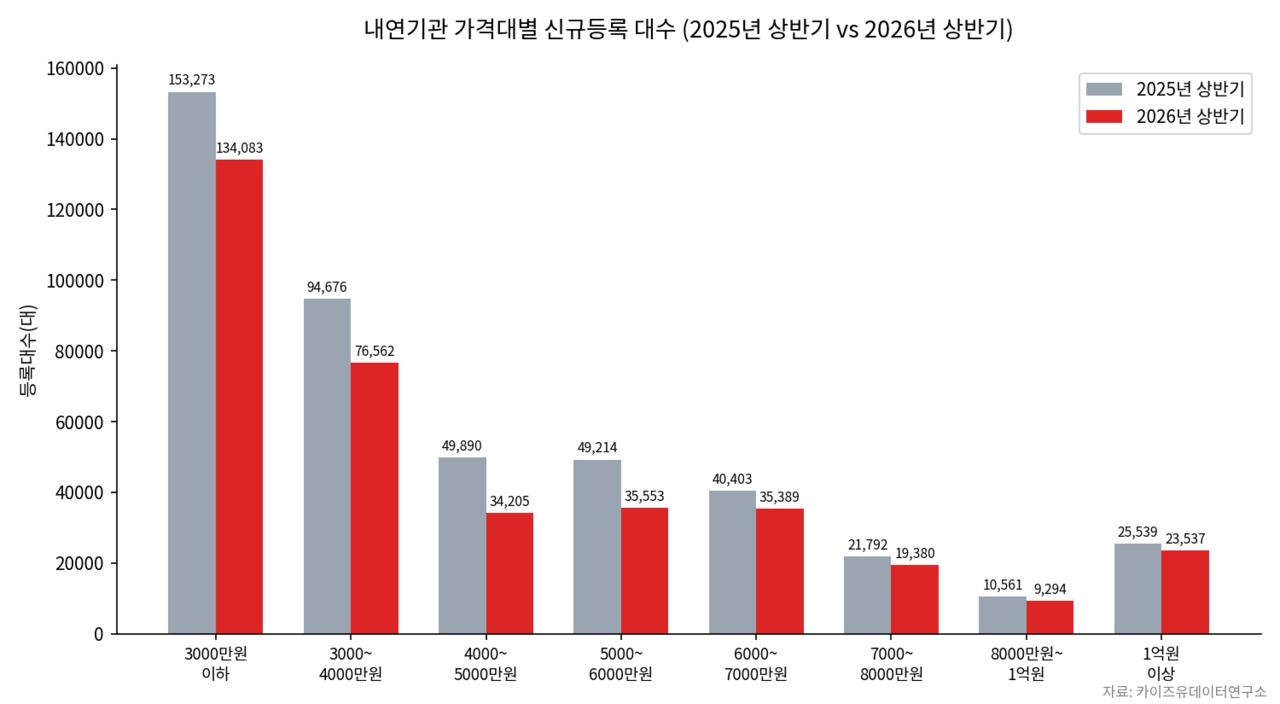
A breakdown by price band reveals a stark divergence between powertrains. ICE vehicles have grown increasingly concentrated in the low-price segment: 134,083 units priced below 30 million won were registered in the first half of this year, accounting for 36.4 percent of all ICE sales — up 2.0 percentage points from last year and the largest single price band. The 30 million to 40 million won range ranked second, with 76,562 units, or 20.8 percent of the total.
Above 40 million won, ICE market share fell to single digits. Last year, the 40 million to 50 million won and 50 million to 60 million won bands each accounted for roughly 11 percent of ICE sales; both have since contracted.
Analysts attribute the trend to a shortage of affordable EVs, which has left the sub-30 million won segment largely to ICE vehicles. The only EVs currently sold in Korea below 30 million won are Kia's Casper Electric, the Ray EV and BYD's Dolphin. ICE buyers in that range, by contrast, can choose from a wide selection — Hyundai Motor's compact and mid-size sedans such as the Avante and Sonata, and SUVs including the Kona and Tucson, as well as Kia models such as the K5, Seltos, Niro and Sportage.
EV surge drives 23% growth in 40–50 million won segment; 100 million won-plus EVs also expand
Hybrids and EVs both sell most heavily in the 40 million to 50 million won range. Hybrids recorded 100,041 units in that band, representing 45.8 percent of all hybrid sales. Volume was roughly flat compared with last year, but the segment remained the core price point for hybrid buyers.
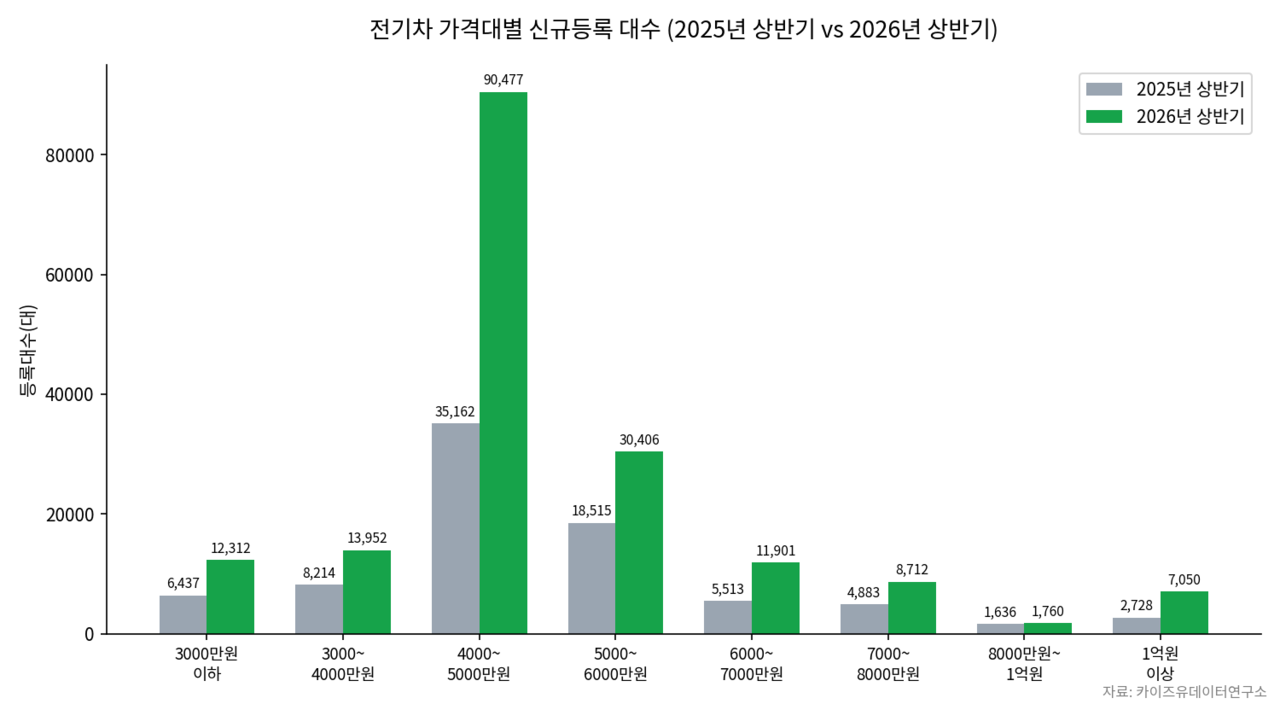
EV growth in the same band was explosive. Sales of EVs priced between 40 million and 50 million won reached 90,477 units in the first half of this year — 51.2 percent of all EV sales — more than doubling from 35,162 units in the same period last year. In effect, the vast majority of the year-on-year increase in EV sales came from this single price bracket.
That surge made the 40 million to 50 million won band the fastest-growing segment across all powertrains combined. First-half sales in that range totaled 224,723 units, the only price bracket to post double-digit growth — a 23 percent increase — across the entire market.
Tesla is believed to have led the surge. According to the Korea Automobile Importers & Distributors Association (KAIDA), Tesla sold 34,798 vehicles in the 40 million to 50 million won range alone in the first half of this year, with the Model 3 RWD and Model Y Premium RWD posting strong numbers. Hyundai Motor's Kona Electric and Ioniq 5, along with select models from Kia's EV lineup, also sit in that price band, broadening the choices available to consumers.
Meanwhile, EVs are also gaining ground at the premium end. The share of EVs priced at 100 million won or more rose from 3.3 percent last year to 4.0 percent this year, with unit sales jumping from 2,728 to 7,050. Demand is growing at both ends of the market simultaneously — entry-level models are selling in far greater numbers while high-end buyers continue to show consistent interest — pointing to a broad expansion of the EV market overall.
"The rapid growth of the EV market is largely offsetting the decline in ICE vehicles," the Carisyou Data Research Institute said. "In particular, the launch of multiple EV models in the 40 million won range, combined with subsidies, is quickly concentrating demand in that price band." The institute added that the concentration of EV sales in the high-volume 40 million to 50 million won segment "signals that the market has moved beyond its early adopter phase and is entering a full-scale mainstream stage."
eyre@heraldcorp.com