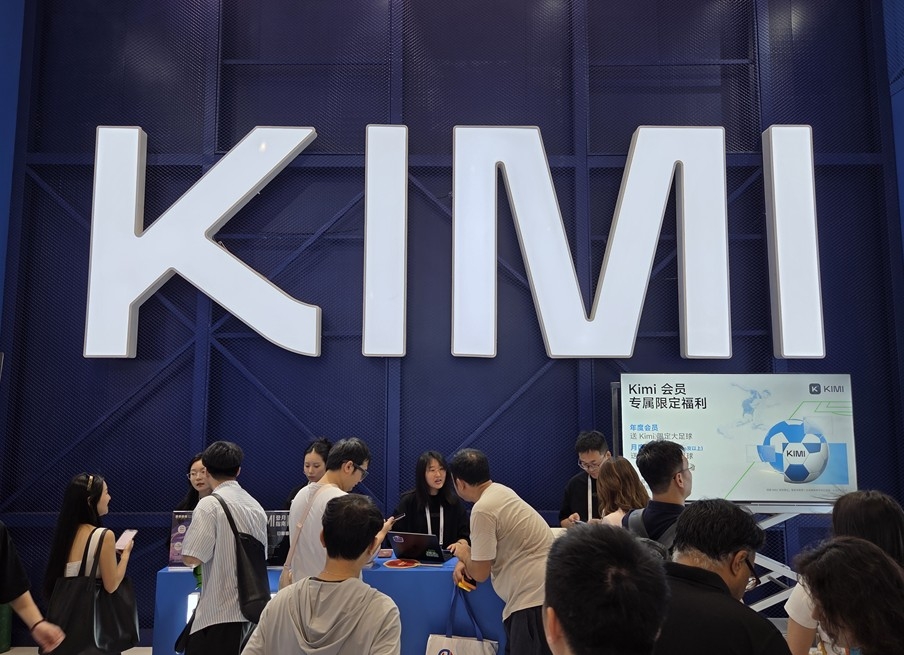
Shares of AI chipmakers have weakened since Chinese AI startup Moonshot AI unveiled its massive open-weight model Kimi K3, but analysts say the market is misreading what the model actually means for the industry. While Kimi K3 improves computing efficiency, it requires dramatically more memory to run — a development seen as positive for demand for HBM and other memory chips.
Bloomberg reported Monday (local time) that although semiconductor stocks have fallen since Kimi K3's release in a pattern resembling the selloff that followed DeepSeek R1's debut earlier this year, the situation this time is fundamentally different.
DeepSeek had raised fears that dramatically lower AI training and inference costs could reduce demand for AI infrastructure investment. Nvidia's market capitalization shed roughly $600 billion in a single day at the time.
Kimi K3, by contrast, achieves its efficiency gains at the cost of significantly higher memory consumption — the key distinction analysts are highlighting.
Kimi K3 is China's largest AI model, with 2.8 trillion parameters. Its sparsity ratio is at a record high, meaning fewer parameters are active during any given computation — but all 2.8 trillion parameters must still be stored in memory.
Even when compressed into a low-precision data format, the model requires approximately 1.4 terabytes of memory. Bloomberg said running it directly would require an AI rack on the scale of Nvidia's next-generation AI system, the Blackwell GB300.
"With 2.8 trillion parameters and a one-million-token context window, Kimi K3 demands far more memory capacity than previous generations," Bloomberg said, adding that this "suggests sustained demand in the memory market, which is dominated by a handful of players including SK Hynix and Samsung Electronics."
Stanley Tang, chief portfolio manager at Sumitomo Mitsui DS Asset Management, also said memory chipmakers are positioned to maintain the most favorable standing in the semiconductor industry.
"With a limited number of suppliers, memory companies will remain competitive," Tang said. "If models like Kimi spread widely, AI agent adoption will accelerate, making it highly unlikely that overall semiconductor demand will shrink."
Moonshot AI plans to release the model weights for Kimi K3 on July 27.
sjy@heraldcorp.com