"Is this really free? Can I just take it?"
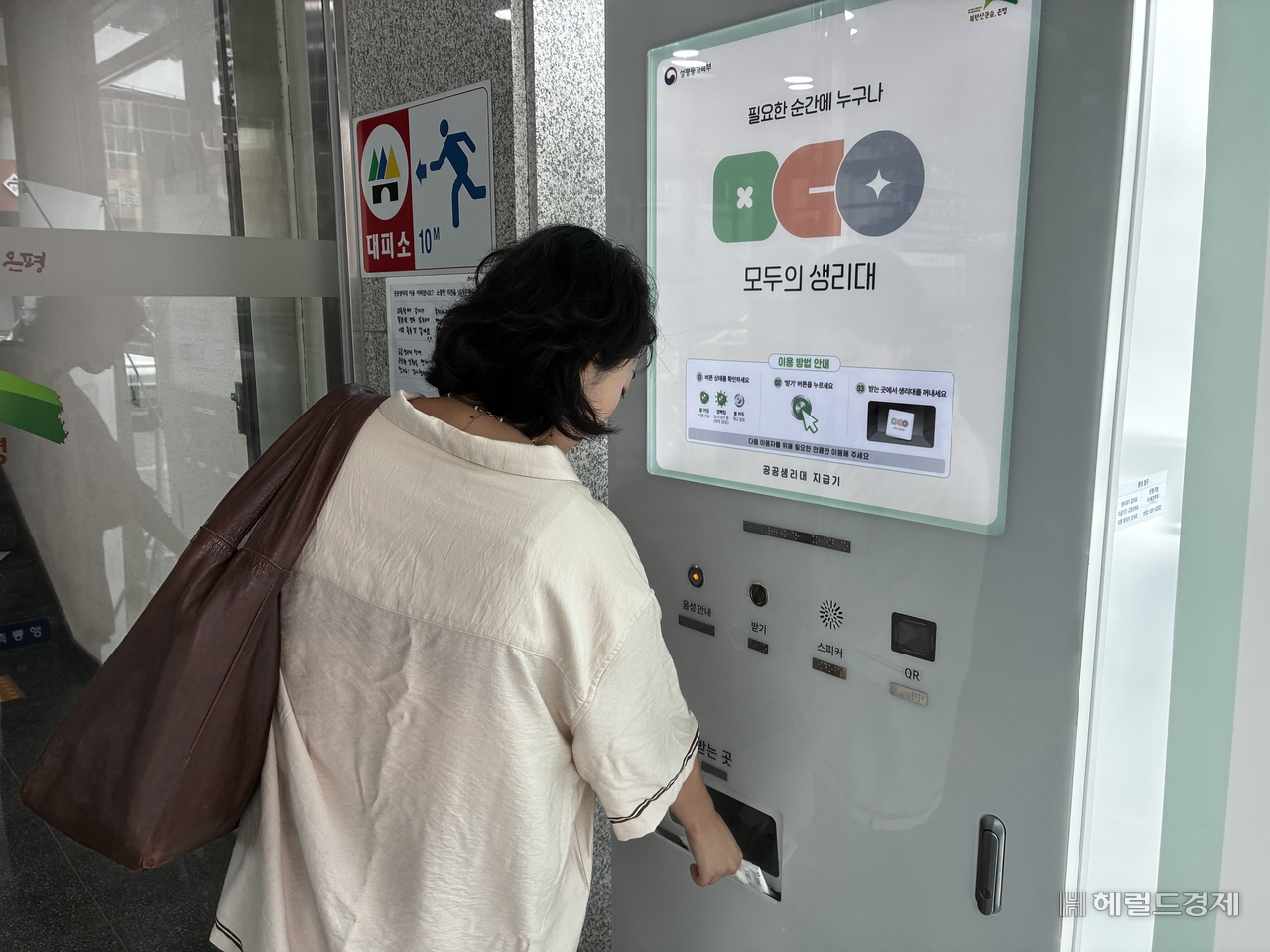
That was the question Kim Min-jeong, 30, a resident of Eunpyeong-gu, asked cautiously Monday afternoon as she stood before a "Pads for All" automatic dispenser installed at the Eunpyeong District Office in Seoul.
She pressed the coin-sized "Receive" button, and a pack containing two sanitary pads dropped into the collection tray. No identity verification or authentication was required.
The government is expanding a pilot program that provides free public sanitary pads to anyone, regardless of age or income. Following the earlier rollout of 300 manual dispensers, automatic dispensers began operating Tuesday. The government aims to install 400 automatic units at public facilities — including community centers, libraries and youth facilities — across 12 pilot regions nationwide by September.
The automatic dispenser at the Eunpyeong District Office was roughly the size of a large refrigerator. Its front panel featured a screen, a voice-guidance button, a receive button, a speaker and a QR code reader.
When the receive button was pressed, a packaged product bearing the labels "Public Sanitary Pad" and "Pads for All" dropped into the tray.
Pressing the button again 10 seconds after receiving a pack triggered a recorded message: "This dispenser cannot be used for 30 seconds." The 30-second interval is designed to prevent a single person from taking multiple packs in quick succession.
The 12 pilot regions are: Gwangjin-gu and Eunpyeong-gu in Seoul; Gwangmyeong and Suwon in Gyeonggi Province; Seocheon-gun in South Chungcheong Province; Jung-gu in Daejeon; Jeongeup in North Jeolla Province; Mokpo in South Jeolla Province; Buk-gu in Gwangju; Gumi in North Gyeongsang Province; Geochang-gun in South Gyeongsang Province; and Jeju.
Kim said she had often bought two-pack sanitary pads at convenience stores in a pinch, finding the roughly 4,000 won price tag a burden each time. "Trying it today, it's convenient," she said. "If there were more dispensers within my daily routine, I think I'd use them often."
An official at the Eunpyeong District Office said operating the manual dispensers had shown that many residents hesitated to use them because they were unsure whether they could really take the pads for free. "No cases of misuse or abuse have been confirmed so far," the official said.
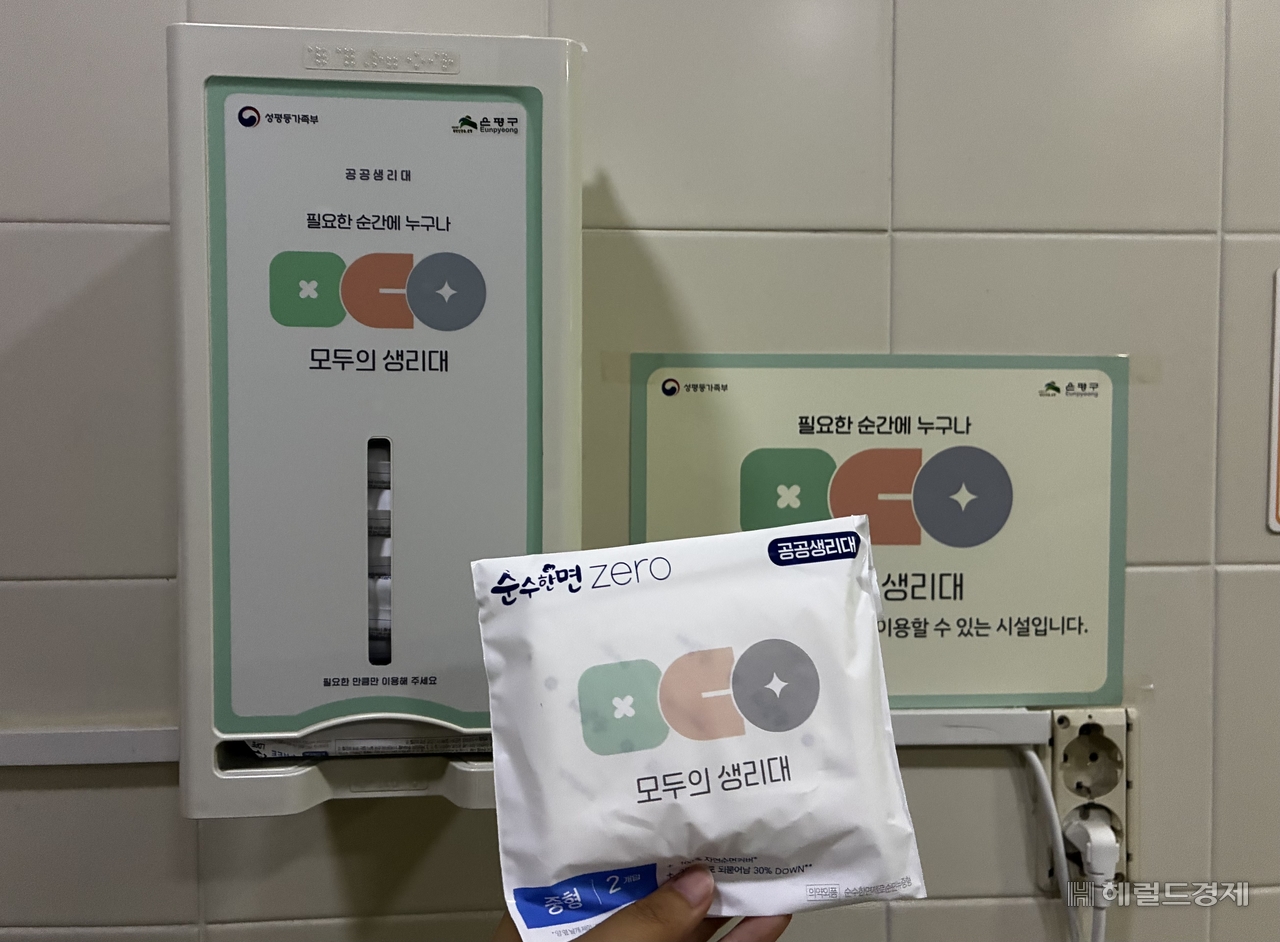
The products distributed as public sanitary pads are all based on commercially available pads and have been formulated without colorants or fragrances in compliance with Ministry of Food and Drug Safety standards.
The automatic dispensers are equipped with Internet of Things technology for real-time inventory management, and include voice guidance and Braille features to ensure accessibility for the visually impaired.
The Ministry of Gender Equality and Family plans to launch a dedicated webpage in October where users can check dispenser locations and current stock levels.
If serious misuse emerges during the pilot, the ministry is also considering a QR code-based system that would verify a user's age group and region before dispensing.
The ministry has also taken steps to prevent resale of the public pads. It worked with secondhand trading platforms to register the pads as prohibited items.
Awareness of the free public dispensers remains limited. During a two-hour observation at the site Tuesday afternoon, only one person used the dispenser to collect pads.
A ministry official said the government would review usage volumes and patterns during the pilot period to refine the program, and would ramp up promotion once the webpage is live. "Our goal is to create an environment where anyone who needs one can take a pad without hesitation — the same way people use toilet paper in a restroom," the official said.
kido@heraldcorp.com
snsd@heraldcorp.com