
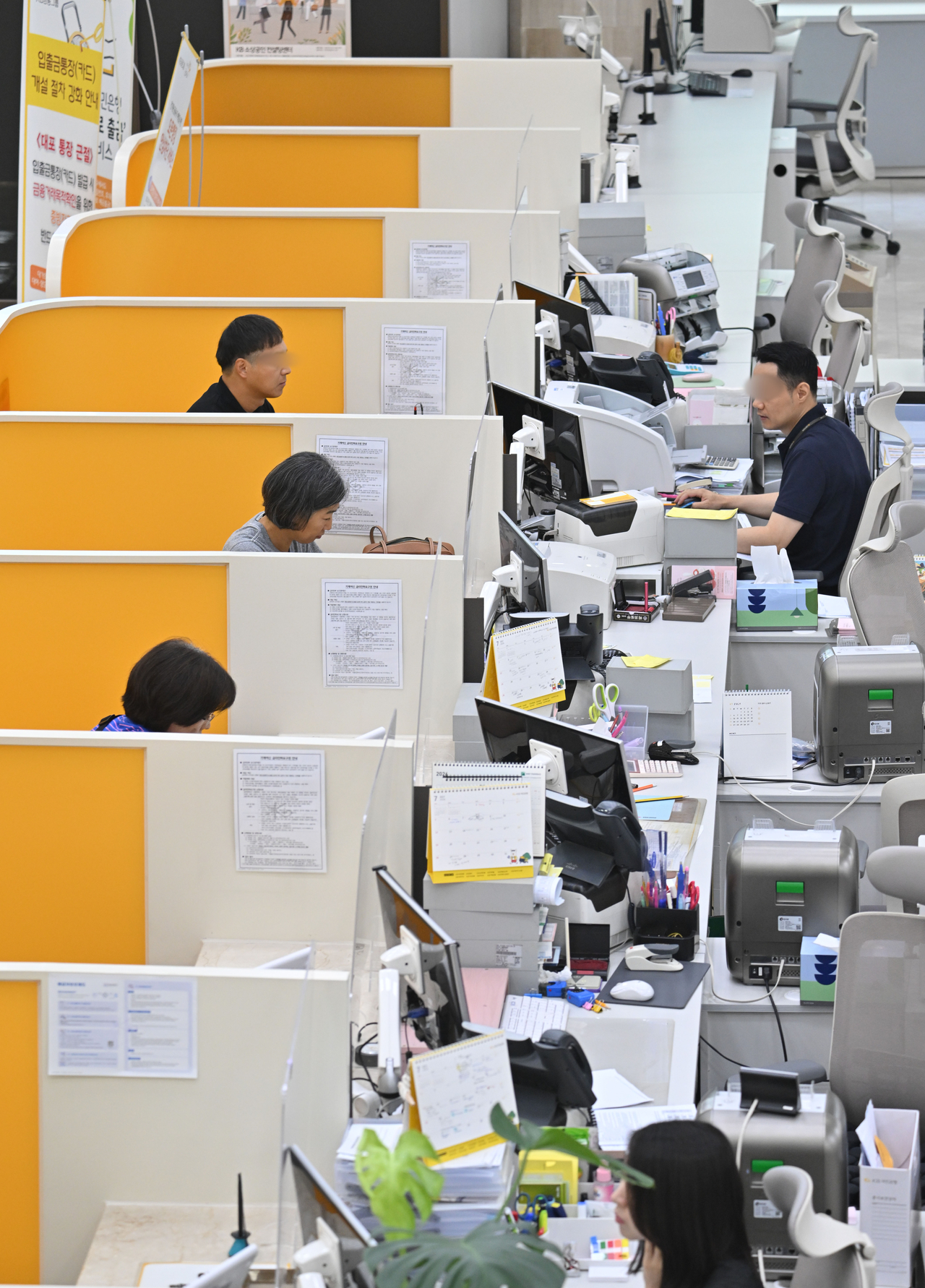
Banks are expected to raise the bar further on household lending in the third quarter as they maintain their household debt management stance. Demand for housing-related loans is also forecast to decline amid tightening regulations.
According to the Bank of Korea's lending behavior survey released Monday, the composite lending attitude index for banks stood at -7 in the third quarter of this year — a wider negative reading than the -1 recorded in the first quarter and the -2 in the second quarter.
In the index, a negative reading indicates tighter lending standards, lower credit risk or weaker loan demand compared with the previous quarter, while a positive reading signals the opposite.
Breaking down the figures by borrower type, the index for household housing loans came in at -14 and that for general household loans — including unsecured credit loans — at -11, both pointing to a tightening bias.
"Household lending standards are expected to tighten for both housing-related loans and general loans as banks continue their household debt management stance," the Bank of Korea said.
Lending attitudes toward large corporations and small and medium-sized enterprises were both projected to hold steady at 0, unchanged from the previous quarter.
The composite loan demand index for the third quarter came in at 17, down from 24 in the second quarter. Among household borrowers, demand for general loans is expected to rise — with an index of 14 — driven by living expenses and stock market investment. Demand for housing-related loans is forecast to fall, with an index of -6, as regulations tighten and interest rates rise.
Corporate loan demand is expected to increase for both large companies, with an index of 6, and small and medium-sized enterprises, at 25, driven by liquidity needs amid domestic and external uncertainty as well as rising corporate bond yields.
The composite credit risk index that banks projected for the third quarter came in at 22, down from 29 in the second quarter.
Credit risk for small and medium-sized enterprises, at 25, is expected to rise more sharply than for large corporations, at 8, as prolonged conflict in the Middle East sustains uncertainty over business conditions. For households, the index stood at 19, reflecting concerns over the weakening debt-repayment capacity of vulnerable borrowers.
Non-bank financial institutions, including savings banks, are broadly expected to maintain tighter lending standards while credit risk remains elevated.
The survey was conducted from June 4 to June 17 among 203 chief credit officers at financial institutions, using electronic questionnaires, mail and interviews.
kimstar@heraldcorp.com




