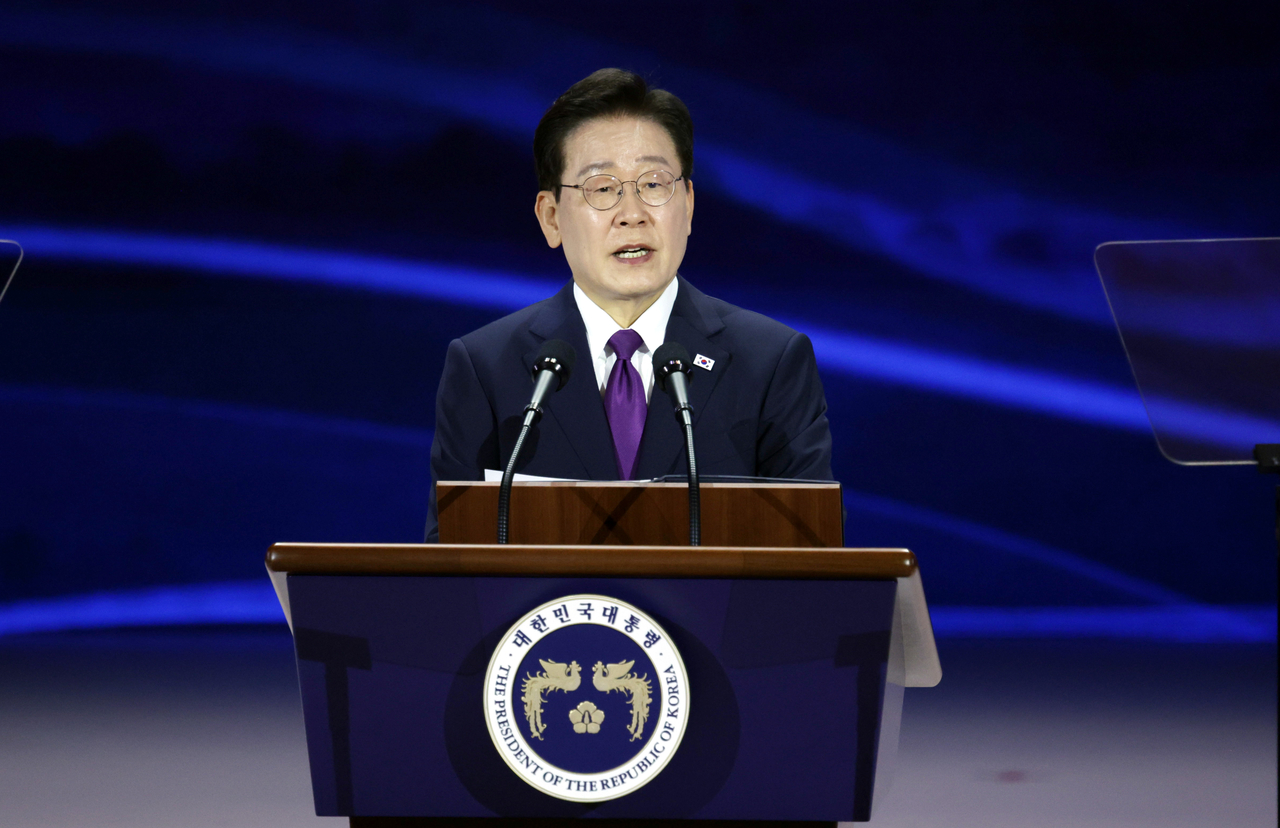
President Lee Jae Myung has drawn intense political attention after voicing opposition to a steep hike in candidate deposits for the ruling Democratic Party of Korea's upcoming national convention. With less than a month to go before the convention, a string of related messages from Lee has sparked debate within the party.
A Cheong Wa Dae official said Monday that Lee's post on X, formerly Twitter, regarding youth candidate deposits represented "a principled view on the purpose of publicly funded elections and youth participation in politics."
The explanation appeared aimed at containing the controversy after criticism of Lee emerged not only from the People Power Party and other opposition parties but also from within the Democratic Party's own support base.
In a post on X on Sunday, Lee said, "Being unable to run for office because of money creates incentives for corruption," and proposed that the party "consider reverting deposits to their previous levels, if possible, given that the burden falls more heavily on non-incumbent and especially young candidates than on sitting lawmakers."
The Democratic Party had earlier decided to set candidate deposits for its Aug. 17 convention at 100 million won ($67,400) for the party leader position and 50 million won for supreme council member positions — 2.5 times and 3.3 times higher, respectively, than the 40 million won and 15 million won charged at last year's August convention. The party offered a 50 percent discount for non-incumbent politicians aged 39 or under, but even the discounted amount remains higher than last year's full deposit.
Some online users criticized Lee for interfering in party affairs, and Lee directly shared and rebutted a post by one of them. A user going by the name "Pulip-i" suggested Lee seemed to be "confused about whether you are the president or the Democratic Party leader," and invoked former presidents Park Geun-hye and Roh Moo-hyun, both of whom faced controversy over alleged interference in party matters.
Lee said he "gratefully accepts the opinion and the rebuke," but pushed back, arguing that "the president is recognized, under law and the Democratic Party's constitution and rules, as having the right to participate as a party member in ordinary party activities that are not election-related. Expressing a view on a sudden and excessive hike in youth candidate deposits cannot constitute interference in party affairs."
Responding to criticism from the PPP and other opposition parties, Lee said, "A political party must be able to distinguish between internal party elections and public office elections. Failing to do so is as serious a problem as being unable to tell public governance from a private business — and with that level of competence, it would be hard to handle state affairs."
Lee has issued a series of convention-related messages in recent weeks. On June 13, he said the ruling party "should focus more on the language of responsibility than the language of conviction," a remark widely interpreted as a jab at former Democratic Party leader Jung Chung-rae. On June 28, he reshared a post by Democratic Party policy committee vice chairman Jeong Min-cheol, who had clashed with author Yu Si-min over criticism of Lee, fueling speculation that Lee was backing Jeong's bid for a supreme council seat. Two days later, on June 30, Lee praised former Prime Minister Kim Min-seok — who stepped down to run for party leader — saying he had "played the biggest role in the government's achievements."
Then on Wednesday, in connection with a guilty verdict against former Democratic Research Institute vice president Kim Yong on illegal political funds charges, Lee called the indictment "a bizarre conclusion." Kim is running for a supreme council seat at the convention.
The controversy surrounding Lee's convention-related messages is expected to continue for now. Political commentator Lee Jong-hun said the president's conduct was "difficult to characterize as outright active interference in party affairs, but it appears to be part of an effort to bring about a pro-Lee leadership," adding that internal party tensions would "keep intensifying until the convention is over."
moone@heraldcorp.com