
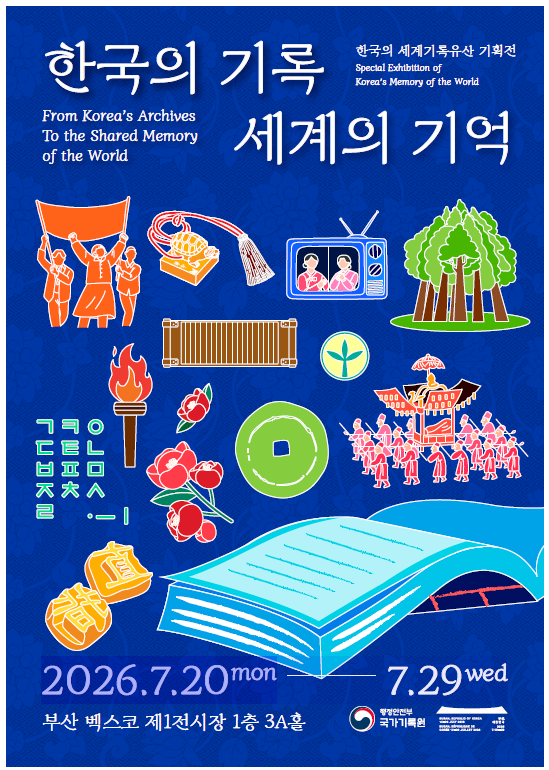
The National Archives of Korea, under the Ministry of Interior and Safety, said it will hold a special exhibition titled "Korea's Records, the World's Memory," bringing together all 20 of Korea's UNESCO Memory of the World inscriptions to mark the 48th Session of the UNESCO World Heritage Committee, being held in Korea for the first time.
The exhibition runs Monday through July 29 — 10 days in total — at the "Republic of Korea Pavilion" in Exhibition Hall 1 of BEXCO in Busan, and is open daily from 10 a.m. to 6 p.m.
South Korea holds 20 UNESCO Memory of the World inscriptions, ranking first in Asia and fifth globally. The exhibition is designed to give visitors a comprehensive look at these records, recognized for their breadth, originality and outstanding cultural value as heritage that all of humanity should remember.
The exhibition is divided into four thematic zones, with more than 100 archival items on display in an immersive format.
The first zone, dedicated to the foundations of history, showcases the vast and continuous record of state governance through the Annals of the Joseon Dynasty and the royal protocols known as "uigwe."
Visitors can examine vivid entries from the annals of King Taejo and King Cheoljong, as well as the draft manuscript of the Gwanghaegun Diary — the only surviving annals bearing visible traces of revision and correction — along with the storage chest used to safeguard the annals.
The "Uigwe of the Royal Wedding of King Yeongjo and Queen Jeongsun" and the "Royal Seal of King Hyojong" illustrate the dynasty's distinctive approach to record-keeping, shedding light on how the legitimacy of the royal house and records from 600 years ago have been preserved intact to the present day.
The second zone, themed around the light of wisdom, explores the compassion and ingenuity of Korea's ancestors in sharing knowledge with all people, through Hunminjeongeum, the Jikji (Baegun Hwasang Chorok Buljo Jikji Simche Yojeol) and the Goryeo Tripitaka woodblocks.
Visitors can see the "Hunminjeongeum Haeryebon" — highly regarded because it records who created the script, when, and the principles behind its design — alongside the "Baegun Hwasang Chorok Buljo Jikji Simche Yojeol," the oldest surviving book printed with movable metal type. The exhibition also offers a vivid, up-close experience of key passages carved into the woodblocks of the Goryeo Tripitaka and the Confucian Printing Woodblocks.
The third zone covers human rights and democracy, tracing the steps of Koreans who devoted themselves to defending freedom, justice and human dignity — from the Donghak Peasant Revolution to the April 19 Revolution.
On display are the trial records of Jeon Bong-jun, which document the course of the Donghak Peasant Revolution in detail, and the "Register of Prisoners," containing the names of victims referred to military tribunals during the Jeju April 3 Incident. Through photographs and footage from the April 19 Revolution and the May 18 Democratization Movement, visitors can engage with the history of human rights and democracy firsthand.
The final zone, themed around the restoration of life, demonstrates the resilience of the Korean community in overcoming national crises through records of the National Debt Repayment Movement and the saemaul movement.
The zone draws on the National Debt Repayment Movement — a voluntary public fundraising campaign to pay off the country's debt — as well as story boards and reunion scenes from the KBS program "Finding Dispersed Families," which moved the nation to tears, and records of the successful reforestation effort in which citizens and government worked together to restore the country's devastated land.
Also on the program is a screening of the film "Saebeokkil" (Dawn Road), which captures the saemaul movement against the backdrop of Busan in the 1980s.
Lee Yong-cheol, director of the National Archives of Korea, said "records are a valuable heritage that humanity must remember together, transcending the history of any single nation," adding that he hopes "the wisdom, culture, democracy and community that Korea has preserved will, through this exhibition, live on as cherished memories shared and felt by the world today."
thlee@heraldcorp.com




