
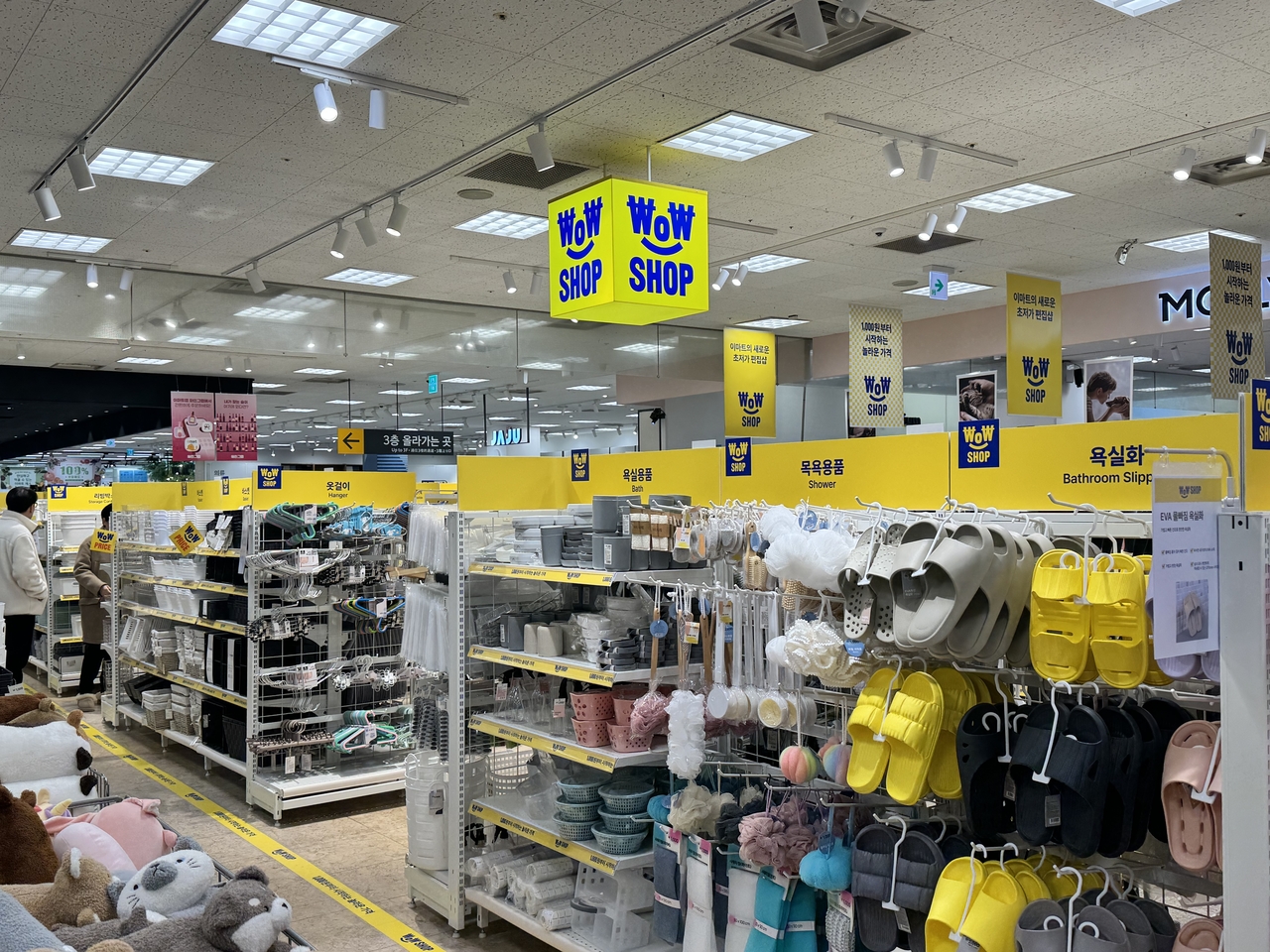
E-mart is scaling up its in-house fixed-price lifestyle brand, Wow Shop, enlarging existing locations and opening standalone stores as it pushes into full-scale expansion. With everyday household items priced between 1,000 and 5,000 won, the format is taking direct aim at Daiso, South Korea's go-to value-goods destination.
E-mart relocated and expanded its Wow Shop at the Eunpyeong branch on July 7, moving from a 62.8-square-meter space on the third floor to a 337-square-meter area on the sixth floor — the first time the brand has launched as a large-format standalone store. The product lineup grew by roughly 50 percent, from about 1,300 items to around 1,980. Since the reopening, average weekday sales have risen 52.1 percent and weekend sales 78.4 percent. E-mart said it has not finalized plans for further store openings or additional expansion.
E-mart introduced Wow Shop in December last year, starting with its Wangsimni branch, as a curated zone for ultra-low-price household goods priced at 5,000 won or less. Every item — from digital accessories and storage products to kitchenware — is sold at a fixed price between 1,000 and 5,000 won, with nothing priced above that ceiling. Most products are sourced directly through E-mart's overseas procurement process, cutting out intermediate distribution steps to keep prices low.
Wow Shop launched in four stores in December last year and has since grown to 13 locations, with some branches exceeding their sales targets by more than double. Sales as of June were up roughly 99 percent compared with January, reflecting the increase in store count. Since January, E-mart has also been selling 30 to 40 of Wow Shop's signature items on regular shelves across 116 of its stores. Despite the limited selection, E-mart said more than 40 percent of Wow Shop's total sales have come from those shelf sections.
The 5,000-won price ceiling matches Daiso's own pricing structure, and the household-goods-focused product mix overlaps considerably with what Daiso offers. The comparison raises questions about differentiation — Shinsegae Group's "Pierrot Shopping," launched in 2018 as a take on Japan's Don Quijote discount chain, withdrew after just two years following a similar failure to carve out a distinct identity.
Daiso currently operates more than 1,600 stores nationwide, giving it an overwhelming lead among household goods retailers. Last year, Daiso posted sales of 4.54 trillion won ($3.05 billion), up 14.3 percent from the previous year, while operating profit rose 19.2 percent to 442.4 billion won. The chain's annual sales have climbed steadily — from 2.95 trillion won in 2022 to 3.46 trillion won in 2023, 3.97 trillion won in 2024, and 4.54 trillion won last year.
korean@heraldcorp.com



