
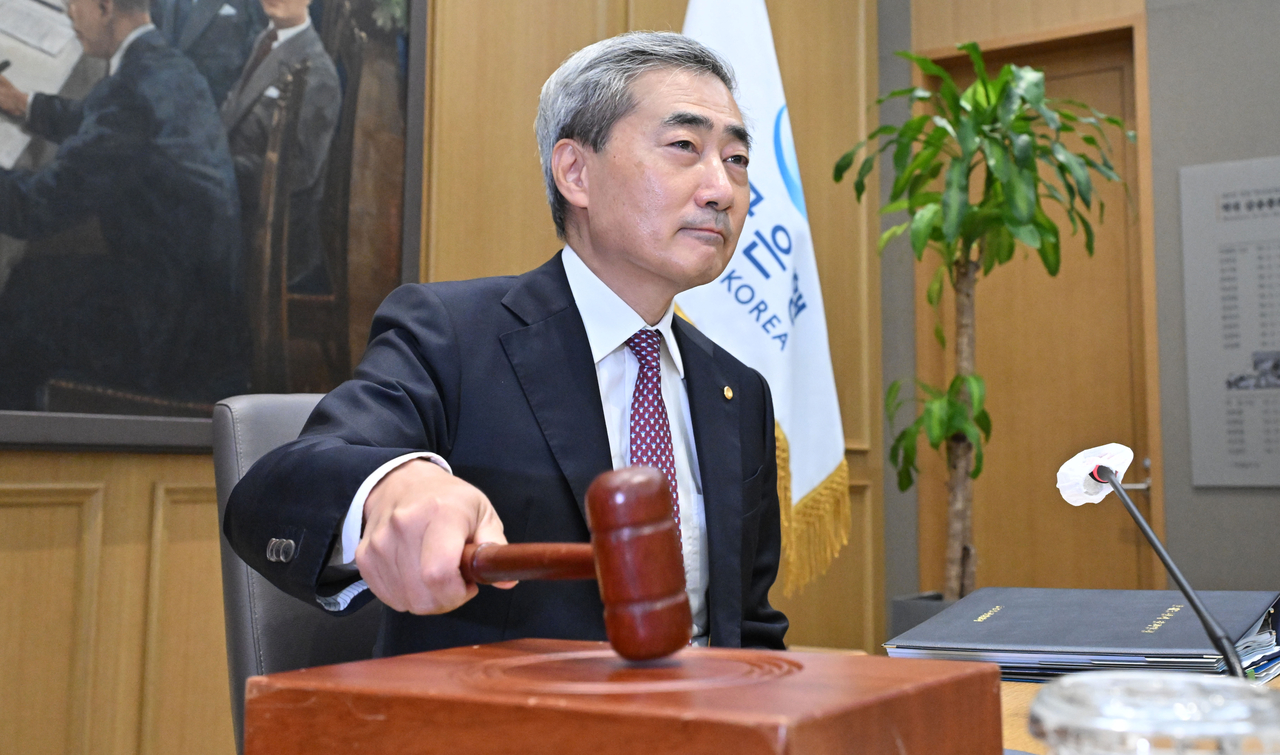
On the 16th floor of the Bank of Korea's headquarters in Jung-gu, Seoul, Gov. Shin Hyun-song walked into the meeting room Thursday morning wearing a red tie and struck the gavel to open his second Monetary Policy Board session. About 50 minutes later, the central bank announced a 0.25 percentage point increase in its benchmark interest rate — a sharp contrast to the previous meeting in May, when Shin had worn a blue tie and held rates steady.
The rate hike at Thursday's Monetary Policy Board meeting, at which Shin appeared in a red tie, has revived a long-dormant piece of market folklore: the theory that the Bank of Korea governor's tie color signals the direction of interest rates.
The idea holds that a red or warm-toned tie means a rate hike, while a blue or cool-toned tie signals a hold or cut. There is no logical basis for any correlation between tie color and monetary policy, but the theory has taken on a life of its own as a lighthearted pastime among market participants hungry for any extra clue about rate movements.
![Then-Bank of Korea Gov. Lee Chang-yong strikes the gavel to open a Monetary Policy Board meeting at the central bank's headquarters in Jung-gu, Seoul, in April. [Yonhap]](https://wimg.heraldcorp.com/news/cms/2026/07/17/rcv.YNA.20260410.PYH2026041002430001300_P1.jpg)
The tie-color theory first gained traction during the tenure of former Gov. Kim Joong-soo, when markets began paying close attention to what color tie he wore on rate-decision days. The lore held that a blue tie meant a hold and a red tie meant a change — either a hike or a cut. The theory carried over to his successor, former Gov. Lee Juyeol, with observers noting that he tended to wear green or blue ties on days when rates were held and red ties when a change was coming.
The theory faded after former Gov. Lee Chang-yong took office. Lee favored ties featuring hangul calligraphy designs but repeatedly denied — both in public and in private — that his neckwear carried any signal. At his 2022 confirmation hearing, he appeared in a flamboyant pink-and-red tie and, when asked about its meaning, said his spouse had picked it out. He even went tieless when Deputy Prime Minister for Economic Affairs Koo Yun-cheol visited the Bank of Korea last year.
![Then-Bank of Korea Gov. Lee Juyeol strikes the gavel to open a Monetary Policy Board meeting at the central bank's headquarters in Jung-gu, Seoul, in May 2021. [Bank of Korea]](https://wimg.heraldcorp.com/news/cms/2026/07/17/news-p.v1.20260716.3dcf362e011a4c4980a201dff0a923b3_P1.jpg)
Central bank governors abroad have faced similar scrutiny. In Europe, markets once speculated that former ECB President Mario Draghi's tie color — blue or red — predicted whether his remarks would lean dovish, favoring monetary easing, or hawkish, favoring tightening. In the United States, a folk theory held that a thick briefcase carried by former Federal Reserve Chair Alan Greenspan signaled an imminent policy change, while a thin one meant rates would stay put.
Shin held rates steady at his first Monetary Policy Board meeting after taking office in May, wearing a blue tie. Having raised rates at Thursday's second meeting in a red tie, he is likely to draw even more attention from markets on future meeting days.
The policy statement issued Thursday signaled further tightening, saying the board "judges it necessary to continue the rate-hiking stance going forward." With some market participants raising the possibility of consecutive hikes as soon as August, interest in what color tie Shin will wear at the next meeting has grown considerably.
At a press briefing following Thursday's rate decision, Shin left the door open on consecutive hikes. "A lot of important data will come out going forward, so I cannot say definitively either way," he said. "We will conduct monetary policy with all options on the table."
![Then-Bank of Korea Gov. Kim Joong-soo attends a regular Monetary Policy Board meeting at the central bank in Seoul in February 2014. [Herald DB]](https://wimg.heraldcorp.com/news/cms/2026/07/17/news-p.v1.20260716.8a2d4c2bc98b4178b56f7945bb0df5ca_P1.jpg)
kimstar@heraldcorp.com




