![President Lee Jae Myung speaks at a policy briefing by the Ministry of Finance and Economy, Ministry of Planning and Budget, National Tax Service, Financial Services Commission and Ministry of Statistics, held at Cheong Wa Dae's Yeongbingwan on Wednesday. [Yonhap]](https://wimg.heraldcorp.com/news/cms/2026/07/16/news-p.v1.20260715.c620d6f34b094fc3be74f9d1120e000f_P1.jpg)
With President Lee Jae Myung calling for faster passage of the 'share-price suppression prevention bill' — a proposed amendment to the inheritance and gift tax act — analysts are now turning their attention to which companies stand to benefit. Nearly half of all listed firms in South Korea trade below 0.8 times book value, the threshold cited in the bill, but the securities industry says the real winners will be a far smaller group: companies with solid profitability and the capacity to return capital to shareholders.
Korea Exchange data show that 1,291 of the 2,718 companies listed on the Kospi and Kosdaq as of Wednesday traded at a price-to-book ratio below 0.8 times, accounting for 47.5 percent of all listed firms.
The price-to-book ratio, or PBR, is calculated by dividing a company's market capitalization by its net assets. A PBR of 1.0 means the market values the company at exactly its net asset value; a reading of 0.8 means the stock is priced 20 percent below that value, while 0.5 means it trades at half. A proposed amendment to the inheritance and gift tax act targeting companies with a PBR below 0.8 has been introduced in the National Assembly, and the government is expected to announce related reform measures as part of its tax revision package later this month.
The securities industry cautions, however, that PBR alone is not enough to identify genuine beneficiaries. Analysts say investors need to look beyond the ratio and consider each company's industry conditions and underlying fundamentals.
Lee Jeong-bin, a researcher at Shinhan Investment, said the bill's practical effects are unlikely to be uniform across all low-PBR stocks. "Steel, chemicals and retail are in fundamental-discount territory due to weak industry conditions and low profitability," he said. "A simple regulatory change alone is unlikely to trigger a valuation rerating in those sectors."
In a report last month, Lee identified 19 potential beneficiaries using criteria including a PBR below 1.0, a return on equity of at least 5 percent, a controlling shareholder stake of at least 20 percent, a net cash position and a dividend payout ratio below 40 percent. Companies on that list included Hankook & Company, Korean Reinsurance, Hyundai Green Food, Youngone and DB Insurance.
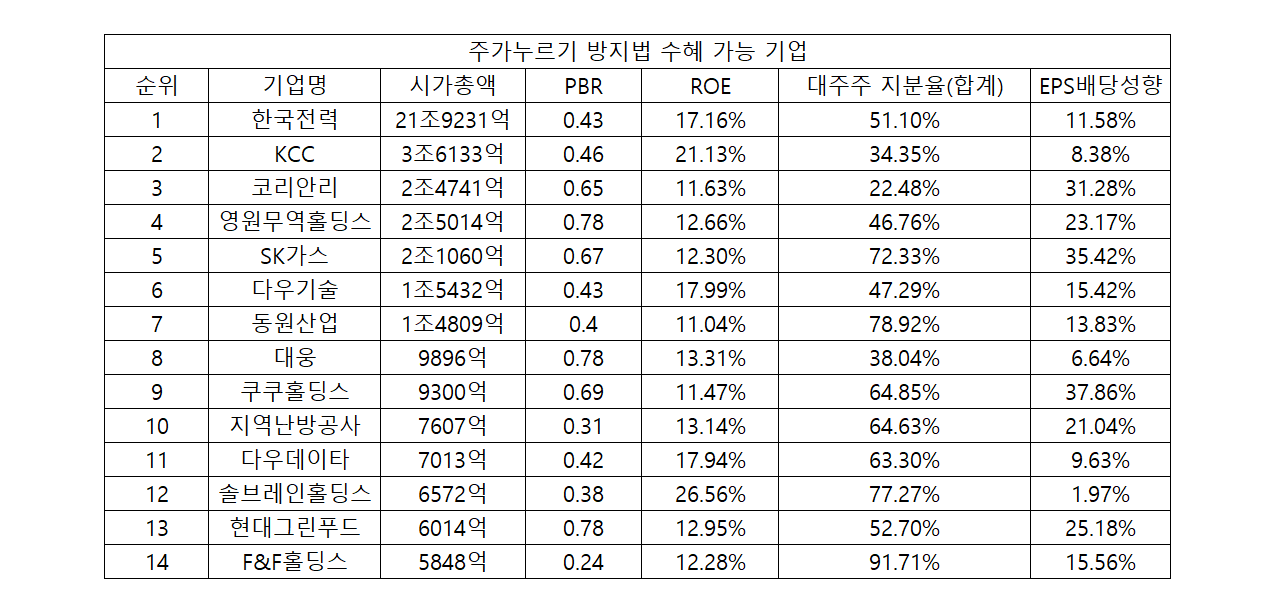
Applying the stricter criteria in the bill introduced by Democratic Party of Korea lawmaker Lee So-young — a PBR below 0.8, an ROE target of 10 percent (a level many companies have set as a medium- to long-term goal in their value-up disclosures) and a market capitalization of at least 500 billion won — narrows the field to 14 companies. That group includes Korea Electric Power Corporation, KCC, Korean Reinsurance, Youngone Holdings, SK Gas, Daou Technology, Dongwon Industries, Daewoong, Cuckoo Holdings, Korea District Heating, Daou Data, Soulbrain Holdings, Hyundai Green Food and F&F Holdings.
The policy push behind these companies comes from the top. At a Financial Services Commission briefing on Wednesday, President Lee said legislation including the share-price suppression prevention bill "is not moving well and is being delayed," and urged officials to "get cooperation however possible and pick up the pace." He called capital market normalization and advancement "a very important national policy."
The government has said, through its second-half 2026 economic growth strategy, that it will pursue a reform of how listed shares are valued for inheritance and gift tax purposes, with the aim of eliminating incentives for so-called share-price suppression. Under current law, the value of listed shares for inheritance and gift tax is based on the average share price over a four-month window — two months before and two months after the transfer date. Because a lower share price reduces the tax burden, controlling shareholders facing succession have long had an incentive to keep their stock prices depressed, critics have argued.
Several related bills have been introduced in the National Assembly. The bill by Democratic Party lawmaker Lee So-young would require that when a controlling shareholder of a company trading below 0.8 times book value transfers shares through inheritance or a gift, the taxable value be based on asset value and earnings value rather than the market price. Bills by fellow Democratic Party lawmakers Kim Hyeon-jeong and Ahn Do-geol would make it mandatory for companies that have traded at a low PBR for an extended period to publicly disclose corporate value improvement plans.
Law firm Sejong said listed companies should monitor the progress of the legislation while proactively managing their PBR and ROE levels and preparing corporate value improvement plans that cover dividend policy, treasury share programs and investor relations activities. "Companies that have sustained a low PBR for an extended period, or where a controlling shareholder succession or governance restructuring is possible, need to take a comprehensive look at the tax implications alongside shareholder return policies and disclosure strategy," the firm said.
Lee of Shinhan Investment said holding companies and owner-operated firms with relatively stable ROE and large cash or asset holdings are well positioned to benefit from a share-price rerating. "The enactment of the share-price suppression prevention bill is likely to improve shareholder return policies at these companies," he said.

hajun825@heraldcorp.com