
![A view of the Gangnam area in Seoul, where apartment complexes and multi-family housing are interspersed. [Yonhap]](https://wimg.heraldcorp.com/news/cms/2026/07/16/rcv.YNA.20260713.PYH2026071309020001300_P1.jpg)
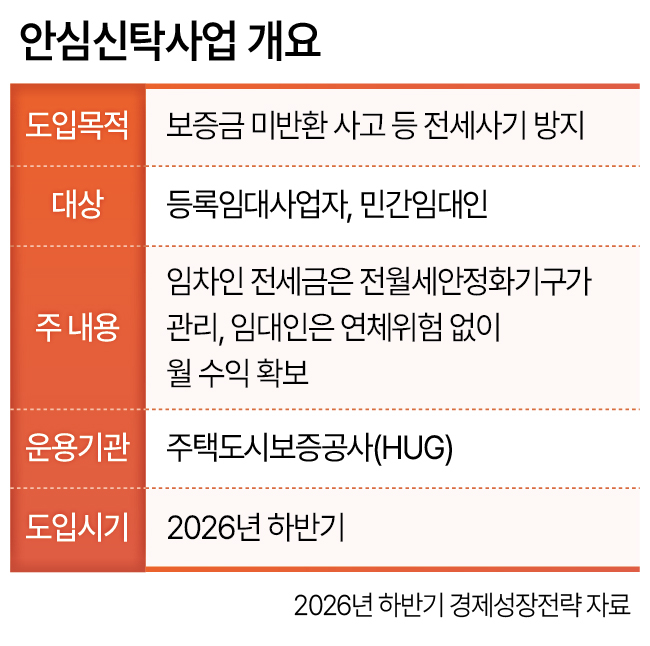
Attention is turning to how the rental market will be affected by the government's plan to introduce a so-called "safe trust" scheme, under which a public agency — rather than the landlord — would hold and manage jeonse deposits. The government had initially planned to make the program available only to registered rental business operators on an optional basis, but revised the scope in its second-half economic growth strategy to include private landlords such as multi-home owners and non-resident single-home owners.
The rationale behind the scheme is to prevent jeonse fraud. If the jeonse and monthly rent stabilization agency manages tenants' deposits, it can return the funds immediately in the event of a default — without the need for a separate subrogation process. The specific operational details have not been disclosed, but the agency would invest the deposits and pay landlords a monthly return from the proceeds.
The central question is whether the promise of monthly returns will be enough to draw voluntary participation from landlords. Because landlords would lose free use of the deposit funds, few are likely to join unless a guaranteed annual return is on offer. The market broadly expects that while the scheme was designed to stabilize and invigorate the jeonse market, it will in practice accelerate the shift from jeonse to monthly rent arrangements.
The jeonse market is already in a state where demand from tenants far outstrips supply. According to the Korea Real Estate Board, the Greater Seoul jeonse supply-demand index rose to 110.2 in June from 107.6 the month before. The monthly rent supply-demand index also climbed over the same period, from 107.4 to 109.1. A reading above 100 indicates a supply shortage.
Concerns are also emerging that the jeonse shortage — already worsened by government housing market regulations tightening owner-occupancy requirements — could deepen further if private landlords are drawn into the safe trust system, reducing the supply of jeonse listings as landlords' cash flow considerations diminish their incentive to offer such arrangements.
Housing costs could also rise more steeply. Landlords may pass on the opportunity cost of restricted access to their funds by converting leases to monthly rent or raising management fees. If that happens, a policy designed to protect tenants by preventing jeonse fraud could end up worsening their housing burden instead.
The specific product structure to be unveiled — including whether landlords can choose among different options, the monthly return rate on deposited funds, and the mandatory trust ratio — will likely determine how the rental market moves. Industry observers say the government's method for assessing individual landlords' deposit-repayment capacity, and the degree to which mandatory ratios are differentiated, will determine how much of a deposit landlords can still freely manage.
"In many cases, a jeonse deposit functions as an interest-free loan — a structure where the landlord borrows from the tenant to cover a shortfall in home purchase funds," one real estate expert said. "If landlords are not given 100 percent discretion, a controversy could arise over the government infringing on their right to manage private property."
Another key question is whether the scheme can protect deposits safely while guaranteeing returns higher than the current jeonse-to-monthly-rent conversion rate — set at the benchmark interest rate plus 2 percentage points, or 4.5 percent as of Wednesday. Park Hap-su, an adjunct professor at Konkuk University's Graduate School of Real Estate, warned that unless high returns are guaranteed, more landlords will simply opt to collect monthly rent directly, accelerating the collapse of the jeonse system. "Placing a deposit with the agency means that amount is off-limits for the landlord," he said. "If high yields aren't assured, many will just say they'd rather take monthly rent — and that could speed up the demise of jeonse."
Some see the scheme as a viable option for landlords who have difficulty putting deposit funds to use. Song Seung-hyeon, head of Urban and Economy, said some landlords may prefer delegating management in exchange for stable returns. "However, if participation in the trust is made mandatory for jeonse lease contracts, excessive government control over private finance could heighten market instability," he added.
hope@heraldcorp.com




