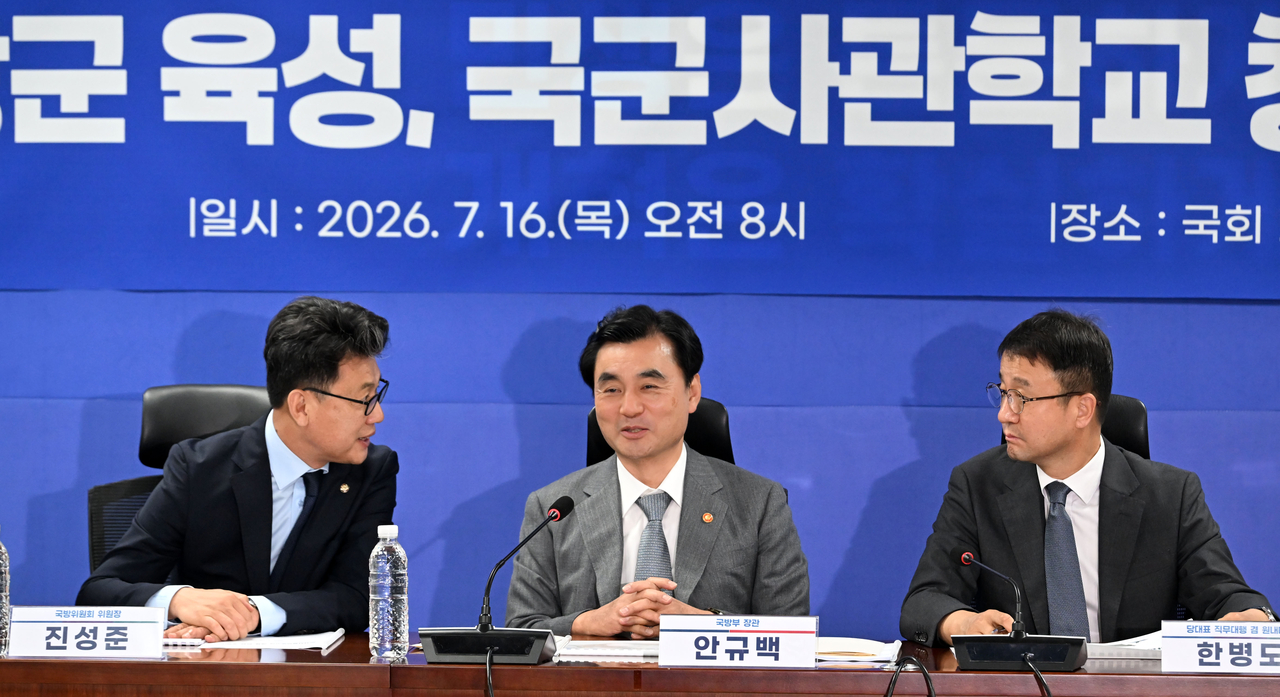
Defense Minister Ahn Gyu-back said Thursday that a newly established unified military academy will be located in the Jaunae area of Daejeon, where it will train officers equipped with creativity, convergent thinking, expertise and technological literacy.
Ahn made the remarks to reporters after a ruling party-government consultation on the academy plan held at the National Assembly members' office building. He said the Defense Ministry had consulted with relevant agencies and prepared a foundational plan for the academy's establishment, which it announced Thursday.
He said the military academy education system maintained over the years "faces serious challenges from within and without," and cited three reasons for reform: redundancy and inefficiency across the separate service academies, the need to adapt the education system to changing patterns of warfare, and preparation for the recovery of wartime operational control.
"To train 2,900 cadets, we are maintaining seven general officers — including three three-star generals — along with more than 3,000 support personnel, which calls for structural improvement," Ahn said. "Academy education must also evolve into a system capable of preparing officers for future warfare that spans all domains."
Ahn went on to say that graduates of the academy "must become the driving force leading the combined Korea-US defense posture after the recovery of operational control." He said the establishment of the unified academy "is not a mere mechanical merger of existing organizations" but "a transformative leap — the first step in a sweeping defense reform and a full redesign of the military academy education system — to build a world-class, cutting-edge academy that future generations of Koreans will be proud to choose."
On the new academy itself, Ahn said the Army, Navy and Air Force academies would be integrated into a single institution in Daejeon, which he described as "the heart of South Korea's science and technology ecosystem," home to leading research institutions including KAIST as well as the Korea Aerospace Research Institute, the Korea Astronomy and Space Science Institute, the Electronics and Telecommunications Research Institute and the Korea Atomic Energy Research Institute. He said the ministry would build a state-of-the-art smart campus there.
Ahn added that through "bold, concentrated investment," the ministry would consolidate aging military facilities into a single, top-tier integrated education platform that achieves economies of scale. He also said the share of civilian faculty, currently around 24 percent, would be gradually raised to more than 50 percent, with compensation guaranteed at the level of a national university so that leading scholars could join the front lines of officer training.
In addition, Ahn said the ministry would establish a dedicated organization to lead the defense education reform and push ahead with all related matters at pace. He said the goal was to build a world-class, advanced academy with academic capabilities on par with top universities and competitive with officer-training institutions in major countries.
Rep. Kim Byung-joo, the ruling party's floor whip on the National Assembly's National Defense Committee, said the party and government had agreed to integrate and reform the educational capabilities of the existing service academies to build a world-class unified military academy. He added that concerns raised by some during the establishment process would be addressed through public hearings, seminars and other input-gathering procedures at the level of the Democratic Party's policy committee or the defense committee.
addressh@heraldcorp.com