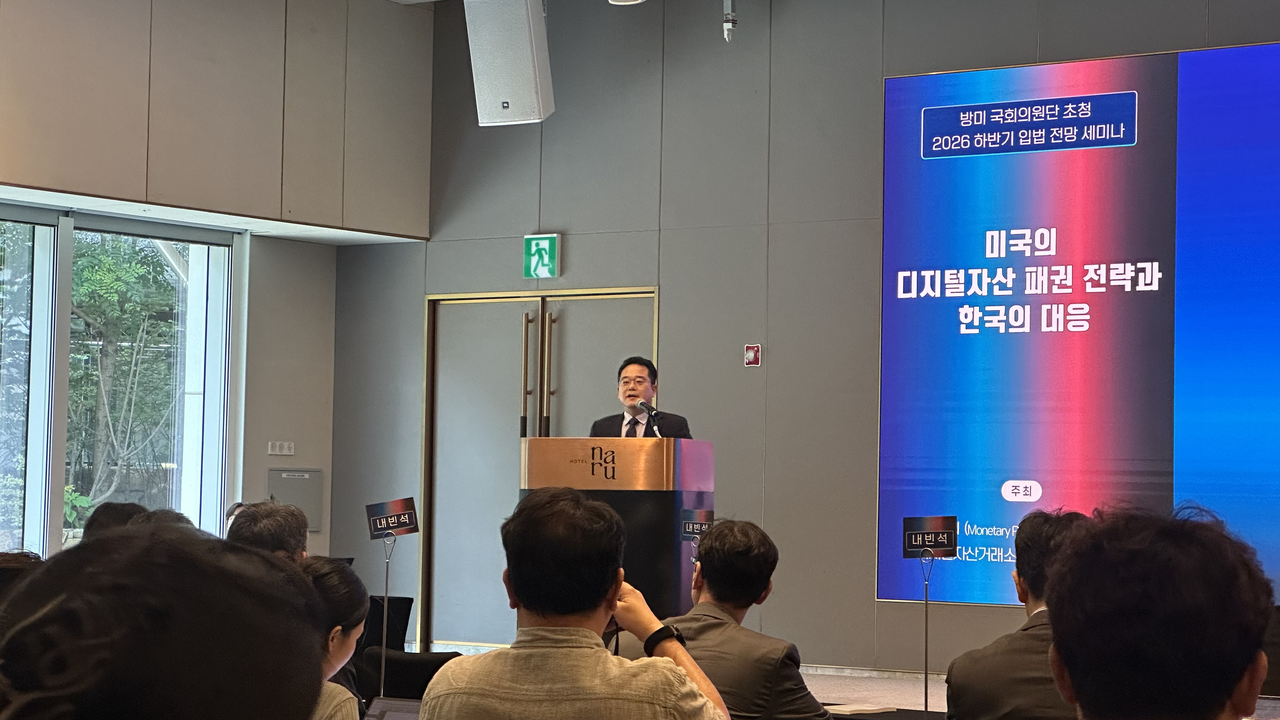
Democratic Party of Korea lawmaker Min Byeong-deok, who recently returned from meetings with US politicians and digital asset industry players, urged South Korea to accelerate legislation of a basic digital asset law, warning that the United States is moving far faster on digital asset policy.
Speaking Wednesday afternoon at the "Seminar on Second-Half Legislative Outlook for the US-Visit National Assembly Delegation," held at Hotel Naru Seoul MGallery in Mapo-gu, Seoul, Min opened with an apology. "I want to first say I am sorry to those who are working hard to develop technology in the market, as legislation of the digital asset basic law has been delayed by about a year," he said.
Min said the United States is treating digital assets as part of a national strategy to reinforce dollar dominance. "The US is moving quickly and strategically to strengthen dollar hegemony," he said. "Through the GENIUS Act, it is bringing payment stablecoins under a federal legal framework, and through the CLARITY Act, it is organizing the digital asset market structure."
The US visit included wide-ranging meetings not only with Congress and the administration but also with major digital asset and financial industry players. "In June, I visited Washington, D.C., and New York with lawmakers Park Min-gyu and Kang Min-guk," Min said. "We met with the US Congress, the White House, regulators, exchanges, custodians and stablecoin operators."
The central takeaway from the visit, Min said, was that the United States views digital assets not merely as an investment class or a matter of price volatility, but as a question of national competitiveness. He added that the delegation met with Senate Banking Committee Chairman Tim Scott, Sen. Bill Hagerty — the original sponsor of the GENIUS Act — Rep. Bryan Steil, SEC Commissioner Hester Peirce, and representatives from Bitco, Coinbase, the New York Stock Exchange, Tether and Cantor Fitzgerald.
"What is clear is that the US sees digital assets not simply as a price issue but as a matter of national strategy," Min said. "The global stablecoin market has already surpassed $300 billion, and dollar stablecoins from Tether and Circle alone exceed $250 billion."
Min also highlighted the participation of South Korean companies in emerging dollar stablecoin projects. "Not only global financial, big-tech and payment companies, but also major Korean firms including Samsung Electronics, Shinhan Financial Group and Dunamu are participating as early partners in OpenUSD," he said. "The fact that Korean companies are joining this trend shows that the influence of dollar stablecoins has already entered our industry."
He added that "because payment is a habit before it is a technology, once a dollar stablecoin becomes the standard it will be very hard to reclaim, and whichever payment network becomes the standard will also take control of data and fee-based industries."
Min warned that South Korea would not have much time to respond if the stablecoins being prepared in the United States enter the global market in earnest. "I am told there are as many as 200 stablecoins being prepared in the US," he said. "At least dozens of them will receive approval and flood into the global market."
He then turned to the pace of domestic legislation and infrastructure development. "The speed of discussion in Korea is at a devastating level," he said. "If the rules lag behind the technology, and if the infrastructure lags behind the demand, opportunities will flow overseas."
Han Seo-hee, an attorney at law firm Bae, Kim & Lee who accompanied the delegation to the United States, warned that South Korea must prepare for dollar stablecoins flowing into the country as a trade and corporate settlement tool. "Once the GENIUS Act takes effect in January next year, there will be no choice but to accept regulation-compliant stablecoins domestically as well," Han said. "They will flow in through digital asset operators, and going forward there is a high likelihood they will be used for trade payments and settlement."
Han said it was therefore necessary to examine how prepared domestic financial institutions and digital asset operators are to handle foreign exchange transactions. "When stablecoins in fact flow into the country as trade payments, we need to look at the technical side — whether domestic companies are ready to process them as foreign exchange handling institutions," she said.
Han also said regulations such as network separation rules must be eased to allow blockchain technology to be used in the financial sector. "Particularly, Korea's network separation regulations need to be relaxed quickly for blockchain utilization to increase and for banks to accumulate the relevant technology," she said, adding that "the need to prepare for pilot programs using innovative financial services should also be considered."
kyoung@heraldcorp.com