More than 200 prosecutors have resigned since the Lee Jae Myung government took office, far outpacing the rate of departures seen under previous administrations. Analysts say the exodus has accelerated as the ruling government and party, which came to power on a platform of prosecution reform and pursued the abolition of the prosecution service, left prosecutors facing an uncertain future for both their organization and their careers — a situation that reached a tipping point once the abolition became a reality.
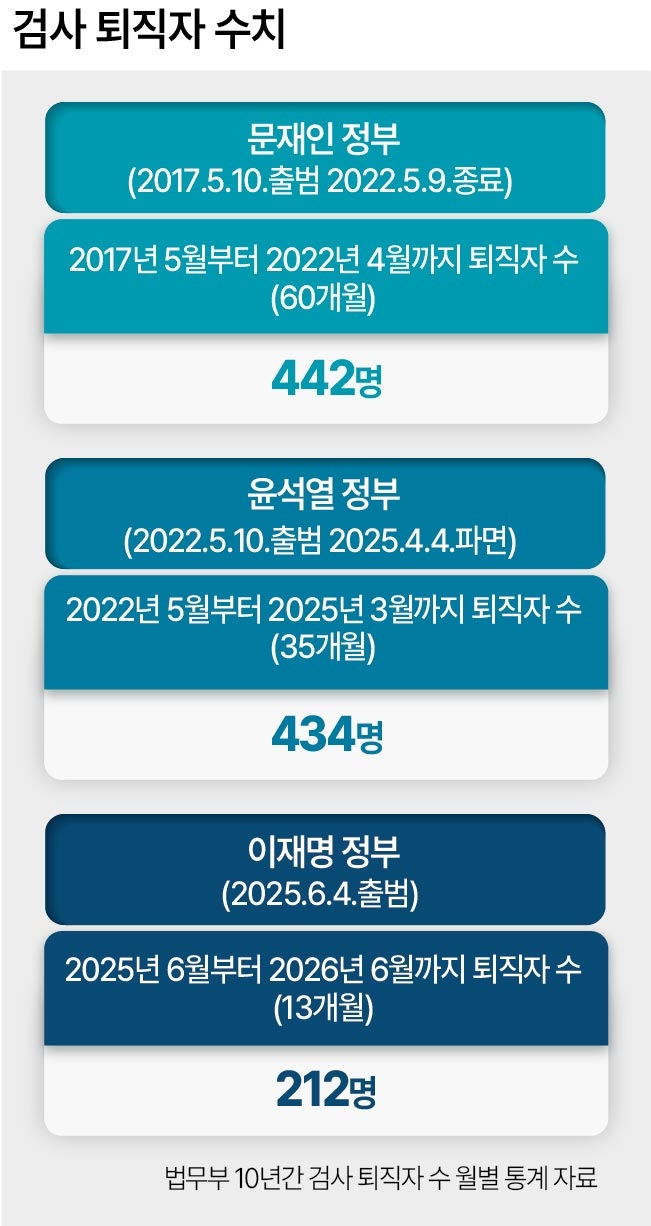
Monthly statistics on prosecutor resignations over the past decade, obtained from the Ministry of Justice, show that 212 prosecutors left the prosecution service in the 13 months from June last year, when the Lee Jae Myung government was inaugurated, through June this year — an average of 16.3 departures per month. The current government was inaugurated on June 4 last year, the day after the 21st presidential election.
The number of prosecutors who resigned in roughly 13 months under the current government is nearly half the total who left during the entire Yoon Suk Yeol administration. Yoon took office May 10, 2022, and his presidency ended when the Constitutional Court ordered his removal from office on April 4 last year. Under Yoon, 434 prosecutors resigned over 35 months — from May 2022 through March last year — an average of 12.4 per month.
Even under the Moon Jae-in government, when internal discontent ran high over prosecution reform through investigative authority adjustments, the rate of departures was comparatively lower. The Moon administration took office May 10, 2017, and served its full five-year term through May 9, 2022. Over those 60 months — from May 2017 through April 2022 — 442 prosecutors resigned, an average of 7.4 per month.
Breaking the figures down by year, 175 prosecutors left last year — the highest annual total in the past decade. Of those, 99 resigned voluntarily, 70 took early retirement, and 6 reached mandatory retirement age, meaning 96.6 percent left of their own accord. The single busiest month for departures last year was September, when 47 prosecutors quit — the same month the National Assembly passed legislation to abolish the prosecution service.
The exodus has continued this year. Eighty prosecutors resigned between January and June — 36 voluntarily, 39 through early retirement, and 5 at mandatory retirement age — with 93.8 percent departing of their own accord.
Those inside and outside the prosecution service attribute the surge in departures to the arrival of the Lee government, which took office pledging sweeping prosecution reform. While some departures following a new administration's large-scale personnel reshuffle are customary, analysts say the spike reflects deeper factors: anxiety over the organization's uncertain future, concerns about individual career prospects, and a pervasive sense of helplessness about the current situation.
A lawyer and former high prosecutors' office chief said the situation resembled "people jumping off a sinking ship as fast as they can," adding that "regardless of whether prosecutors retain investigative authority, institutional reform driven by distrust of the prosecution has left prosecutors with nothing left to do." The lawyer added that while personnel grievances had driven many past resignations, "the current situation is different — the main reason people are leaving is that they see no future for the organization."
Some observers note that the pace of departures has quickened further ahead of the planned October dissolution of the prosecution service and the launch of the Serious Crimes Investigation Agency and the Public Prosecution Service. A sitting prosecutor at a district office said politicians had "demonized and then abolished the prosecution, leaving the organization with nothing but a bleak future," adding that prosecutors feel they must "go out and find a way to survive." The prosecutor said choosing between the new agencies requires a sense of vision, but that "it is hard to think about the future when basic working conditions and job descriptions have not even been spelled out."
Some analysts argue that departures among senior officials and those among rank-and-file prosecutors should be viewed separately. Senior officials who leave are often seen in the legal market as well-connected former insiders commanding high fees at law firms, whereas younger prosecutors who resign are more likely driven by a deep sense of futility over the organization's uncertain prospects.
Prosecutors' sense of helplessness appears to have deepened further as even the supplementary investigative authority — a key point of contention in ongoing National Assembly discussions over revisions to the Code of Criminal Procedure — faces possible elimination. One prosecutor said the prosecution had "continuously conveyed to the government the need to preserve supplementary investigative authority, but in the end nothing was reflected," adding that "every office has given up and is focused solely on clearing pending cases."
yg@heraldcorp.com