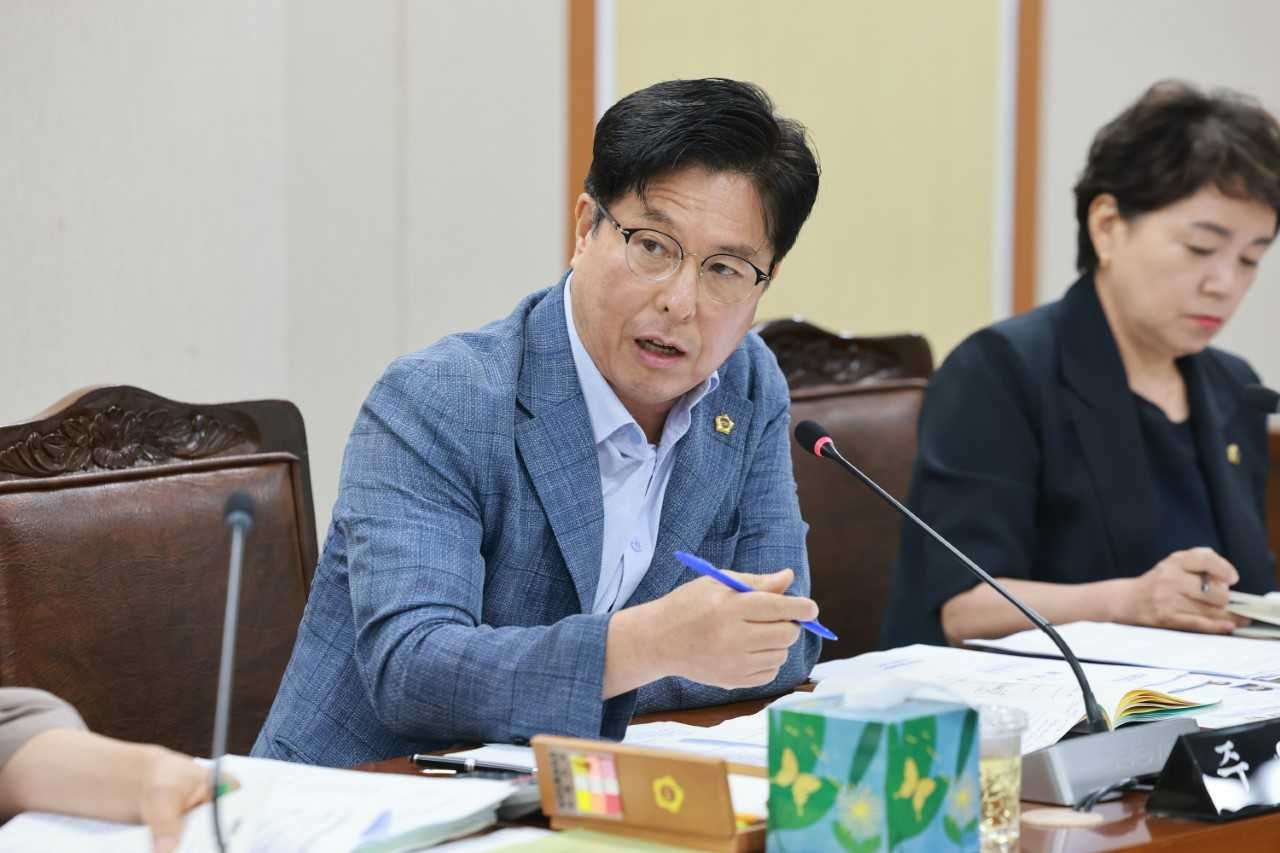
Ju Yeon-chang, a lawmaker on the Safety and Construction Committee of the South Jeolla-Gwangju Special Metropolitan Assembly representing Yeosu District 4, on Tuesday pressed city officials to establish a concrete plan for 149.7 billion won ($100 million) in public contributions linked to the Gwangcheon Terminal mixed-use district unit plan, and urged the city to prepare traffic congestion measures from the earliest stages of the project.
The total public contribution for the Gwangcheon Terminal mixed-use development stands at 149.7 billion won, comprising 12.9 billion won in in-kind contributions — covering the installation of a direct-access ramp — and 136.8 billion won in cash. Ju questioned the scale of development profits the project operator stands to gain and the criteria used to calculate the public contribution, and pressed officials on how the 136.8 billion won in cash contributions would specifically be used.
"It must be made clear how this large public contribution will be used going forward," Ju said. "It should translate into expanded infrastructure and stronger public benefits that residents can actually feel."
He added that the expansion of a department store and the addition of residential and accommodation facilities would significantly increase traffic around the Gwangcheon Terminal area, warning that traffic impact assessments must not be reduced to a mere formality.
"Gwangcheon Terminal is a major regional transit hub for people traveling to and from Gwangju, and traffic congestion there is already severe," Ju said. "With a department store and residential and accommodation facilities set to move in, traffic volumes could rise sharply. The collection and use of public contributions must be handled transparently, and a comprehensive, effective traffic plan must be finalized before the project moves forward."
In response, Urban Space Bureau Director Park Geum-hwa said the public contribution was calculated based on the increase in land value resulting from the mixed-use development, and that the funds would be used for purposes prescribed by law, including infrastructure, public rental housing and dormitories.
sij@heraldcorp.com