
![A villa complex in Seoul on Sunday. [Yonhap]](https://wimg.heraldcorp.com/news/cms/2026/07/15/rcv.YNA.20260712.PYH2026071205590001300_P1.jpg)
As housing instability deepens across the greater Seoul area — with both purchase prices and jeonse and monthly rent rising in tandem — row houses, multi-family homes and officetels, collectively known as non-apartment housing, are emerging as a key alternative to apartments given their shorter construction timelines. The government has reaffirmed its commitment to boosting the supply of newly built non-apartment units, and calls for deregulation in the sector dominated discussion at a forum hosted by the Ministry of Land, Infrastructure and Transport.
According to the real estate industry, at a forum on housing supply expansion held Tuesday, the Ministry of Land, Infrastructure and Transport heard proposals including easing floor and total floor area restrictions on multi-family and row houses, excluding non-apartment purchases from household property counts, and relaxing loan-to-value ratio regulations.
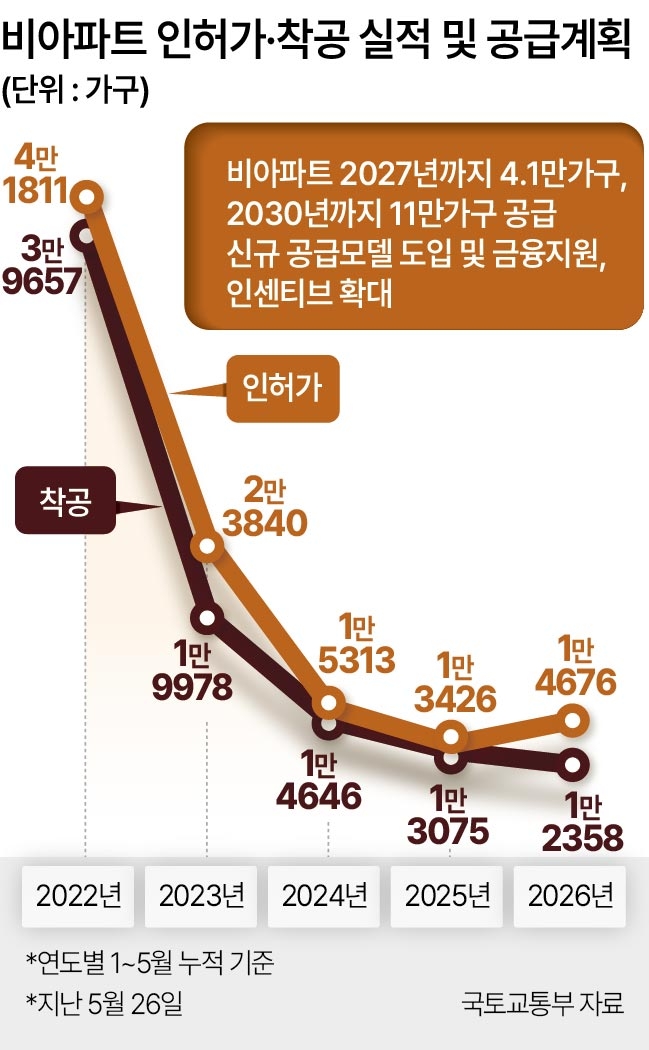
Experts say the supply of non-apartment housing — which serves as a stepping stone on the residential ladder — has plunged over the past several years due to the fallout from jeonse fraud and deteriorating construction conditions, deepening supply-demand imbalances across the broader housing market. Non-apartment building permits issued from January through May this year totaled 14,676 units, according to ministry statistics, down 185 percent from 41,811 units during the same period in 2022. Ground-breakings and completions also fell sharply over the same period — from 39,657 units to 12,358 and from 35,472 units to 11,448, respectively — pointing to a near-total supply cliff.
Kim Deok-rye, a senior research fellow at the Korea Housing Industry Research Institute, appeared as a panelist at Tuesday's forum and said the decline in non-apartment supply was "the combined result of building regulations, loans, taxes and jeonse fraud." She stressed that "to normalize the non-apartment sector, much of the future uncertainty surrounding these projects must be removed, and consistent policy design is critical."
She added that building regulations need to be reformed — including raising the current four-story height limit on row and multi-family houses under the Building Act and easing total floor area requirements for residential use. "The building standards for villas were set in 1990 and have remained unchanged," Kim said. "We are now in an era where apartments rise to 20 or even 60 stories, yet the height cap remains excessive."
From the supply side, participants argued that easing loan restrictions — including the current zero loan-to-value ratio — was essential for smooth project financing, alongside building deregulation. There were also pointed observations that even when non-apartment units are newly built at great difficulty, tax regulations leave no buyers. The consensus was that demand-side tax incentives, such as excluding non-apartment purchases from household property counts, must accompany any supply-side measures.
The government has already signaled broad agreement on the need for such deregulation to normalize the non-apartment market. Land Minister Kim Yun-deok, speaking at a Cabinet meeting Tuesday morning ahead of the forum, reported that "given the slump in non-apartment housing, there are calls to ease financial and tax regulations for new builds only — unlike for apartments — but there are also views that no exceptions should be made in the interest of fairness with multi-home ownership rules."
In May, the government unveiled a plan to deliver 41,000 non-apartment units by 2027 and 110,000 by 2030 through measures including construction financing support for non-apartment developers, a dedicated project financing guarantee from the Korea Housing and Urban Guarantee Corporation, the introduction of pre-sale guarantees, and eased building regulations for urban-type residential housing.
Experts said non-apartment housing's relatively short construction timeline makes it a practical near-term supply solution. They particularly emphasized the need to lower the entry barrier for rental investors by permanently excluding non-apartment units from household property counts. Currently, non-apartment units with an exclusive use area of 60 square meters or smaller and an acquisition price of up to 600 million won ($408,000) in the greater Seoul area — or up to 300 million won in other regions — are exempt from property counts if acquired by the end of next year. Experts said the deadline should be extended and the eligibility criteria broadened.
Park Hap-su, an adjunct professor at Konkuk University's Graduate School of Real Estate, said non-apartment units "can be built within a year, so if regulations are eased, there will be a short-term supply effect." He added that "the real question is who will buy them to rent out," and called for measures such as excluding up to three units of residential officetels or other homes with an exclusive use area of 60 square meters or smaller from household property counts, so that rental investors can absorb the villa supply.
Park Moon-su, a professor in the real estate department at Sangmyung University and president of the Korea Real Estate Industry Association, also said the government "should actively consider granting exceptions or separate classifications for non-apartment units below a certain size that serve a public function through long-term rental, when calculating single-homeowner status." He said that "only when tax and financial burdens are reduced by excluding such units from property counts will the private sector have an incentive to purchase non-apartment housing and supply it as long-term rental housing."
Experts broadly agreed that easing loan restrictions such as relaxing the loan-to-value ratio, as raised at the forum, would amplify the supply effect if pursued alongside other measures. Park Won-gap, chief real estate specialist at KB Kookmin Bank, said "the top priority is to ease loan constraints stemming from tightened loan-to-value ratios so that developers and builders can actively move forward with new villa construction — building non-apartment housing quickly, what you might call 'fast-food housing.'" He added that "if apartment-style villas such as officetels and urban-type residential housing — spaces the MZ generation, raised on apartments, are already familiar with — increase in number, that will also have a stabilizing effect on the market."

hwshin@heraldcorp.com
hope@heraldcorp.com




