
![A real estate agency in Seocho-gu, Seoul, displays notices related to property taxes on Tuesday. The Ministry of Land, Infrastructure and Transport is holding a forum on housing supply on Tuesday, the Financial Services Commission will host a discussion on financial regulation on Wednesday, and the Ministry of Economy and Finance will hold a forum on real estate taxation on Thursday. [Yonhap]](https://wimg.heraldcorp.com/news/cms/2026/07/15/rcv.YNA.20260714.PYH2026071416090001300_P1.jpg)
With the Bank of Korea leaving the door open to further benchmark interest rate increases, an analysis shows that even a 0.25 percentage point rise would add 1.8 trillion won ($1.2 billion) a year to the interest burden on housing-related borrowers. Analysts warn that repayment pressure could intensify for so-called "yeongkkul-jok" — borrowers who stretched their finances to buy homes amid rising prices — as well as for financially vulnerable debtors.
According to data that People Power Party lawmaker Lee Jong-wook obtained from the Bank of Korea, a 0.25 percentage point increase in interest rates based on first-quarter 2026 figures would raise the annual interest burden on housing-related borrowers by 1.8 trillion won. A 0.50 percentage point rise would push the figure to 3.7 trillion won, and a 0.75 percentage point increase would bring it to 5.5 trillion won.
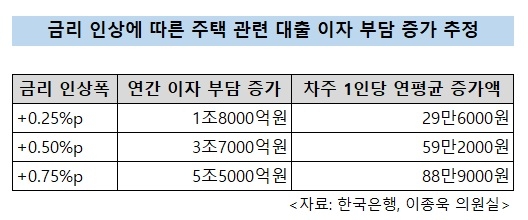
The added cost for individual borrowers is also significant. A 0.25 percentage point rate increase would raise the average annual interest payment per borrower from 5.84 million won to 6.14 million won — an increase of 296,000 won. A 0.75 percentage point rise would push the average annual burden to 6.73 million won, meaning borrowers would pay 889,000 won more than they currently do.
Outstanding housing-related loans stood at 1,178.6 trillion won as of the first quarter of this year. About 35 percent of mortgage loans at deposit-taking banks carry variable rates, meaning a benchmark rate increase would directly raise interest costs for a large share of borrowers. The figures include not only individual mortgage loans but also jeonse deposit loans and group loans.
An analysis of home purchase financing plans by Lee's office found that 154,000 properties in Seoul and Gyeonggi Province were bought using borrowed funds — from financial institutions or other sources beyond the buyer's own capital — since the Lee Jae-myung government took office. While not all of those buyers would be classified as yeongkkul-jok, analysts say a combination of further rate hikes and rising bank lending spreads could significantly increase the principal and interest repayment burden for many of them.
There are also concerns about the deteriorating repayment capacity of vulnerable borrowers. According to the Bank of Korea, the average outstanding mortgage balance per vulnerable borrower — defined as those with multiple debts who are also low-income or have low credit ratings — stood at 135.2 million won in the first quarter of this year. If rates continue to rise, delinquency rates among this group could climb and the risk of household loan defaults could widen.
"With home prices surging and interest burdens growing, young people and genuine end-users are being squeezed even harder," lawmaker Lee said. "The government must closely monitor the household debt risks stemming from rising rates and normalize the market through a shift in real estate policy."
fact0514@heraldcorp.com




