![A loan counter at a bank branch in Seoul [Herald DB]](https://wimg.heraldcorp.com/news/cms/2026/07/14/news-p.v1.20260714.0aa664f3cda0438785b25bc18489a1d1_P1.png)
"I was out visiting properties, trying to buy a home, and then this hit me out of nowhere. If loans were going to be first-come, first-served, couldn't they at least have told us to hurry? This is basically loan rationing."
Nam, a 37-year-old office worker living in Namyangju, Gyeonggi Province, has abandoned his home-buying plans for this year entirely. He had been carefully mapping out his finances in line with government lending regulations and scouting properties — until KB Kookmin Bank this month slashed its mortgage lending cap in half on its own initiative. A flood of reports that other banks were considering similar restrictions drained what remained of his motivation.
"If you suddenly cut the limit by 300 million won ($199,000) without any warning, where exactly are we supposed to find that money?" Nam said. "Banks should lend within what a borrower can repay — I don't understand why we should be penalized based on when we apply."
Concerns about a repeat "lending cliff" are mounting as KB Kookmin Bank sharply reduced its mortgage cap in the second half of the year. Reports of people being turned away for loans are spreading rapidly through online communities and short-form video platforms, fueling anxiety among prospective borrowers.
With the lending cliff now recurring every second half of the year like clockwork, frustration among borrowers is growing. Critics argue the system is fundamentally unfair because access to credit hinges on the timing of an application rather than a borrower's ability to repay. Some borrowers are already saying they need to prepare for a "loan open run" — a rush to apply the moment banks reopen their books — at the start of next year.
KB Kookmin Bank cut its mortgage lending cap in the Greater Seoul area and regulated zones from 600 million won to 300 million won starting Friday. It also introduced a new 300 million won cap for areas outside regulated zones.
Banks had already been tightening credit through measures such as reducing personal loan limits and restricting access to mortgage credit insurance and mortgage credit guarantee products.
The market shock was amplified because KB Kookmin Bank had, as of the first half of the year, the most remaining household loan capacity among the five major banks — KB Kookmin, Shinhan, Hana, Woori and NH NongHyup. When one bank tightens lending under an already-stricter annual cap, demand inevitably floods into the others. Some banks are in fact weighing additional restrictions, though not to the same degree as KB Kookmin Bank.
Following KB Kookmin Bank's move, Shinhan Bank and Woori Bank said they would restrict access to mortgage credit insurance and mortgage credit guarantee products — a step that also reduces the maximum loan amount available to borrowers. Woori Bank went further, announcing it would cut the monthly mortgage origination cap per branch from 3 billion won to 1 billion won starting Thursday.
The combined household loan balance at the five major banks — excluding policy loans — stood at 648.36 trillion won as of Thursday, up 3.38 trillion won from the end of last year. That figure represents 78 percent of the 4.34 trillion won in household loan growth the banks are permitted for the full year. With July barely underway, less than 1 trillion won in annual lending capacity remains.
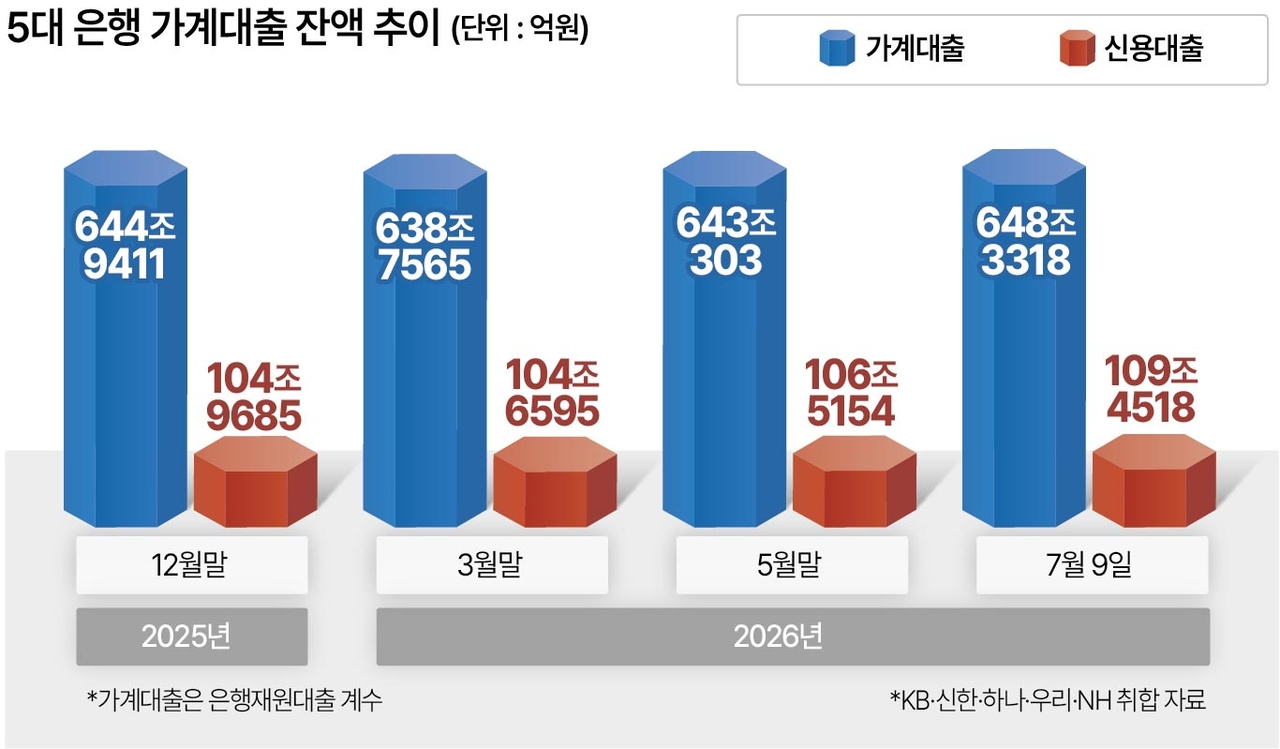
Anxiety that "the loan window will close soon" is spreading fast among borrowers. SNS platforms and real estate online communities are filling up with posts asking whether loans are still available and sharing consultation experiences. Some analysts warn that the rapid spread of information through new media is stoking artificial demand — people rushing to borrow before restrictions tighten further — creating a vicious cycle.
Kim, 35, who lives in Incheon and is set to marry in November, began scrambling to visit bank branches to inquire about a mortgage after coming across posts in online communities.
"I had been steadily preparing to buy a home according to my financial plan, but when I heard that bank loans were suddenly being cut off, I panicked," Kim said. "I visited several branches, and the limits were much lower than I had expected — so I have effectively had to shelve my plans."
Those who have already signed purchase contracts are in a state of panic, fearing they will be unable to cover interim payments or final settlement amounts. Group loans and interim-payment loans are also subject to the household lending cap. One online community saw a post from a user who said they had asked their pre-sale agent whether the loan would come through as planned, only to be told to consider the possibility of paying out of pocket.
Another user wrote: "I've already signed the contract, but as the final payment date gets closer I'm getting more and more anxious. With lending regulations tightening, I'm worried the loan won't actually come through as expected."
As banks raise their lending bar, the impact is being felt not only by homebuyers but also by borrowers who need funds for everyday expenses. When bank loans become harder to obtain, borrowers are pushed toward credit card companies and savings banks that charge higher interest rates — and existing secondary-lender customers risk being pushed further down to peer-to-peer lending platforms or loan sharks. There are growing concerns about a rise in so-called "loan refugees." A senior official at one savings bank said borrowers who normally use commercial banks have been coming in for loan consultations more frequently as regulations tighten, adding: "Demand hasn't surged sharply yet, but we're watching closely for signs that it might."
Critics say the second-half lending crunch has become an annual occurrence ever since financial authorities introduced aggregate loan caps. The Financial Services Commission set a household loan growth target of 5 to 6 percent of the prior year's balance in 2021, lowering it to 4 to 5 percent the following year. The cap was eased between 2023 and 2024 to allow growth within the nominal economic growth rate, but authorities reimposed it last year as real estate prices began to stir again. Last year's cap was set at 1.7 percent of the prior year's increase; this year it has been tightened further to 1.5 percent.
In 2021, NH NongHyup Bank effectively halted household lending at the start of the second half, sending demand rushing to other banks and secondary lenders. At the time, NongHyup Bank risked exceeding its aggregate target and being unable to process group loans for apartment projects it had agreements with; Shinhan Bank, which had relatively more capacity, stepped in to handle some of that volume.
Starting this year, the government set quarterly targets to prevent lending from clustering in specific periods. Critics say the measure is difficult to enforce in practice, however — the only penalty for missing a quarterly target is a deduction from the following quarter's allowance. The fact that the aggregate loan cap is also a voluntary self-regulatory measure makes meaningful sanctions difficult to apply.
"Financial companies are judged on annual earnings, so originating as many loans as possible early in the year helps boost annual interest income," a financial industry official said.
hyuk@heraldcorp.com
ehkim@heraldcorp.com
forest@heraldcorp.com