The final showdown to set next year's minimum wage got underway Tuesday.
Business representatives argued that even a 2 percent increase would be too much for small business owners to bear, while labor representatives urged a sharp hike, saying low-wage workers had been pushed to the brink by five consecutive years of meager raises.
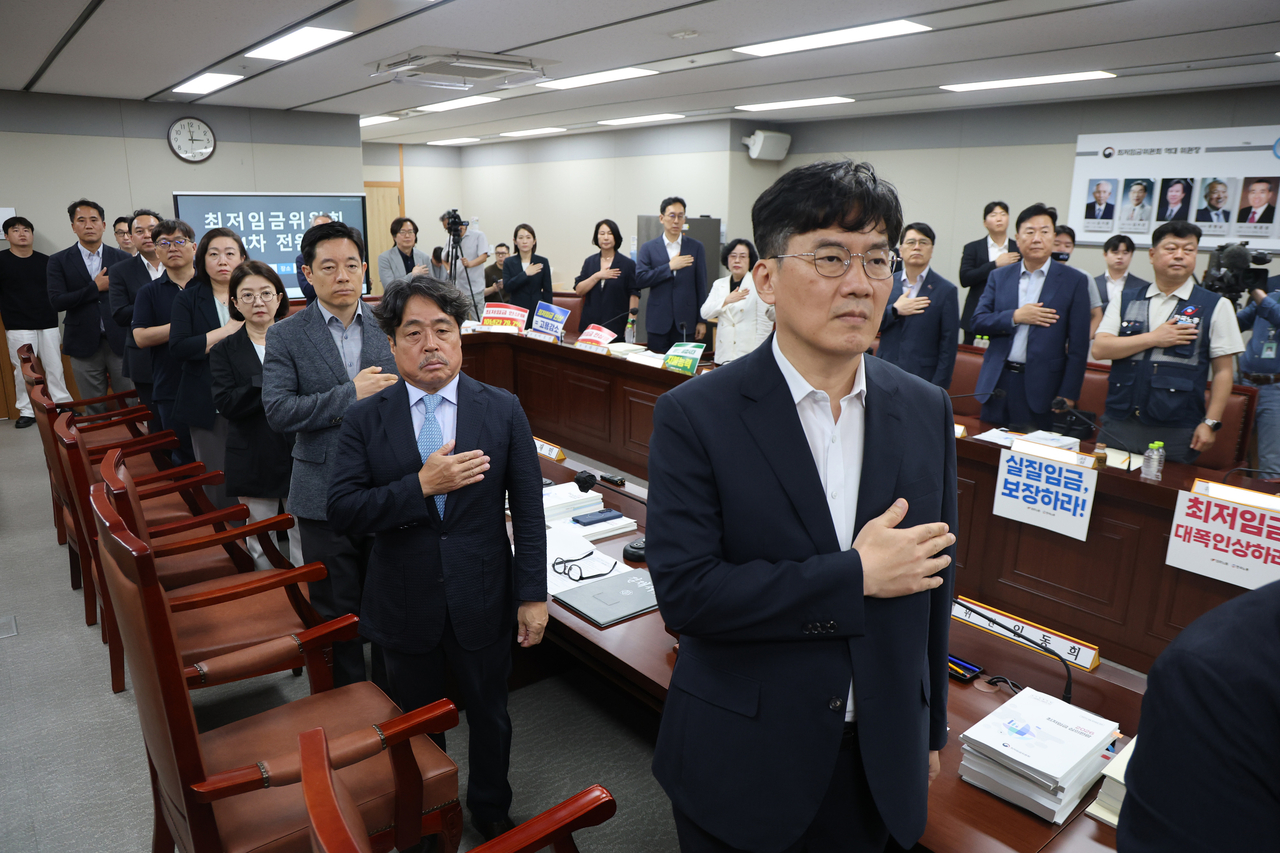
Minimum Wage Commission Chairman Kwon Soon-won opened the 14th plenary session at Government Complex Sejong, heard opening remarks from labor, management and public-interest members, and then moved into final deliberations. The session is widely expected to be the last before next year's minimum wage is effectively decided.
Ryu Ki-jung, executive vice president of the Korea Enterprises Federation, said the minimum wage had already reached a high level, adding that it exceeds 12,000 won ($9) per hour when weekly holiday pay is included. "Unlike some improving macroeconomic indicators, small and medium-sized enterprises and self-employed business owners can no longer hold on under the weight of sluggish domestic demand and rising labor costs," he said.
He added that because the minimum wage is a legally mandated floor set by the state, it could undermine even the most basic will of small business owners to keep operating. He urged the commission to reach a conclusion "at a level that allows small businesses and self-employed owners to maintain employment."
Yang Ok-seok, head of the human resources policy division at the Korea Federation of SMEs, said the walkout by self-employed employer members at the previous session over a proposed 2 percent increase reflected the desperation of their situation. "Business closures are rising and the loan delinquency rate has hit its highest level in nearly 11 years," he said, stressing that the commission must give full consideration to the payment capacity of small and medium-sized enterprises, self-employed owners and farmers.
Labor representatives pushed back, arguing that a minimum wage increase is a core policy tool for reviving domestic consumption and easing inequality.
Ryu Ki-seop, secretary-general of the Federation of Korean Trade Unions, said the minimum wage increase must go beyond covering basic living costs and serve as a catalyst for reviving the sluggish domestic economy. "Years of low increases have entrenched a low-wage structure, and raising the minimum wage is the most direct way to restore workers' spending power amid high inflation," he said.
He also doubled down on the need to expand minimum wage coverage, saying new forms of work such as contract-based and platform workers had already become a significant part of the labor market but were not adequately protected under the current system.
Lee Mi-seon, vice chairwoman of the Korean Confederation of Trade Unions, said the lives of low-wage workers were already collapsing "in a way that makes a mockery of South Korea's status as the world's 10th-largest economy," adding that the minimum wage was not enough to cover three meals a day. "We must make the bold decision to raise the minimum wage to reflect workers' real living costs, and we cannot accept any compromise that cuts workers' real income," she said.
Seong Jae-min, secretary of the public-interest members, said Tuesday marked "a critical moment to reach a responsible conclusion that shows consideration for all sides, in accordance with the Minimum Wage Act." He called on all labor, management and public-interest members to do their utmost to arrive at a meaningful outcome.
Earlier Tuesday afternoon, ahead of the 14th plenary session, both sides took their arguments outside the meeting room in a last-minute push to sway public opinion.
The two major union federations held a press conference in front of the Minimum Wage Commission at Government Complex Sejong, urging a sharp minimum wage increase to restore real wages and boost domestic demand. Employer members affiliated with the Korea Federation of Small Business Associations, meanwhile, gathered outside the Ministry of Employment and Labor press room to reaffirm their position that a 2 percent increase was the absolute maximum self-employed owners could absorb.
At the 13th plenary session, labor submitted its ninth revised proposal of 11,220 won per hour — an 8.7 percent increase over this year's rate — while management proposed 10,530 won, a 2.0 percent rise. The gap between the two sides narrowed to 690 won but no agreement was reached. At Tuesday's session, whether the public-interest members present a deliberation-facilitation range and whether either side offers further revised proposals are expected to be the deciding factors in setting next year's minimum wage.
fact0514@heraldcorp.com