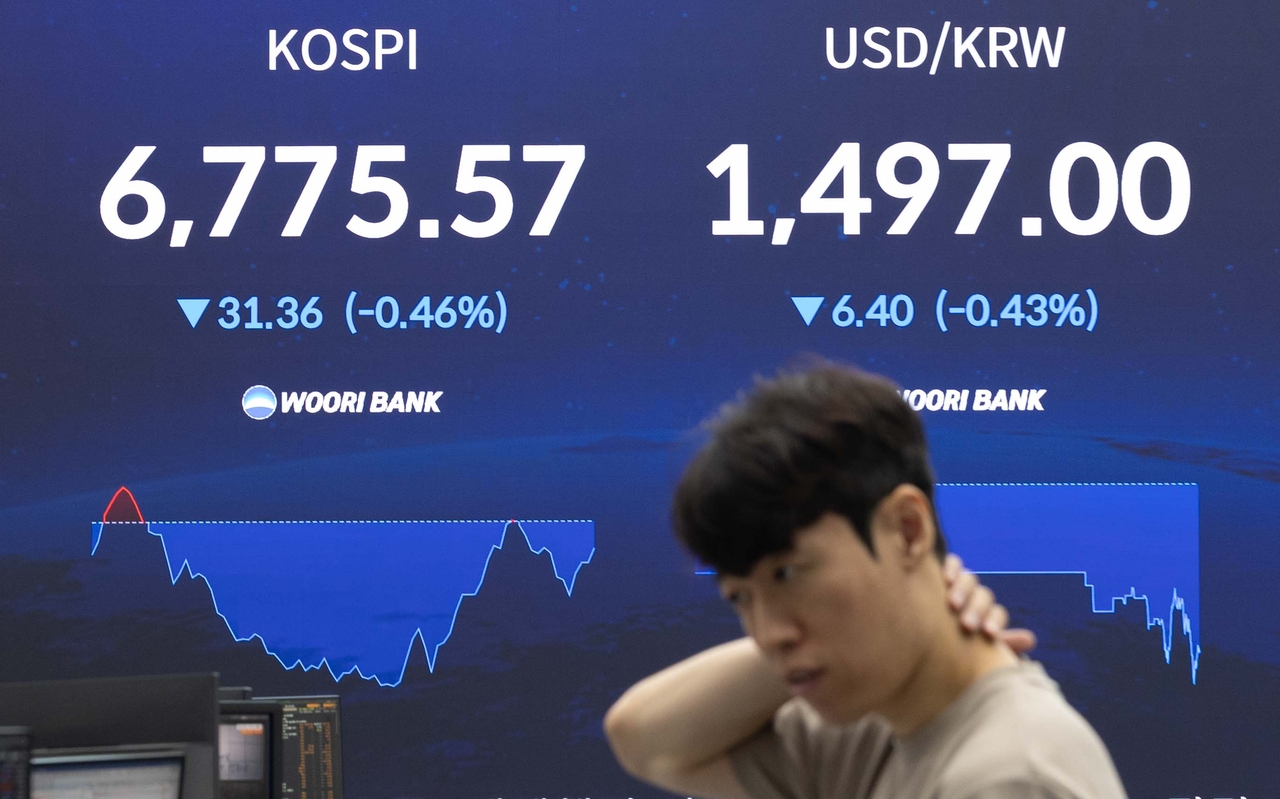
The supply-and-demand formula driving the Kospi this year has been straightforward: when foreigners sell, retail investors buy, and the index holds steady or climbs. From January through June, as the benchmark surged from the 4,000s to above 9,000 and set an all-time high, retail investors kept the market afloat — absorbing foreign selling through a sharp rally in January and February, a brief pullback in March, and a fresh record run from April through June.
But since the index hit an intraday all-time high of 9,385.59 on June 19, it has been in freefall. By Monday's closing price of 6,806.93, the Kospi had shed 27.47%. On the surface, the dynamic looks the same as in the first half of the year — foreigners are still selling and retail investors are still buying. The difference is that the index is now moving in the opposite direction.
Headwinds are not hard to find: fears of a semiconductor peak-out, a renewed flare-up in US-Iran tensions, and a persistently high exchange rate hovering around 1,500 won per dollar. Similar pressures appeared earlier this year, yet the market bounced back quickly each time. This time, recovery has proved elusive. The reasons lie in an intensified wave of foreign selling, institutions joining the sell-off, and a retail investor base that is running out of steam.
According to Korea Exchange data released Tuesday, foreigners were net buyers of just 314 billion won ($209 million) in the Kospi market — including ETFs, ETNs and ELWs — in January. Institutions net sold 18.31 trillion won that month, but retail investors absorbed 14.7 trillion won, propping up the index as it climbed from 4,212.17 at the end of last year to 5,224.36 by the end of January.
From February, foreign selling intensified. Foreigners net sold 20.41 trillion won, launching a sustained offensive. Retail investors and institutions countered with net purchases of 13.86 trillion won and 3.99 trillion won, respectively, pushing the index up to 6,244.13 by the end of February.
In March, the fallout from US-Iran clashes prompted heavy selling by both foreigners and institutions. Foreigners net sold 35.16 trillion won and institutions 10.47 trillion won, while retail investors net bought 41.87 trillion won to support the index — but it still slid to 5,052.46 by month-end.
April brought a reversal, with foreigners and institutions net buying 2.34 trillion won and 4.04 trillion won, respectively, lifting the index again while retail investors took profits. In May, foreigners unleashed another 44.05 trillion won in net selling, but retail investors fired back with a record 56.53 trillion won in net purchases, fueling another rally that pushed the index into the mid-8,000s. Retail buying overwhelmed foreign selling, and institutional selling remained modest.
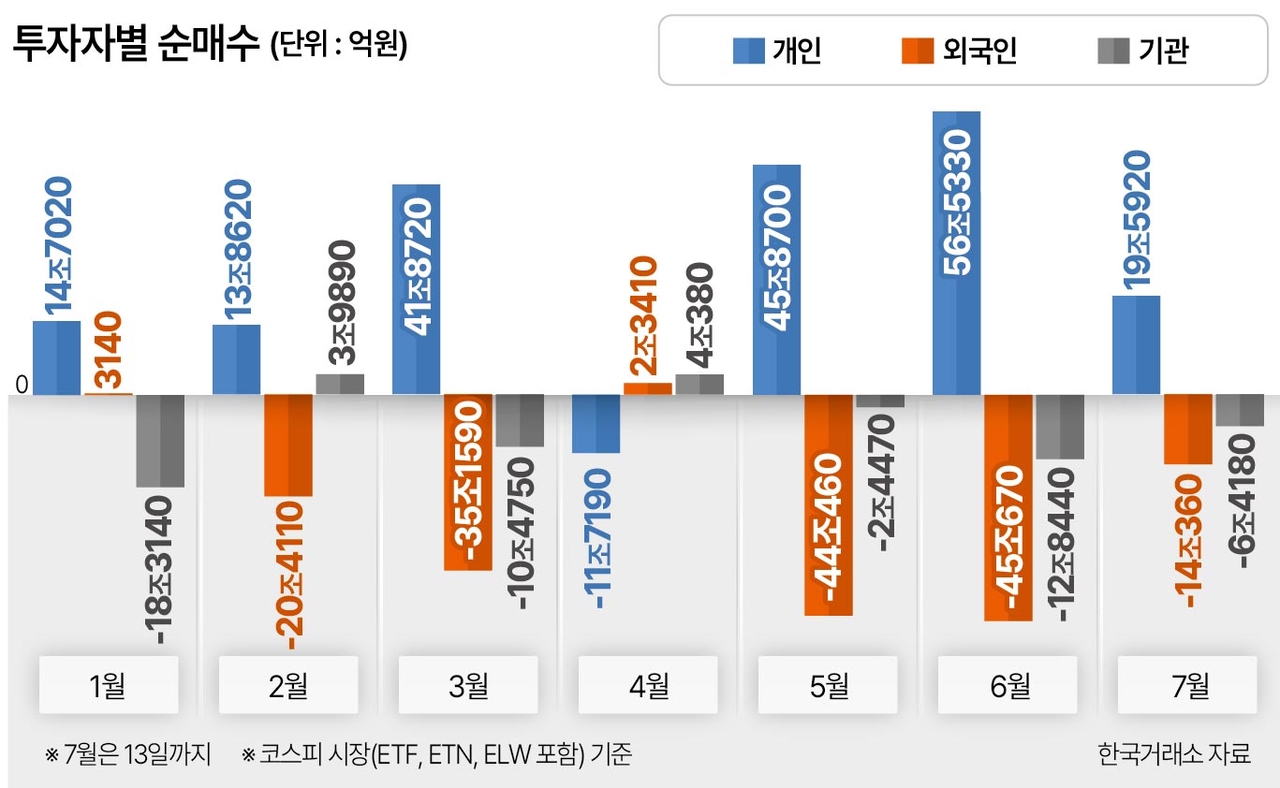
June marked a sharp turning point. The index briefly touched an all-time intraday high of 9,385.59 on June 19, but ended the month little changed amid a tug-of-war between buyers and sellers. Foreigners net sold 45.07 trillion won — the largest monthly total of the year so far.
Foreign rebalancing away from semiconductor holdings has been cited as one factor adding to the downward pressure on the market. Retail investors countered with 56.53 trillion won in net purchases, but institutions net sold 12.84 trillion won, opening a crack in the market's supply-and-demand structure.
The institutional selling is attributed to rebalancing by pension funds and mechanical selling triggered by the rebalancing of single-stock leveraged ETFs launched in late May. Within the institutional net selling in June, pension funds accounted for 269.4 billion won and financial investment firms for 1.11 trillion won.
The market, which had been locked in a near-standoff, turned into a rout in July. Over just nine trading days from July 1 through Monday, foreigners net sold 14.04 trillion won and institutions 6.42 trillion won. Retail investors net bought 19.59 trillion won, but could not offset the combined foreign and institutional selling of 20.45 trillion won.
Beyond the steeper selling by foreigners and institutions, the firepower of retail investors — who had underpinned the market throughout the first half — is visibly depleting, and that erosion has cracked the market's fragile equilibrium. According to the Korea Financial Investment Association, investor deposits stood at 105.58 trillion won as of Friday — the lowest since Feb. 20 (104.13 trillion won) — and 34 trillion won below the all-time high of 139.69 trillion won recorded on June 4.
Investor deposits represent cash sitting in brokerage accounts that has been earmarked for stock purchases but not yet deployed. A decline in this reserve signals that retail investors, who have been absorbing selling pressure from foreigners and others to prop up the domestic market, are running low on ammunition.
The balance of margin loans — a gauge of debt-fueled investing — fell to 35.57 trillion won as of Friday, its lowest level in more than two months.
Kim Byeong-yeon, a researcher at NH Investment Securities, said retail investors have been taking profits in July, but deposits remain above 100 trillion won. He added that foreign and pension fund rebalancing is likely to ease gradually as the index falls to lower levels, and that foreign ownership of semiconductor stocks has declined to near historic lows, suggesting further selling pressure should also subside.
The Kospi, which closed down 8.9% on Monday, reversed course early Tuesday, recovering the 6,900 level with gains of around 2%. Institutions and foreigners, which had been heavy sellers on Monday, both turned net buyers, recouping part of the previous session's steep losses. The index opened down 37.87 points, or 0.56%, at 6,769.06 before buying interest pushed it into positive territory and extended its gains.
Early Tuesday trading was the mirror image of Monday's session. On Monday, institutions and foreigners net sold 2.23 trillion won and 1.69 trillion won, respectively, leading the index lower, while retail investors net bought 3.89 trillion won to absorb the selling. Early Tuesday, institution-led bargain hunting drove the rebound and foreigners also tilted slightly toward buying, while retail investors turned net sellers.
Large-cap semiconductor stocks, which tumbled on Monday, also clawed back some of their losses. As of 10 a.m., Samsung Electronics was surging more than 5%, Samsung Electronics preferred shares were up more than 4%, and SK Hynix was rising more than 3%. SK Square and Samsung Electro-Mechanics were also up more than 2%.

jiyun@heraldcorp.com
kacew@heraldcorp.com