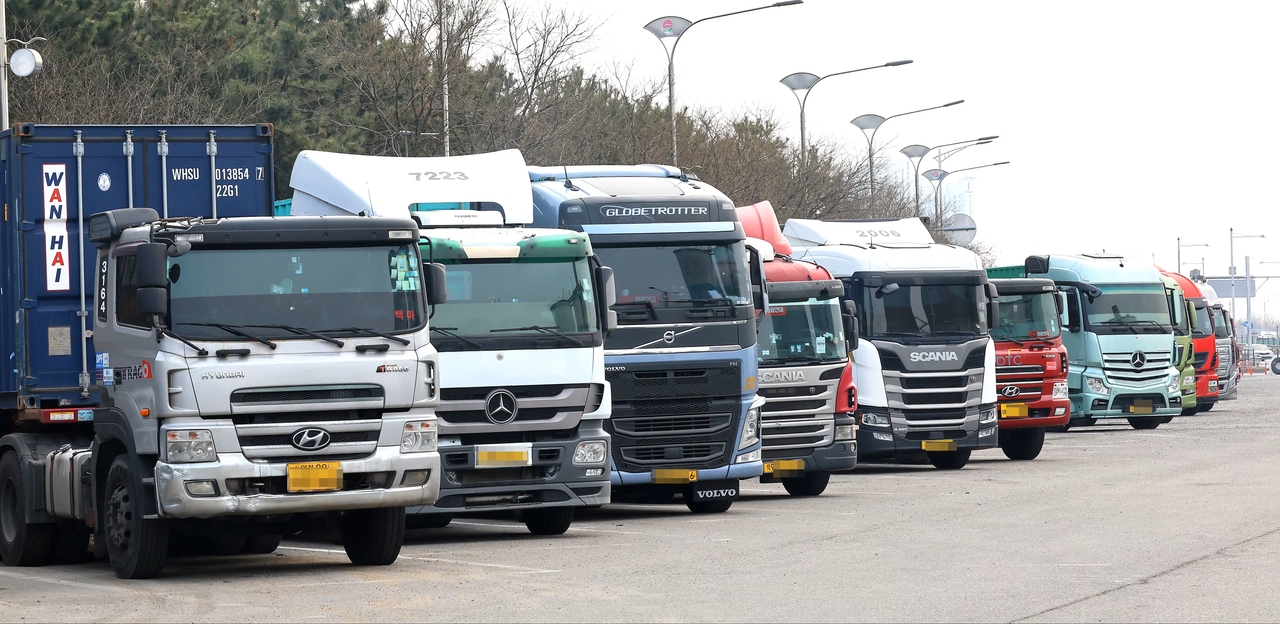
Starting next year, large freight trucks and tractors with a gross vehicle weight of 15 tons or more will face fines if they fail to meet greenhouse gas emission standards.
The Ministry of Climate, Environment and Energy said Tuesday it would begin a 60-day public notice period Wednesday for proposed amendments to guidelines and notices related to vehicle greenhouse gas and fuel-efficiency standards.
Under the current system, automakers and importers must keep the average greenhouse gas emissions of vehicles they sell each year below a set threshold.
However, medium- and large-sized commercial vehicles have so far been exempt from fines for missing the targets. Companies that meet the standards receive credits they can use when compliance becomes mandatory, but those that fall short face no financial penalty.
That will change gradually. Starting next year with heavy freight trucks and tractors weighing 15 tons or more, compliance will become mandatory for medium- and large-sized commercial vehicles — extending to medium- and large-sized vans in 2028, and to medium freight trucks and dump trucks under 15 tons in 2030.
Under the new standards, automakers and importers must reduce the average greenhouse gas emissions of medium- and large-sized commercial vehicles sold next year by 16.5 percent against the baseline — the average recorded in 2021 and 2022. The required reductions will increase to 21 percent by 2028, 25.5 percent by 2029 and 30 percent by 2030.
Fines for non-compliance will be capped at 1 percent of sales. For each gram of greenhouse gas emitted above the limit, the penalty will be 500,000 won ($332) from 2027 to 2030, rising to 1.4 million won from 2031 to 2032 and reaching 2.2 million won in 2033. The EU charges 4,250 euros per gram — far higher than the Korean rate, the ministry said.
To ease the burden on automakers and importers as mandatory compliance takes effect, and to encourage the development and sale of electric and hydrogen vehicles, the government will retain the "super-credit" system under which one electric or hydrogen vehicle sold counts as three. Hydrogen internal combustion engine vehicles will also be added to the list of models eligible for super credits.
Greenhouse gas standards for small vehicles will also be tightened under the amendments.
For passenger cars and vans with up to 10 seats, the emission limit will be lowered from 83g/km to 81g/km in 2027, from 80g/km to 74g/km in 2028, from 75g/km to 65g/km in 2029, and from 70g/km to 54g/km in 2030.
For vans seating 11 to 15 passengers and small freight trucks, the limit will fall from 155g/km to 128g/km in 2027, from 152g/km to 118g/km in 2028, from 149g/km to 108g/km in 2029, and from 146g/km to 98g/km in 2030.
Super credits for electric, hydrogen and hybrid small vehicles — which had been set to expire this year — will be retained but scaled back, counting as 1.4 vehicles in 2027 and 2028, and 1.2 vehicles in 2029.
Manufacturers selling 50,000 or fewer vehicles annually will have their standards relaxed by 7 to 9.8 percent, while those selling 10,000 or fewer will receive a 10 to 14 percent relaxation. Manufacturers that directly use or generate renewable energy at domestic facilities will also be allowed to count that as an "indirect reduction," up to a 5 percent credit.
thlee@heraldcorp.com