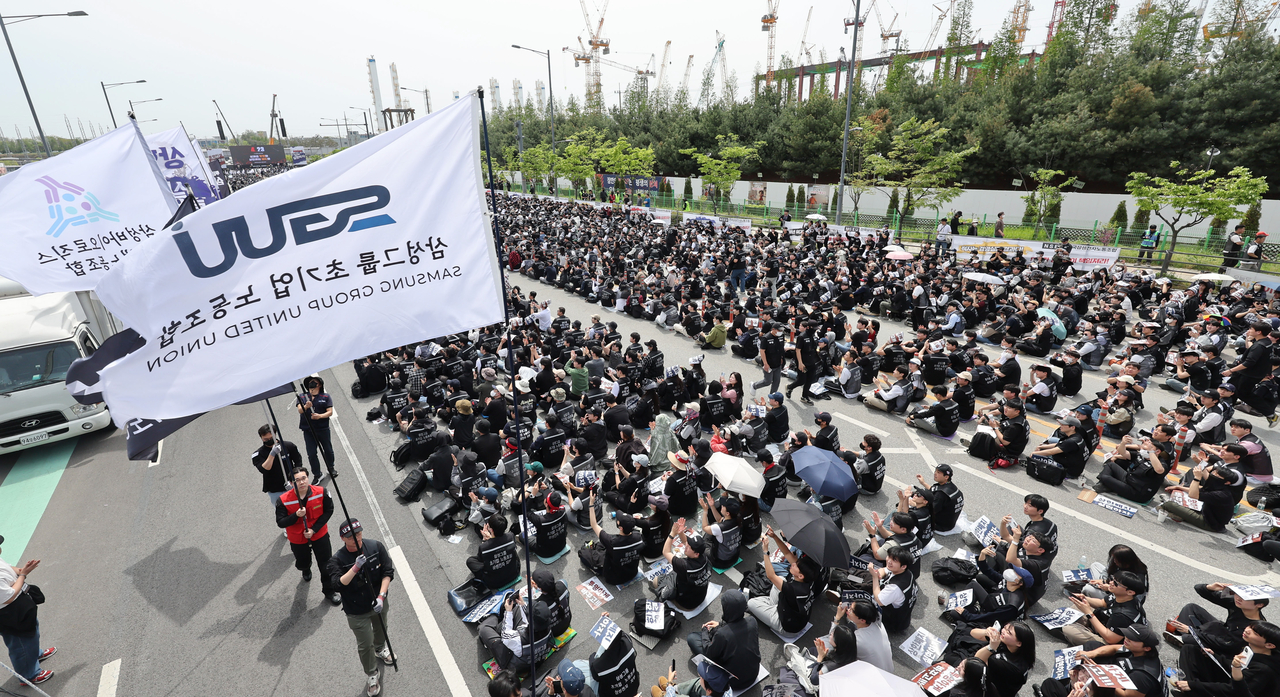
The Ministry of Employment and Labor has officially stated that corporate investment and factory construction, as business management decisions, are not subject to collective bargaining — pushing back against the Samsung Electronics branch of the inter-enterprise union, the company's largest, after it announced plans to put the government's Honam semiconductor mega-project on the agenda for 2027 wage and collective agreement negotiations.
The ministry issued the clarification as debate spread over whether corporate investment decisions could become subject to union bargaining ahead of enforcement of the revised Trade Union Act, commonly known as the "yellow envelope law."
The ministry said Tuesday in an explanatory release that corporate investment, factory scale-ups and similar business management decisions are difficult to regard as having a substantial and concrete impact on working conditions, and are therefore not included among the subjects of collective bargaining or labor disputes under the revised Trade Union Act.
The ministry added that its interpretive guidelines on the revised act also make clear that business management decisions — including corporate investment, mergers, splits and transfers — are not subject to bargaining in their own right. Investment decisions fall within the scope of management prerogative and cannot themselves be treated as a matter for labor-management negotiations, the ministry said.
However, the ministry drew a line: if working conditions actually change in the course of implementing a business management decision, those specific changes could become subject to bargaining.
"If the implementation or realization of a business management decision results in a substantial and concrete change in working conditions, the matters relating to those working conditions may become subject to collective bargaining," the ministry said.
The statement was a direct rebuttal to the Samsung Electronics inter-enterprise union, which said Monday that "under the revised Trade Union Act, business decisions that affect the working conditions of union members are also included among the subjects of bargaining," and announced it would place the Honam semiconductor mega-project on the agenda for 2027 collective bargaining.
The union argued that the government's Honam semiconductor investment project could affect the workplaces and treatment of tens of thousands of employees, and that union input should be reflected in how the project is pursued. It also said that in an internal member survey, 84 percent of respondents opposed the project.
fact0514@heraldcorp.com