
The government is undertaking a sweeping overhaul of its macroeconomic management framework and supply chain policy in response to the Middle East war. The plan aims to make economic security a central pillar of the national growth strategy as geopolitical risks originating in the Middle East spread across raw materials, supply chains and financial markets. A new minister-level macroprudential council will be established to manage the so-called "triple high" risks — inflation, exchange rates and interest rates — on a pan-government basis, and a domestic production tax credit will be introduced to expand the domestic production base for key economic security items.
Deputy Prime Minister and Minister of Economy and Finance Koo Yun-cheol announced the "2026 Second-Half Economic Growth Strategy" at a Cabinet meeting Tuesday. The government said it will build a standing system to manage the "triple high" risks permanently and restructure supply chain and energy policy around economic security to create an economy more resilient to external shocks.
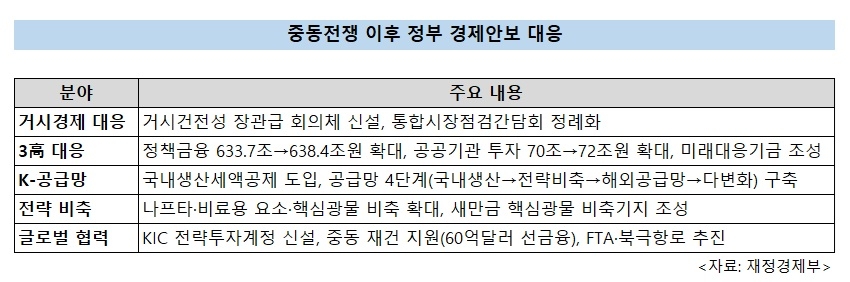
The macroeconomic response framework will be converted into a permanent standing operation. The government will regularize an integrated market monitoring body covering international oil prices, exchange rates, financial markets and the real estate market, and establish a new minister-level macroprudential council with participation from the Ministry of Economy and Finance, the Bank of Korea, the Financial Services Commission and the Financial Supervisory Service.
Fiscal policy will also be deployed more actively. The government will raise public institution investment from the originally planned 70 trillion won ($46.5 billion) to 72 trillion won, and expand policy finance supply from 633.7 trillion won to 638.4 trillion won. Additional tax revenue generated by the semiconductor boom and other factors will be channeled into a newly created "Future Response Fund" and reinvested in future industries, youth and regional development. The government plans to officially designate such revenue as "additional tax revenue" rather than "surplus tax revenue."
To stabilize prices, the government will inject an additional 350 billion won to extend discount support for agricultural, livestock and fishery products across all categories, and will apply tariff-rate quotas to 49 food items in the second half of the year. Central government public utility fees will remain frozen through the second half.
To counter the high exchange rate, the government will extend the reduction of the macroprudential stability levy and issue additional foreign exchange stabilization bonds. Small and medium-sized enterprises struggling with the weak won will receive 14.9 trillion won in emergency business stabilization funds. To ease the burden of high interest rates, the government will expand Industrial Bank of Korea's Hope Dream loans and Korea Development Bank's on-lending funds, and broaden eligibility for small business debt refinancing support.
The government will comprehensively restructure supply chain policy into a four-stage framework: expanding domestic production, strengthening strategic stockpiles, building overseas supply chains and diversifying import sources. For key items with high overseas dependency, domestic production will be increased; for items difficult to produce domestically, strategic stockpiles will be expanded while overseas production bases are secured and import sources diversified in parallel.
A new domestic production tax credit will be introduced targeting items of high strategic value from an economic security and green transition perspective. Unlike conventional investment tax incentives, the credit will be tied to actual domestic production and sales performance, with the aim of preventing offshoring and maintaining and expanding the domestic production base. Separate support measures will be prepared for companies that record losses in the early investment phase and cannot fully utilize the tax credit, and production subsidies will continue for items that must be produced domestically for economic security reasons.
The strategic stockpiling system will also be significantly revamped. The government will move beyond its traditional focus on crude oil to expand stockpiling to items essential for industry and daily life, including naphtha — a key petrochemical feedstock — and urea for fertilizers. A new stockpiling model in which government-held reserves are supplied directly to partner companies will be piloted, and a dedicated storage facility for advanced and critical minerals will be built at the Saemangeum National Industrial Complex.
The government will also work to raise self-sufficiency in critical minerals. Waste permanent magnets containing rare earth elements will be designated as recyclable resources, and the urban mining industry will be fostered to expand critical mineral recycling. The target is to raise the critical mineral recycling rate to around 20 percent by 2030, reducing dependence on overseas raw materials.
The government will also move aggressively to secure overseas supply chains. It plans to establish a strategic investment account within the Korea Investment Corporation to make long-term investments in overseas resources, strategic industries and supply chain hubs. Rather than creating a separate sovereign wealth fund, the government intends to leverage KIC's overseas investment experience and networks to improve the efficiency of strategic industry investment. Companies that substitute imports from countries with high dependency concentration will receive low-interest loans through the Supply Chain Stabilization Fund, and public-private joint overseas investment will also be expanded.
Energy security measures will proceed in parallel. The government will develop a Korean Green Transformation (K-GX) strategy, add future-oriented energy to the list of national strategic technologies, and expand solar and wind-centered renewable energy capacity to 100 gigawatts by 2030. Legislation for small modular reactors will be enacted to accelerate the development of the next-generation nuclear power industry.
External economic cooperation will also be restructured. A $6 billion pre-financing program will be operated to support entry into the Middle East reconstruction market, and a "Middle East Infrastructure Strategy Fund" will be established centered on the Korea Overseas Infrastructure and Urban Development Support Corporation. Cooperation with the United States in shipbuilding and advanced industries will be expanded, and negotiations will proceed on follow-up talks under the Korea-China FTA covering services and investment, as well as improvements to the Korea-India Comprehensive Economic Partnership Agreement.
fact0514@heraldcorp.com




