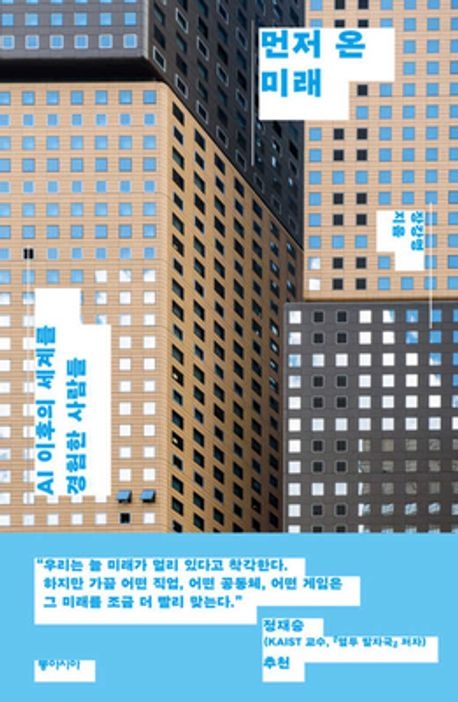
Kyobo Book Centre announced Monday that it has selected "Meonjeo On Mirae (The Future That Came First)" by Jang Kang-myoung as its humanities book of the year.
The award was established to take stock of intellectual currents in the humanities at the midpoint of 2026 and to suggest a direction for reading in the second half of the year.
A panel of 62 judges — including authors, critics, translators, publishers and booksellers — recommended standout humanities titles published over the past year, from June 1, 2025, to May 31, 2026, with the book receiving the most nominations named the winner. Panelists included Kim Sang-uk, a physics professor at Kyung Hee University; science communicator Gwedo; author Geum Jeong-yeon; Lee Eun-hye, editor-in-chief of Geulhangari; and Jeong Ji-hye, a book consultant at Sajeokin Seojeon.
"Meonjeo On Mirae" is a work of reportage in which Jang met 30 current and former professional Go players and six Go experts to reflect on the "future that arrived early" in the Go world following the 2016 match between Lee Se-dol and AlphaGo, and to consider the changes AI may bring to the literary world and other industries. Drawing on firsthand voices, the book warns that AI could erode the authority and pride of experts, distort the nature of work and experience, and threaten values we have long pursued. It received 11 votes from the panel to claim the top prize.
Judges noted that the book captures not so much the pace of technological change as the specific ways human lives and sensibilities are unsettled within it. Gwedo described it as "a book that asks what we fear and what we must choose in an era overwhelmed by the speed of technology," while Lee said it "conveys the degradation of the human spirit and the foretelling of an existential shift in the most vivid, firsthand language and feeling."
Second place went to Ogiwara Sayaka's "Chungking Mansions ui Boseu neun Algo Itda (The Boss of Chungking Mansions Knows)," praised for its anthropological imagination toward a society connected without trust. Third place went to Lee Ra-yeong's "Ssoetdol (Iron Ore)," which drew attention for illuminating the history of mines, abandoned pits and labor through one family's migration and work set against the backdrop of modern Korean history.
A range of other titles across the humanities, social sciences and natural sciences also received panel nominations, including "Iyagikkun Esei (Storyteller Essays)," "Bicheul Meongneun Jonjaedeul (Beings That Eat Light)," "Nappeun Yujeonga (Bad Genes)," "Itgi Himdeun Saramdeul (People Who Are Hard to Be)," "Sine Gwanhayeo (On God)," "Nareul Galla Nareul Kkeonaegi (Splitting Myself to Find Myself)" and "Natseun Saramgwa Bugeun-eul Mandeulgi (Making Proximity with Strangers)."
Kyobo Book Centre will present the winning and top-ranked titles alongside recommended books, endorsements and panelist profiles in an online feature.
"Humanities titles are a field that captures the questions and intellectual achievements of an era in depth," a Kyobo Book Centre official said. "We will continue to gather diverse voices from the book world and develop this into an annual project that represents the best of humanities publishing."
pink@heraldcorp.com