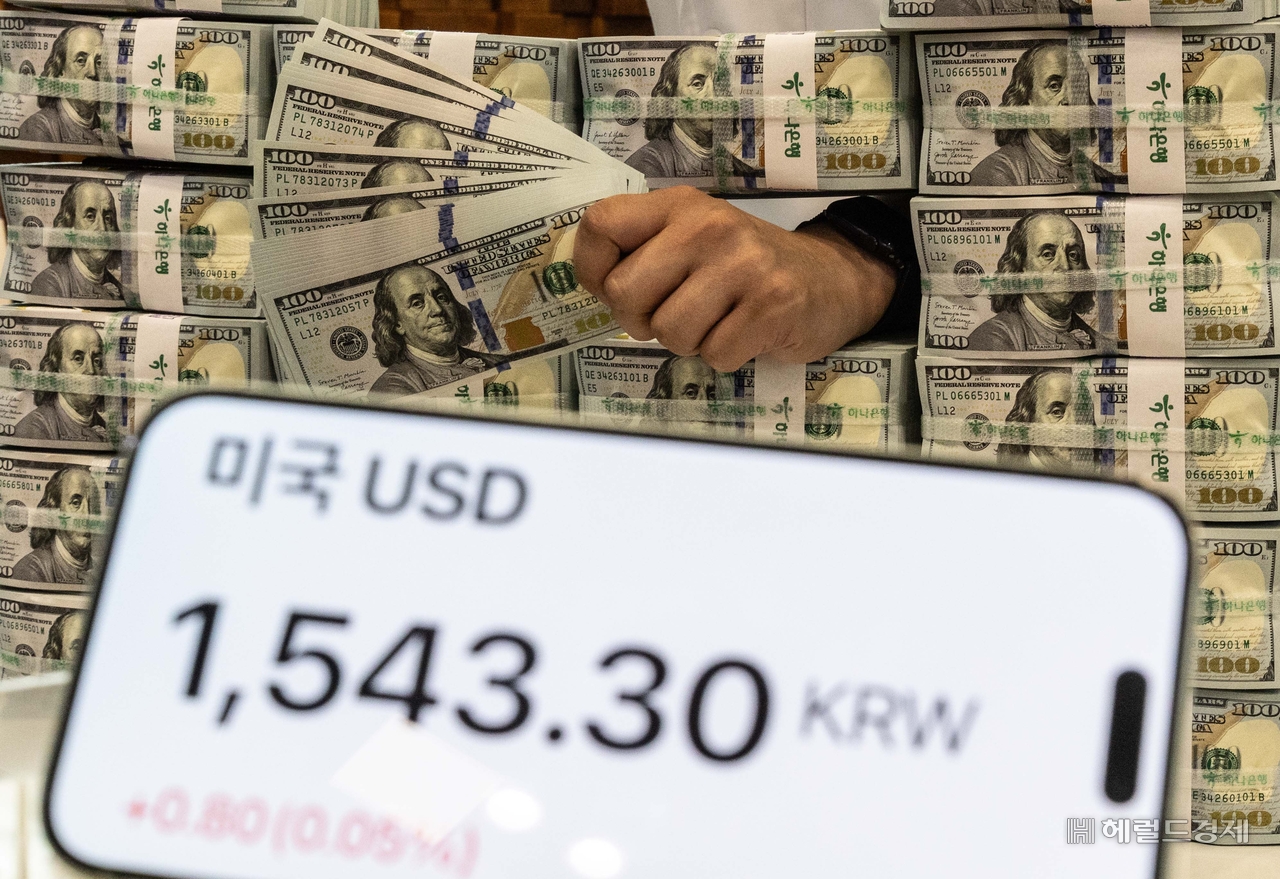
Moon Ji-seong, the Ministry of Economy and Finance's international economic affairs coordinator, said Sunday that forward foreign exchange sales by exporters are expected to increase further.
Moon made the remarks in a phone interview with Yonhap News Agency that afternoon, adding that "the listing of SK hynix's ADR (American depositary receipts) will also serve as a major factor."
SK hynix raised about $26.5 billion through an ADR issuance on Friday. If the company converts a significant portion of those proceeds into won for domestic investment and other uses, it would act as a dollar supply factor in South Korea's foreign exchange market. Market watchers expect the large-scale dollar inflow to help ease the won's weakness.
Moon said the supply-demand dynamics of the won-dollar exchange rate in the second half of this year are expected to gradually shift, reflecting South Korea's economic fundamentals, including a growing current account surplus. He added that "the current exchange rate still remains out of line with fundamentals."
The won-dollar rate has edged lower of late, dipping below 1,500 won during trading, but it remains elevated compared with South Korea's underlying economic conditions — suggesting there is room for further decline.
Moon also said the around-the-clock operation of the foreign exchange market has strengthened market transparency, and that "the playing field for foreign exchange authorities has expanded."
He added that "the authorities' capacity to respond has actually grown."
The remarks appear intended to counter concerns from some quarters that 24-hour foreign exchange market operations could amplify overnight volatility. Moon suggested that authorities now have more time and tools to monitor and respond to market conditions.
The possibility of a renewed Middle East war remains a factor adding some uncertainty.
Many analysts say the impact of the Middle East conflict on the won-dollar rate has already been largely priced in, and that market sensitivity to it is declining. Even as major currencies remain under pressure from Middle East uncertainty and broad dollar strength, the won could for now move in a pattern differentiated from other currencies.
mp1256@heraldcorp.com