
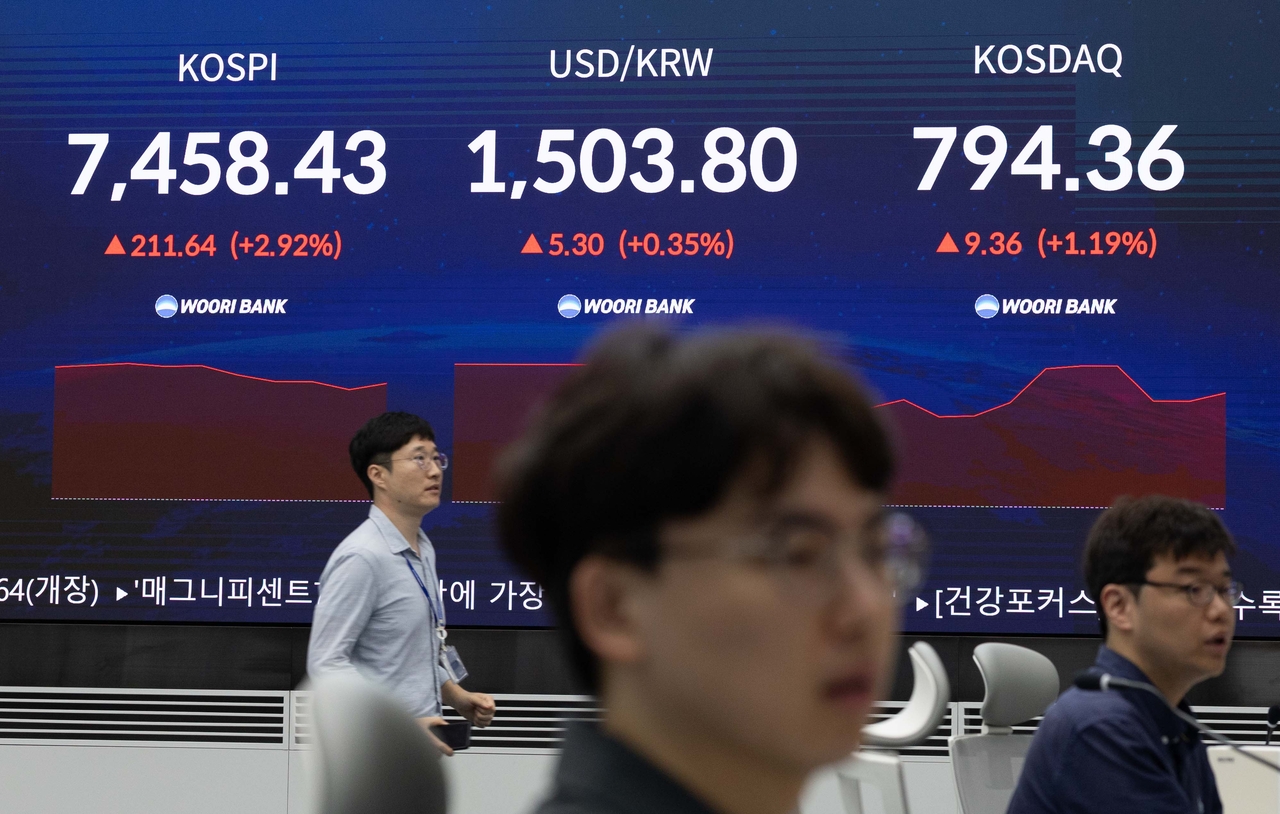
Money is draining out of the Korean stock market fast. Retail investor sentiment — which had been a key driver of the domestic rally — is cooling quickly. Investor deposit balances have fallen consistently this month, dropping to the 107 trillion won ($71.1 billion) range, down roughly 30 trillion won in just one month. On one day alone, the figure shrank by 6 trillion won, underscoring how quickly the pool of investment capital is shrinking.
Meanwhile, investment in US stocks has surged. Korean investors net purchased 1 trillion won worth of American equities in just seven trading days since the start of July, signaling that sentiment cooling toward domestic shares is shifting into the US market.
Market analysts say retail investors, who had been absorbing heavy foreign selling, are no longer buying at the same pace. According to the Korea Financial Investment Association, investor deposit balances fell from around 136 trillion won at the end of last month to around 112 trillion won recently. As of Thursday, the figure stood in the 107 trillion won range, slipping below 110 trillion won. The daily decline has also been widening of late, with the balance falling 6 trillion won in a single day.
The last time investor deposits fell below 110 trillion won was April 8. Compared with the 136 trillion won level about a month ago, the balance has shrunk by nearly 30 trillion won.
The domestic market had been holding up largely because retail investors were absorbing heavy net selling by foreign investors, helping prop up the index. If retail buying power continues to shrink while foreign net selling remains strong, the supply-demand balance could become unstable. The situation is especially precarious given that both foreign selling and retail buying have been concentrated in Samsung Electronics and SK hynix — meaning any weakness in those stocks threatens to drag the entire Kospi lower.
Investment in US stocks, meanwhile, is surging again. According to the Korea Securities Depository's securities information portal SEIBro, Korean investors net purchased $897.79 million worth of US stocks over seven trading days from July 1 through Thursday.
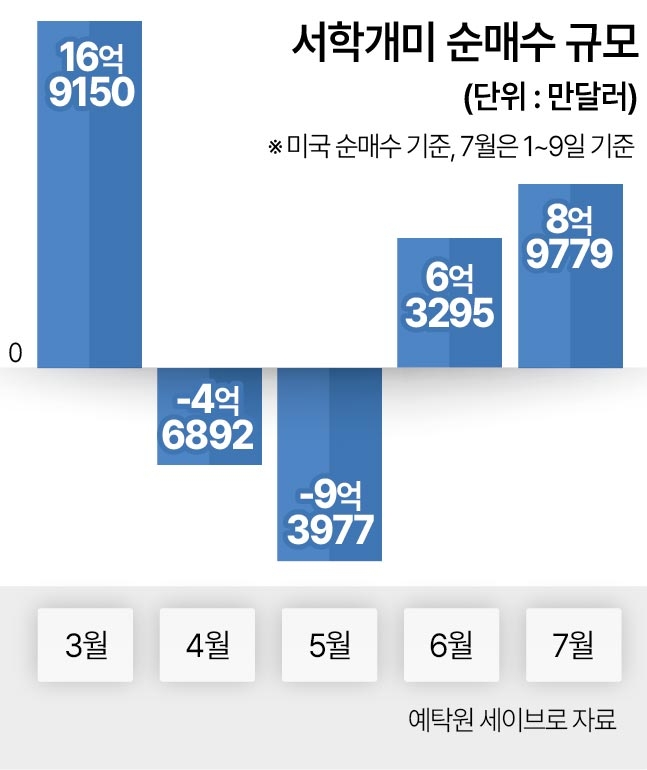
That figure has already far surpassed the total net purchase volume for all of June ($632.95 million). At this pace, July could set a record for Korean investors' net purchases of US equities.
Earlier this year, the government announced a plan to introduce a tax-exempt return incentive account — known as an RIA — that would allow investors to sell overseas stocks and reinvest in the domestic market tax-free, and buying activity had slowed as a result. Net purchases fell from $3.95 billion in February to $1.69 billion in March, when the accounts formally launched, then swung to net selling of $468.92 million in April. In May, the final month in which investors could receive a 100 percent deduction, net selling expanded further to $939.77 million.
But buying resumed in June and has accelerated further in July.
The return of so-called "overseas retail investors" coincides with growing instability in the domestic market. As Kospi volatility spiked and the index fell sharply, the relative appeal of US equities rose again.
The Kospi is currently down more than 20 percent from its recent peak in the 9,300 range.
The key question going forward is whether share prices and investor sentiment around Samsung Electronics and SK hynix can recover. Samsung Securities, in a recent emergency market report, said it was natural for concerns about overheating in AI investment to emerge given how far prices had risen, but added that it did not believe the current AI investment cycle had passed its peak. The brokerage said late-July earnings releases from major US technology companies would mark a critical inflection point for memory chip stocks, and that if hyperscalers' commitment to AI investment is reaffirmed, the domestic market will show resilience again.
Also in focus are the earnings results and AI capital expenditure plans of hyperscalers — Microsoft, Meta, Alphabet and Amazon — scheduled for later this month. Their investment stance will determine whether the memory chip supercycle continues and which direction the broader semiconductor sector heads.

dlcw@heraldcorp.com




