
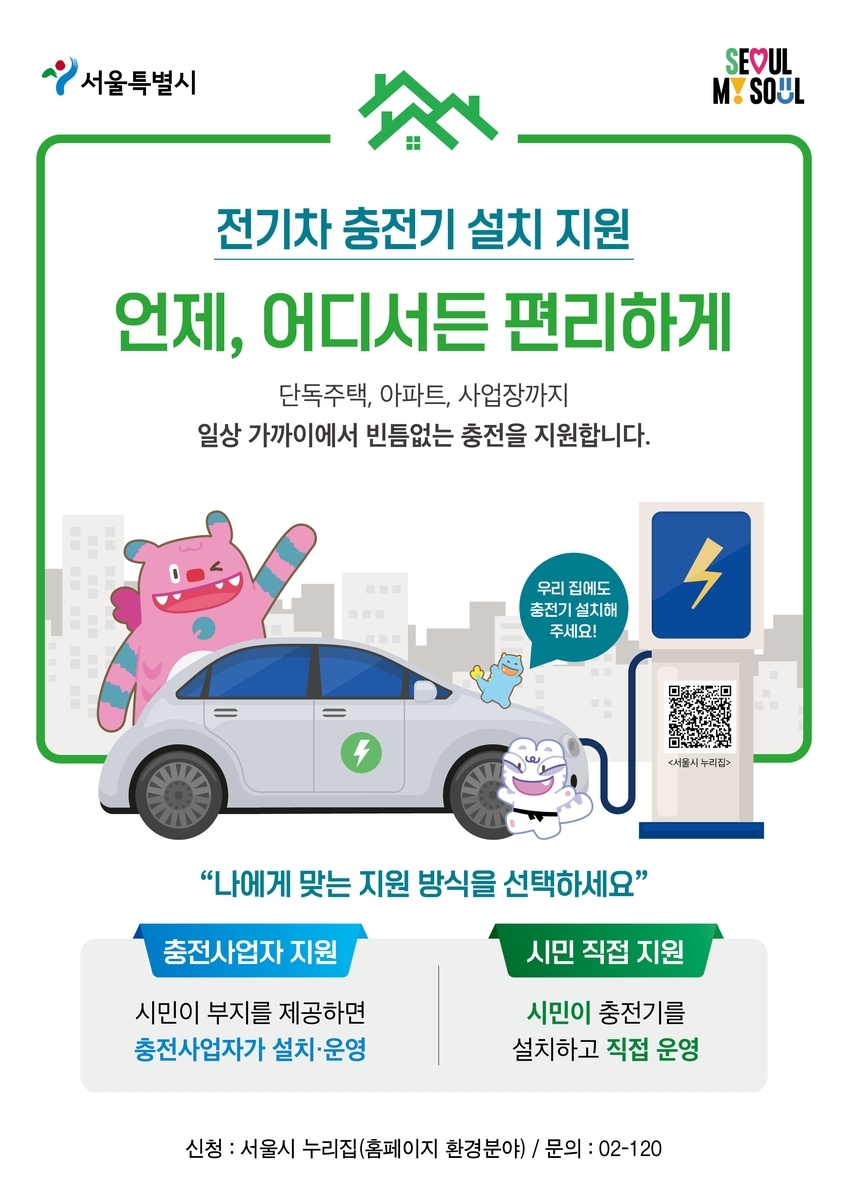
The Seoul Metropolitan Government announced Sunday it is accepting a second round of applications for its 2026 pilot program offering direct subsidies to residents who install electric vehicle chargers on their properties.
The program covers buildings that do not yet have EV chargers, including single-family homes, multi-unit and row houses, small apartment complexes with fewer than 100 units, and commercial buildings. Building managers or site owners of private facilities are eligible to apply after installing a charger.
Subsidies cover 50 to 70 percent of installation costs, depending on the type of charger and power supply capacity. Each eligible site may receive support for one fast charger and up to three slow chargers.
In this round, the city raised the maximum subsidy rate for shared fast chargers — which carry higher upfront installation costs — from 50 percent to 70 percent. Slow chargers installed at single-family homes, multi-unit housing, small apartment complexes and commercial buildings remain eligible for up to 50 percent of installation costs.
For slow chargers, the maximum subsidy per unit is 2.2 million won ($1,460) for a 7-kilowatt model and 2.4 million won for an 11-kilowatt model. When two or three units are installed, the per-unit cap drops to 2 million won and 2.2 million won, respectively. For fast chargers, the maximum support is 14 million won for a 50-kilowatt unit and 26 million won for a 100-kilowatt unit.
When the building manager and the site owner are different parties, a written consent for site use must be submitted. For apartment complexes and multi-unit or row houses, the consent of at least 80 percent of owners is required.
Applications are open through Aug. 7 and can be submitted by registered mail or email to the relevant city official. The city plans to select final recipients next month after a review by the local subsidy management committee and will notify applicants individually.
Kwon Min, head of the Seoul Metropolitan Government's Climate and Environment Bureau, said the city aims to "build a dense charging environment where all residents can conveniently charge their vehicles in their own neighborhoods" by extending direct support to areas with relatively limited charging infrastructure, including single-family homes, row houses, small apartment complexes and commercial districts.
ken@heraldcorp.com




