![President Lee Jae Myung, EU Council President Antonio Costa (center) and European Commission President Ursula von der Leyen pose for a photo after signing a Digital Trade Agreement at the EU Council headquarters in Brussels, Belgium, on Friday (local time). From left: Trade Minister Yeo Han-koo, President Lee Jae Myung, EU Council President Antonio Costa, European Commission President Ursula von der Leyen, and EU Commissioner for Trade and Economic Security Maros Sefcovic. [Yonhap]](https://wimg.heraldcorp.com/news/cms/2026/07/11/rcv.YNA.20260610.PYH2026061022900001300_P1.jpg)
South Korea's steel industry secured a duty-free import quota of 2.073 million tons under the EU's new steel import restrictions, after the government and industry pushed back against an initial offer of just 1.3 million tons — roughly half the previous level — and managed to limit the overall reduction to around 20 percent.
Trade authorities and the steel industry said Saturday that the EU began enforcing new import restrictions this month to protect its domestic steel sector. The bloc sharply reduced its total duty-free steel quota and imposed a 50 percent tariff on volumes exceeding the cap, raising the bar for foreign exporters. The tighter European safeguards are intensifying competition among global steel-exporting nations.
South Korea was initially notified of a duty-free quota of around 1.3 million tons — a 49.6 percent reduction from the previous quota of 2.581 million tons. Had that figure been finalized, the foundation for Korean steel exports to Europe would have been severely undermined.
The government began negotiations with the EU in April, shuttling between Geneva and Brussels. Yeo Han-koo, the Ministry of Trade, Industry and Energy's chief trade negotiator, met four times with EU Commissioner for Trade and Economic Security Maros Sefcovic to make the case for preferential treatment of Korean steel.
Summit diplomacy was also brought to bear during the talks. Yeo said he conveyed a message to the European Commission that President Lee Jae Myung's planned visit to the EU could be canceled if a favorable duty-free quota for South Korea was not guaranteed.
In the final stretch, European Commission President Ursula von der Leyen reportedly took personal charge of managing the negotiations. She is said to have instructed Sefcovic, who had been scheduled to travel to Africa, to remain in Brussels and conclude the talks with South Korea.
![Trade Minister Yeo Han-koo poses for a photo with EU Commissioner for Trade and Economic Security Maros Sefcovic after their meeting at the European Commission in Brussels, Belgium, on Tuesday (local time). [Ministry of Trade, Industry and Energy]](https://wimg.heraldcorp.com/news/cms/2026/07/11/news-p.v1.20260604.cd3830bb1514444ab75ec251eaaa866d_P1.jpg)
South Korea pressed its case by highlighting that it was the first Asian country to sign a free trade agreement with the EU. Seoul also emphasized that Korean steel has never been subject to anti-dumping duties in the EU — unlike steel from China or Japan — arguing that Korean products support European manufacturing supply chains rather than distorting the market.
Korean companies including Hyundai Motor Group's vehicle and parts plants and SK On's battery factories operate production bases across Europe. The government argued to the EU that Korean steel underpins those facilities and the local jobs they support.
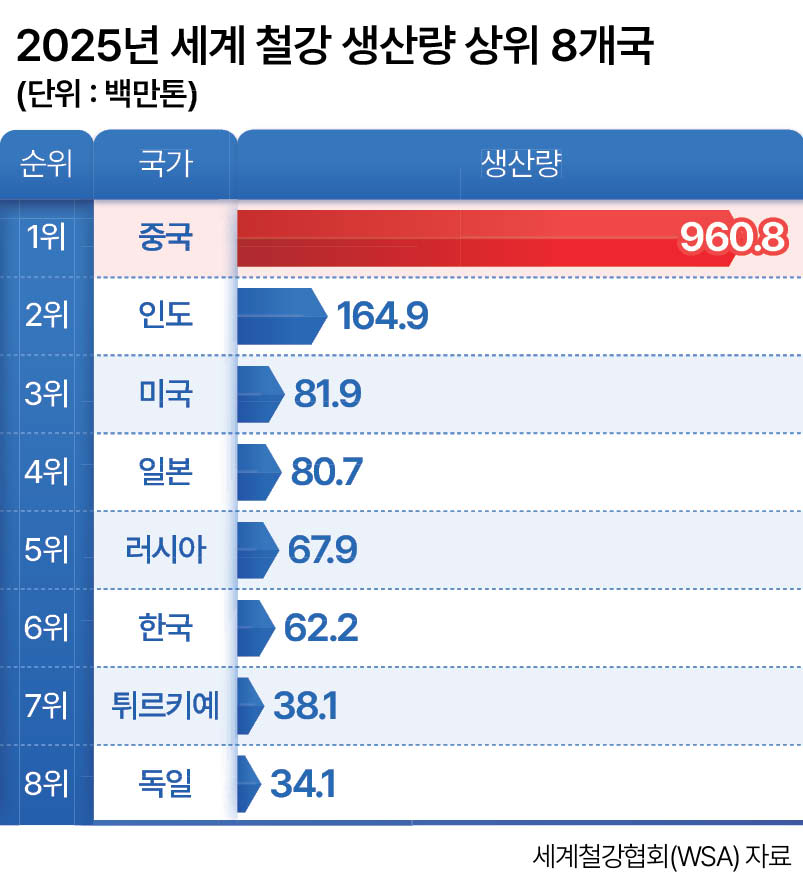
The final outcome secured South Korea a country-specific quota of 2.073 million tons — down 19.7 percent from the previous level. That compares favorably with the EU's overall duty-free quota reduction of roughly 40 to 50 percent, and industry observers say South Korea held its ground relatively well.
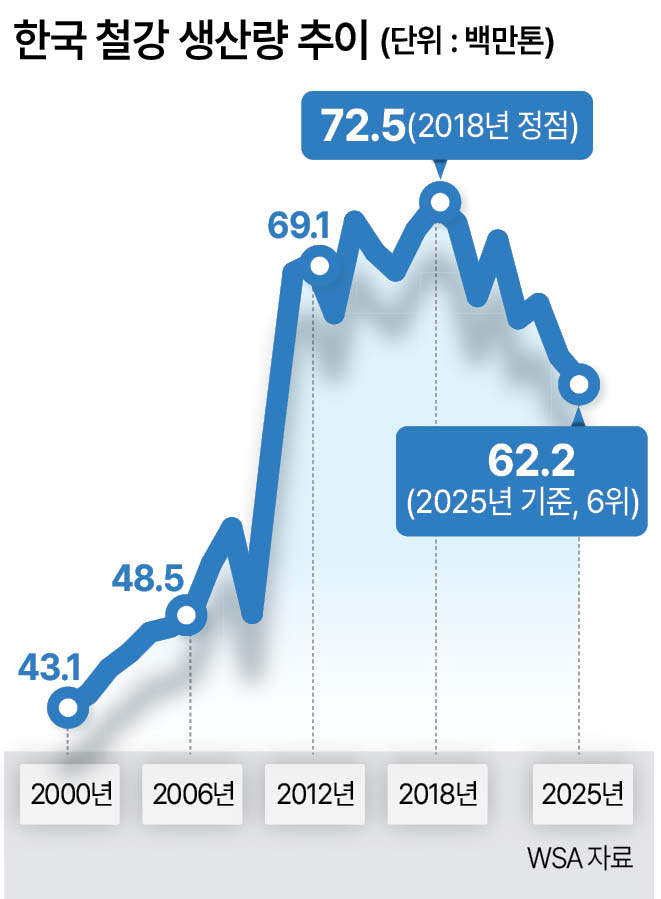
South Korea's reduction was also smaller than those applied to other major steel exporters. Turkey's quota fell 28.4 percent, from 3.994 million tons to 2.861 million tons, while India's dropped 30.2 percent, from 2.785 million tons to 1.944 million tons. The United Kingdom, Ukraine and Switzerland each saw cuts exceeding 50 percent. China, which failed to reach an agreement with the EU, reportedly had its duty-free quota cut by nearly two-thirds.
There is also room for further upside. Beyond its country-specific quota, South Korea secured access to a shared quota that multiple countries can compete to use. Industry analysts say that if Korean steelmakers actively tap the shared quota, total duty-free export volumes could reach as much as 3.548 million tons.
The product mix also matters. Several of South Korea's core steel products — including heavy plates, wire rods and stainless hot-rolled coils — were newly included in the country-specific quota. Industry observers say the result goes beyond simply defending total volume, as it protects the export base for the product categories that account for the largest share of actual shipments.
![South Korea secured a duty-free steel import quota of 2.073 million tons under the EU's new regime, which took effect this month — a reduction of about 19.7 percent from its previous quota of 2.581 million tons. The cut is seen as a relatively strong outcome compared with the EU's overall quota reduction of around 47 percent. [Yonhap]](https://wimg.heraldcorp.com/news/cms/2026/07/11/rcv.YNA.20260630.GYH2026063000100004400_P1.jpg)
The domestic steel industry breathed a sigh of relief. The EU is South Korea's second-largest steel export market after ASEAN. A near-halving of the duty-free quota would have inevitably eroded price competitiveness and driven away customers, but the negotiations averted a sharp shock.
The quota, however, is not the only barrier in the EU market. The EU's Carbon Border Adjustment Mechanism entered full implementation this year. As the cost burden tied to carbon emissions grows for high-carbon products such as steel, aluminum and cement exported to the EU, European buyers are now demanding not just competitive prices and supply stability but also demonstrated carbon-reduction capabilities.
South Korean steelmakers are stepping up their engagement with European customers in response. Posco has been sharing medium- and long-term production plans for low-carbon steel sheet with French automaker Renault. Last month, it held the "Posco-Renault Korea Tech Day 2026" at Renault Korea's central research center to discuss technology cooperation aligned with electrification and decarbonization trends.
Hyundai Steel recently invited major European customers to the World Rally Championship round in Greece, where it showcased its carbon-reduced steel sheet production system based on a combined electric arc furnace and blast furnace process — the first of its kind to be commercialized anywhere in the world. With European automakers increasingly demanding low-carbon materials, the company aims to expand its customer base by leading with its carbon-reduced steel sheet.
Seah Group is also in ongoing volume discussions with customers in Spain, Germany and other major European markets. The aim is to maintain existing trade relationships amid simultaneous tightening of protectionist measures and carbon regulations, while carefully coordinating how to make best use of product-specific quotas. The group also plans to expand contact with European customers at international events, including the Farnborough International Airshow in the United Kingdom later this month.
"The outcome of these negotiations allows us to stably maintain existing trade relationships in the EU market and secure a predictable export base amid a rapidly shifting trade environment," a steel industry official said. "Going forward, securing stable customers within the quota and strengthening tailored responses for each client will become even more important."
kwater@heraldcorp.com